


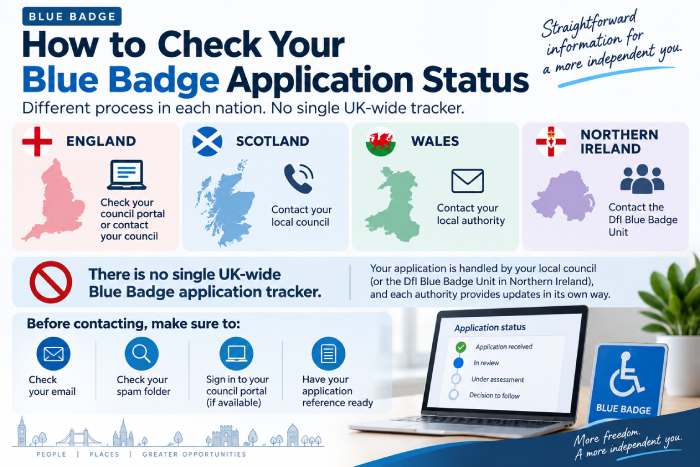
There is no single UK-wide Blue Badge application tracker.
If you live in England, Scotland or Wales, your application is ultimately handled by your local council or local authority, and the way you check progress depends on that authority. Some councils provide an online portal, while others provide updates by email, letter or direct contact.
Northern Ireland is different: applications are handled centrally by the Department for Infrastructure Blue Badge Unit through nidirect rather than by a local council.
If you are waiting for an update, start by checking your application confirmation and the website of the authority handling your application. Keep any application reference number or confirmation details you received.
Can I track my Blue Badge application online?
Sometimes, but there is no national tracker that works for every Blue Badge applicant.
In England, Scotland and Wales, most people start their application through the GOV.UK Blue Badge service, but the application is then handled by the relevant local authority.
GOV.UK does not provide one universal page where every applicant can enter a reference number and see live progress.
Instead, your options depend on your local authority.
A council may:
- provide an online Blue Badge account or portal;
- allow you to sign in and check application progress;
- send email updates;
- contact you if additional evidence is required;
- provide a telephone or email contact for the Blue Badge team;
- or ask applicants not to contact the service until the published processing time has passed.
Do not assume that a tracking option available in one council area will exist in another.
How to check your Blue Badge application status
Use the following process.
1. Check your application confirmation
Start with the confirmation you received when you submitted the application.
Look for:
- an application reference;
- a link to an applicant account;
- the name of the council or authority processing your application;
- contact information;
- and any instructions about when you should expect an update.
If you created an online account, sign in there first.
2. Check your council’s Blue Badge page
If you live in England, Scotland or Wales, search your local authority website for:
- Blue Badge application status;
- track Blue Badge application;
- Blue Badge portal;
- or Blue Badge contact.
Some councils provide dedicated online tracking.
For example, some English councils explicitly allow applicants to sign in to a Blue Badge portal and see progress.
Other authorities do not provide live tracking and instead ask applicants to wait for contact.
3. Check your email and post
Before contacting the authority, check:
- your inbox;
- spam or junk email;
- text messages if you supplied a mobile number;
- and recent post.
The authority may already have contacted you because it needs:
- another document;
- a clearer photograph;
- additional medical evidence;
- clarification about your application;
- or attendance at an assessment.
4. Contact the authority if appropriate
If there is no online tracking facility and the expected processing period has passed, contact the authority dealing with your application.
Have available:
- the applicant’s full name;
- date of birth;
- application reference, if one was provided;
- date of application;
- and current contact details.
Follow the authority’s preferred contact method rather than assuming an office offers a walk-in Blue Badge service.
Blue Badge tracking by nation
| Nation | Who handles the application? | How to check progress |
|---|---|---|
| England | Local council | Check the council’s portal or Blue Badge page; contact the council if necessary |
| Scotland | Local council | Check with the council handling your application |
| Wales | Local authority | Check local authority communications or contact the authority |
| Northern Ireland | Department for Infrastructure Blue Badge Unit | Contact the Blue Badge Unit if an update is needed |
How to track a Blue Badge application in England
In England, you normally start through:
GOV.UK — Apply for or reapply for a Blue Badge
But your local council makes the decision.
GOV.UK specifically tells applicants with questions about the scheme to contact their local council.
There is no England-wide live application tracker.
Some English councils have online tracking
Local arrangements vary significantly.
For example, some councils provide an online Blue Badge portal where you can:
- sign in;
- see the application status;
- upload additional evidence;
- or complete payment after approval.
Other councils communicate mainly by email or letter.
Check the council responsible for your application rather than using another authority’s portal.
See how the Blue Badge application process works in England.
How to track a Blue Badge application in Scotland
Scottish Blue Badge decisions are also made by the local council.
mygov.scot says most people can apply through GOV.UK, but your council:
- decides whether you qualify;
- can request further documents;
- can arrange a mobility assessment;
- and sets its own current waiting time.
There is no single Scotland-wide application-status tracker described by mygov.scot.
If you need an update, check your council’s website and application confirmation.
Official guidance:
mygov.scot — Apply or reapply for a Blue Badge
See how to apply for a Blue Badge in Scotland.
How to track a Blue Badge application in Wales
Welsh Government states that your local council processes your application.
The council will also tell you if you need a mobility assessment.
There is no single Wales-wide applicant tracker described by GOV.WALES, so check:
- your application confirmation;
- emails from your authority;
- your council’s Blue Badge page;
- and any local online account you were asked to use.
If the expected processing period has passed without an update, contact your local authority.
Official guidance:
GOV.WALES — After you apply for a Blue Badge
See how to apply for a Blue Badge in Wales.
How to track a Blue Badge application in Northern Ireland
Northern Ireland does not use the same local-council system.
Applications are handled by the Department for Infrastructure Blue Badge Unit.
nidirect says you should normally be told the outcome within 6 to 8 weeks from the date the application is received.
If additional supporting information is required, it can take longer.
If you need to contact the Blue Badge Unit:
- Phone: 0300 200 7818
- Email: bluebadges@infrastructure-ni.gov.uk
Official contact page:
nidirect — Blue Badge Unit contact details
See how to apply for a Blue Badge in Northern Ireland.
How long should you wait before checking your application?
Do not use one UK-wide waiting period.
The official normal timescales differ.
| Nation | Published general timeframe |
|---|---|
| England | Usually within 12 weeks |
| Scotland | Around 12 weeks for most councils |
| Wales | Around 12 weeks |
| Northern Ireland | Normally 6 to 8 weeks from receipt |
These are general processing estimates rather than guaranteed deadlines.
See how long a Blue Badge application takes for a detailed comparison.
Should I contact the council before 12 weeks?
Check your council’s instructions first.
Some authorities specifically ask applicants not to contact them while the application is still within the published processing period.
Contacting them earlier can still make sense if:
- you think an important document failed to upload;
- your contact information has changed;
- you received a request you do not understand;
- you have missed an assessment invitation;
- you need to report an important change;
- or the council specifically asks you to get in touch.
Otherwise, follow the local authority’s stated waiting-time policy.
What do Blue Badge application statuses mean?
Status wording is not standardised across the UK.
If your council provides online tracking, you might see wording similar to the following, but exact labels vary.
| Possible status | What it generally means |
|---|---|
| Submitted / Received | The authority has received your application. |
| Awaiting evidence | More information or documents may be needed before the application can proceed. |
| Under review / Assessment | The authority is considering your eligibility and evidence. |
| Further assessment required | The authority may need additional professional evidence or a mobility assessment. |
| Approved / Successful | The authority has decided that you qualify, although payment or badge production may still be outstanding. |
| Unsuccessful / Refused | The authority has decided that the eligibility criteria have not been met. |
These are explanations, not official national status labels. Always follow the wording and instructions shown by your own authority.
What does “awaiting evidence” mean?
It usually means the authority cannot yet complete the assessment because it needs more information.
This might include:
- proof of identity;
- proof of address;
- benefit information;
- a suitable photograph;
- medical or professional evidence;
- or clarification of something in your application.
Respond within any deadline the authority gives you.
Some councils close incomplete applications if requested evidence is not supplied within their specified period.
See what documents you need for a Blue Badge application.
What does “under assessment” mean?
It generally means the authority is still deciding whether your application meets the eligibility criteria.
This may involve:
- reviewing your application answers;
- checking benefit eligibility;
- considering medical evidence;
- asking a professional for further information;
- or arranging an assessment.
It does not automatically mean something is wrong with the application.
See what happens at a Blue Badge assessment.
What does “approved” mean?
An approved application means the issuing authority has decided that you meet the relevant eligibility criteria.
However, approval does not necessarily mean the physical badge has already been posted.
There can still be additional steps such as:
- payment where applicable;
- badge production;
- administrative processing;
- and delivery.
How long after approval will my Blue Badge arrive?
There is no single UK-wide delivery period after approval.
Do not rely on a generic claim that every badge arrives within 10 working days.
Delivery arrangements depend on the issuing authority and can include:
- payment before the badge is ordered;
- local authority processing;
- central badge production;
- and postal delivery.
Some councils publish their own post-approval delivery estimate.
Follow the timeframe given by the authority that approved your application.
Can I use Blue Badge parking after approval but before the badge arrives?
Do not assume an approval email, online status or decision letter can be displayed instead of a Blue Badge.
The parking concessions require a valid badge to be displayed correctly where display is required.
Until you receive the valid badge, continue following the ordinary parking rules.
Why is my Blue Badge application taking so long?
Possible reasons include:
- missing documents;
- an unreadable photograph or scan;
- benefit verification;
- additional medical evidence being required;
- waiting for information from a healthcare professional;
- a mobility assessment;
- questions about inconsistent evidence;
- a high local caseload;
- or postal delays.
If your authority asks for additional evidence, the application cannot necessarily progress until it receives it.
See what medical evidence can support your application.
What should I do if my Blue Badge application is delayed?
Use this checklist before chasing the application:
- Check your application date.
- Check the authority’s current published processing time.
- Check your email and spam folder.
- Check your post.
- Sign in to any application portal you were given.
- Confirm whether additional documents were requested.
- Check whether an assessment is outstanding.
- Contact the authority if its expected timeframe has passed.
What if I have been waiting more than 12 weeks?
If you live in England, Scotland or Wales, first check the current waiting time published by your local authority.
If:
- the published period has passed;
- you have received no decision;
- and there is no outstanding request for evidence;
contact the Blue Badge team handling your application.
Remember that some complicated applications legitimately take longer than the general 12-week estimate.
Northern Ireland
Do not wait 12 weeks simply because that figure applies elsewhere in the UK.
Northern Ireland publishes a normal timeframe of 6 to 8 weeks from receipt.
If that period has passed, check whether the Blue Badge Unit requested additional supporting information and contact the Unit if necessary.
Does a mobility assessment delay the application?
It can.
If the authority cannot make a decision from your form and evidence, it may need further assessment.
Time may be needed to:
- arrange the appointment;
- complete the assessment;
- receive professional findings;
- and reconsider the full application afterwards.
This is why an application requiring assessment may take longer than a straightforward case.
Can I track a renewal in the same way?
A Blue Badge renewal is effectively a reapplication.
Tracking arrangements therefore depend on the same authority processing the reapplication.
There is no universal UK renewal tracker.
See how to renew a Blue Badge and when to reapply.
What if my existing badge expires while I am waiting?
A pending reapplication does not create a general UK-wide extension of your existing badge.
Once the expiry date printed on the old badge has passed, you should not continue using it simply because the new application has not yet been decided.
This is why reapplying within the appropriate national timeframe is important.
How will I know if my application has been successful?
The notification method depends on the issuing authority.
You may receive:
- an email;
- an update through an online account;
- a letter;
- a request for payment;
- or the badge and accompanying documents.
Do not assume every council sends exactly the same type of decision notification.
Northern Ireland
nidirect says successful applicants receive a Blue Badge pack containing:
- a letter of issue;
- the badge;
- a time clock;
- and guidance notes.
If the application is unsuccessful, Northern Ireland applicants are told in writing why they are not eligible.
What if my Blue Badge application is refused?
If your application is refused, read the decision carefully.
The next step is not identical throughout the UK.
Depending on where you live, you may be able to request:
- reconsideration;
- a review;
- or reassessment.
Do not assume there is one national statutory Blue Badge appeal process.
See what to do if your Blue Badge application is refused.
Blue Badge status checklist
- ☑ There is no universal UK application tracker.
- ☑ England applications are handled by local councils.
- ☑ Scottish councils make the final decision.
- ☑ Welsh local authorities process applications.
- ☑ Northern Ireland uses the DfI Blue Badge Unit.
- ☑ Some councils provide online portals; others do not.
- ☑ Keep any application reference or confirmation details.
- ☑ Check your inbox, spam folder and post.
- ☑ Respond quickly to requests for evidence.
- ☑ Do not assume “12 weeks” applies to Northern Ireland.
- ☑ Do not assume every approved badge arrives within 10 working days.
- ☑ Follow your authority’s published processing and contact instructions.
Related Blue Badge application guides
- How long does a Blue Badge application take?
- How to apply for a Blue Badge online
- What happens at a Blue Badge assessment?
- Documents needed for a Blue Badge application
- Medical evidence for a Blue Badge
- How to answer Blue Badge application questions
- What to do if your application is refused
- How to renew a Blue Badge
Official application and status information
- GOV.UK — Apply or reapply and contact your local council
- mygov.scot — Scottish Blue Badge applications and council waiting times
- GOV.WALES — What happens after applying
- nidirect — Blue Badge application outcomes
- nidirect — Contact the Northern Ireland Blue Badge Unit
The bottom line
You cannot track every Blue Badge application through one national UK website.
If you live in England, Scotland or Wales, start with the local council or authority processing your application. Check any online account or portal it provides, review your email and application confirmation, and contact the authority if its expected waiting period has passed.
If you live in Northern Ireland, your application is handled centrally by the Department for Infrastructure Blue Badge Unit, and the normal published outcome timeframe is 6 to 8 weeks from receipt.
Most importantly, do not assume that another council’s portal, status labels, waiting time or post-approval delivery period applies to your own application.
Frequently asked questions
Can I track my Blue Badge application on GOV.UK?
There is no single GOV.UK application tracker for every Blue Badge applicant. In England, Scotland and Wales, the relevant local authority handles the application after submission. Some councils provide their own online tracking portal while others provide updates through different methods.
How do I check my Blue Badge application status?
Check your application confirmation, sign in to any council account or portal you were given, review your email and post, and check the authority’s Blue Badge website. If its expected processing period has passed, contact the authority handling your application.
Do all councils have a Blue Badge tracking portal?
No. Some councils provide online application tracking while others do not. Tracking arrangements are set locally.
How long does a Blue Badge application take?
England usually takes within 12 weeks, most Scottish councils take around 12 weeks and Wales gives a timeframe of around 12 weeks. Northern Ireland normally tells applicants the outcome within 6 to 8 weeks from receipt. Applications can take longer if further evidence or assessment is required.
Why is my Blue Badge application taking so long?
Possible reasons include missing evidence, benefit verification, unreadable documents, additional medical information, a healthcare-professional referral, a mobility assessment or a local backlog.
What does “under assessment” mean?
Status wording varies by council, but it generally means the authority is still considering your eligibility. This can include reviewing evidence, checking benefit information or arranging further assessment.
What does “approved” mean?
It normally means the authority has decided that you meet the Blue Badge eligibility criteria. Payment, badge production and delivery may still need to take place before you receive the physical badge.
How long after approval will my Blue Badge arrive?
There is no single UK-wide delivery timeframe. Post-approval processing and delivery times vary between issuing authorities, so follow the estimate given by the authority handling your application.
Can I use Blue Badge parking while waiting for the badge to arrive?
An approval notification does not normally replace the requirement to display a valid physical Blue Badge. Follow ordinary parking rules until you have the valid badge.
What should I do if I have waited more than 12 weeks?
If you live in England, Scotland or Wales, check the authority’s current processing time and make sure no evidence or response is outstanding. If the expected period has passed, contact the Blue Badge team. Northern Ireland uses a shorter normal timeframe of 6 to 8 weeks.
How do I check my Blue Badge application in Northern Ireland?
Northern Ireland applications are handled by the Department for Infrastructure Blue Badge Unit rather than a local council. If an update is needed, contact the Unit using the details published by nidirect.
Can I track a Blue Badge renewal?
A renewal is a reapplication, so tracking depends on the authority handling it. There is no universal UK renewal tracker.
How will I know if my application was refused?
The issuing authority will tell you the outcome and should provide information about the decision. The procedure for challenging a refusal varies and may be called reconsideration, review or reassessment rather than a national appeal.