


For a Blue Badge application in England, Scotland or Wales, you should normally prepare a recent digital head-and-shoulders photograph, proof of identity, proof of address, your National Insurance number if you have one, benefit information where relevant, and supporting evidence if your eligibility needs further assessment.
If you are reapplying, you will also need details of your current Blue Badge.
Northern Ireland uses a separate application system through nidirect and has its own evidence requirements, including specific benefit documents for some applicants.
The exact evidence you need depends on why you qualify. Someone applying through an automatic benefit-based route may need different evidence from someone whose walking, journey or non-visible disability difficulties need to be assessed.
Blue Badge document checklist
For most individual applications, have the following ready before you start:
- ☑ a recent digital head-and-shoulders photograph;
- ☑ proof of identity;
- ☑ proof of address;
- ☑ your National Insurance number, if you have one;
- ☑ information or evidence about any qualifying disability benefit;
- ☑ relevant medical or professional supporting evidence if your eligibility requires assessment;
- ☑ details of your current Blue Badge if you are reapplying;
- ☑ any other evidence specifically requested by your council, local authority or Blue Badge Unit.
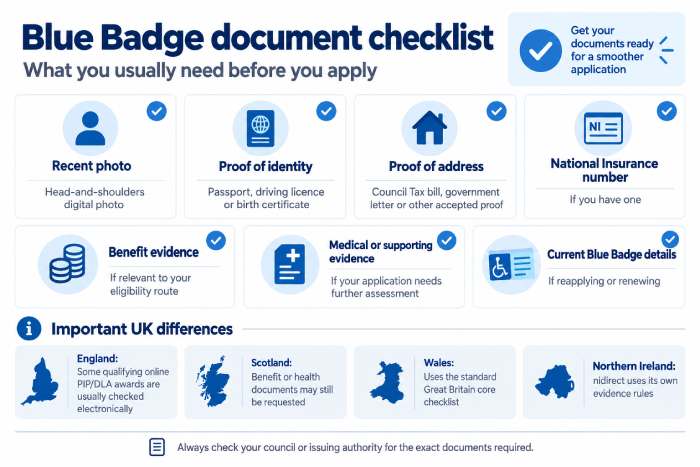
You will not necessarily need every type of evidence on this list. The application service and issuing authority will tell you what is required for your circumstances.
What documents do you need in England, Scotland and Wales?
The official GOV.UK online service used for most applications in England, Scotland and Wales says you will need a recent digital photograph showing your head and shoulders.
You will also normally need a photograph or scan of:
- proof of identity;
- proof of address;
- and proof of benefits if relevant to your application.
You will also need to know:
- your National Insurance number, if you have one; and
- details of your current Blue Badge if you are reapplying.
You can start the official Great Britain application here:
GOV.UK — Apply for or reapply for a Blue Badge
What counts as proof of identity?
GOV.UK gives examples such as:
- a birth certificate;
- a passport;
- or a driving licence.
Depending on the local authority and application method, other documents may also be accepted.
Older or paper council forms can have more specific rules, so follow the list supplied by the authority handling your application rather than assuming every identity document works everywhere.
Can I apply without a passport?
Yes.
A passport is only one example of acceptable proof of identity.
A birth certificate or driving licence can also be accepted through the standard Great Britain application process.
If you do not have any of the documents shown during your application, contact the authority processing your badge and ask which alternative identification it accepts.
What counts as proof of address?
The GOV.UK application service gives examples including:
- a Council Tax bill; or
- a government letter.
Individual councils can accept additional documents, such as certain utility bills or other official correspondence.
Do not assume there is one universal “last 3 months” or “last 12 months” rule across the UK.
Different authorities can specify different age requirements for address evidence.
The safest approach is to use the list shown during your application or on the issuing authority’s current Blue Badge page.
Do I need my National Insurance number?
If you have a National Insurance number, you should have it available when applying through the Great Britain online service.
Northern Ireland’s online Blue Badge service also asks individual applicants for their National Insurance number.
If you do not have one, the GOV.UK service specifically phrases the requirement as your National Insurance number “if you have one”.
What photograph do I need?
For England, Scotland and Wales, GOV.UK asks for a recent digital photograph showing your head and shoulders.
The photo should be:
- recent;
- clear;
- in focus;
- showing the applicant’s head and shoulders;
- and suitable for identification on the badge.
If you are applying online, you can normally upload a digital image or photograph.
Northern Ireland photograph requirements
Northern Ireland describes the requirement slightly differently.
Individual applicants need a recent:
- colour passport-type photograph showing the head and shoulders; or
- for certain paper applications, a suitable photograph cut to 45mm high by 35mm wide.
What benefit evidence do you need?
This depends heavily on where you live and which benefit provides your eligibility.
Do not assume that everyone simply uploads an award letter.
England: PIP and DLA evidence changed in 2025
There are important current rules for online applications in England.
Qualifying PIP awards
From 1 April 2025, applicants in England receiving a qualifying PIP award should no longer normally be asked to upload their PIP award letter through the online Blue Badge application.
Instead, local authorities should use the Department for Work and Pensions Searchlight system to verify the award.
Higher Rate Mobility DLA
From 20 May 2025, England also moved to Searchlight as the default method of validating the Higher Rate Mobility Component of Disability Living Allowance for online Blue Badge applications.
This means an article telling every English PIP or DLA applicant to upload an award letter is now outdated.
You should still know the relevant details of your benefit and follow any evidence request shown during the application.
See how PIP affects Blue Badge eligibility.
Scotland: what benefit evidence might you need?
Scotland has several automatic benefit routes, including qualifying awards of:
- Adult Disability Payment (ADP);
- Personal Independence Payment (PIP);
- Disability Living Allowance (DLA);
- Scottish Adult Disability Living Allowance;
- Child Disability Payment;
- and certain veterans’ benefits.
mygov.scot states that you may have to send copies of documents about your benefit payments or health when you apply.
Do not assume that the England Searchlight process works identically for Scottish benefit routes.
See how to apply for a Blue Badge in Scotland.
Wales: what documents do you need?
Welsh Government gives the same core Great Britain checklist:
- a recent digital head-and-shoulders photograph;
- proof of identity;
- proof of address;
- proof of benefits if relevant;
- your National Insurance number if you have one;
- and your current badge details if reapplying.
Additional evidence may be required where you are applying through routes such as:
- permanent and substantial walking difficulty;
- Severe Cognitive Impairment;
- terminal illness;
- or the Welsh temporary qualification route.
See how to apply for a Blue Badge in Wales.
Northern Ireland: documents are different
Northern Ireland does not use the GOV.UK Great Britain application system.
Applications are made through nidirect and the Department for Infrastructure Blue Badge Unit.
For an online individual application you will need to provide information including:
- your name;
- address;
- date of birth;
- town of birth;
- National Insurance number;
- and a valid contact number.
You will need to upload:
- a digital copy of evidence proving your eligibility, such as an entitlement letter or supporting medical evidence; and
- a recent colour passport-type head-and-shoulders photograph.
PIP evidence in Northern Ireland
If your Northern Ireland application uses the relevant benefit-based route, nidirect currently requires a:
PIP Statement of Entitlement detailing the points awarded.
This is an important difference from the current England online process.
Other Northern Ireland benefit documents
Depending on the route, nidirect lists documents including:
- DLA: Letter of Award;
- War Pension Mobility Supplement: Letter of Entitlement;
- Armed Forces and Reserve Forces Compensation Scheme: Letter of Confirmation;
- registered blind: Certificate of Registration or a relevant Health and Social Care Trust letter.
See how to apply for a Blue Badge in Northern Ireland.
Do I need medical evidence?
Not every applicant needs the same medical evidence.
If your eligibility can be established through an automatic qualifying route, extensive medical evidence may not be necessary.
If your application requires further assessment, you may need evidence showing how your condition affects:
- walking;
- distance;
- speed;
- pain;
- breathlessness;
- balance;
- risk of falls or serious harm;
- journey planning;
- psychological distress;
- or the support you need to travel safely.
The exact medical evidence deserves separate treatment, so see what medical evidence you need for a Blue Badge application.
What medical documents can be useful?
Depending on your circumstances, relevant supporting evidence can come from:
- consultants;
- specialist nurses;
- occupational therapists;
- physiotherapists;
- mental-health professionals;
- memory clinics;
- mobility services;
- care professionals;
- or other professionals familiar with how your condition affects you.
Examples may include:
- clinic letters;
- treatment plans;
- care plans;
- prescriptions or medication information;
- mobility assessments;
- therapy reports;
- or professional correspondence explaining your functional difficulties.
The value of the evidence is in what it shows about your difficulties, not simply the name of your diagnosis.
Is a GP letter required?
Not automatically.
There is no universal UK rule saying every Blue Badge applicant must obtain a GP letter.
In many cases:
- benefit evidence establishes an automatic route;
- other healthcare professionals may have more relevant information;
- or the issuing authority may request specific evidence itself.
In Northern Ireland, for example, the Blue Badge Unit may refer an application for additional GP information where further evidence is required.
Do not pay for or obtain a generic medical letter unless it is actually useful or requested.
What if I have a non-visible disability?
If your application is based on a non-visible disability, supporting evidence should explain the functional impact during journeys.
Depending on the applicable eligibility rules, this could include evidence about:
- overwhelming psychological distress;
- risk near traffic or vehicles;
- difficulty following journeys;
- behavioural responses;
- risk to yourself or others;
- or the supervision and support another person must provide.
A diagnostic report that simply says you have a particular condition may not, by itself, explain why you meet the Blue Badge criteria.
What documents do I need if I am renewing?
A Blue Badge renewal is effectively a reapplication.
For England, Scotland and Wales, GOV.UK says you should also know the details of your current Blue Badge.
Prepare:
- your current badge number;
- its expiry details;
- a new photograph where requested;
- current identity and address information;
- updated benefit information;
- and current supporting evidence if your eligibility requires reassessment.
Do not assume documents from an application made three years ago are automatically sufficient today.
See the complete Blue Badge renewal guide.
What if I am applying for someone else?
You can apply for another person, but the evidence must relate to the person who will hold the Blue Badge.
For example, if you apply for an elderly parent or child, you may need:
- their identity information;
- their address evidence;
- their photograph;
- their benefit details;
- and evidence of their disability or mobility difficulties.
The representative completing the form does not become the badge holder.
Can I upload photographs of documents from my phone?
Yes, for the Great Britain online application.
Official guidance allows applicants to upload photographs or scans of relevant documents.
A smartphone or tablet can therefore be used to photograph documents for upload.
Make sure:
- all text is readable;
- the entire relevant page is visible;
- there is no glare;
- the image is in focus;
- and important information has not been cropped out.
Do documents have to be certified?
Not for every online application.
Do not confuse older paper-form requirements or individual council procedures with the standard GOV.UK online process.
Some paper forms can have specific certification requirements for identity documents.
Always follow the instructions attached to the exact paper form you are using.
See how to get and complete a paper Blue Badge application form.
Should I send original documents?
Follow the instructions of the authority processing your application.
Online applications generally use photographs or scans, so originals are not posted.
For paper applications, many authorities ask for copies rather than valuable original documents, but requirements vary.
Never assume that a document needs to be sent in the post unless the current application instructions say so.
How to make sure uploaded documents are accepted
Before uploading evidence:
- check readability — every relevant word and number should be visible;
- avoid blur — retake photographs if necessary;
- avoid glare from overhead lights;
- include all relevant pages of multi-page evidence;
- do not crop important details;
- check the correct person is named;
- check the document actually supports the eligibility route;
- and follow any file-size or format requirements shown by the service.
What if I do not have all the documents ready?
If you are using the GOV.UK service for England, Scotland or Wales, you can save the application and return to it later.
You therefore do not need to rush through the form with incomplete evidence.
Gathering the correct information first can reduce the chance that the authority has to contact you later.
Northern Ireland is different
The nidirect online application must be completed in one session and times out after a period of inactivity.
If applying in Northern Ireland, prepare your evidence before starting.
Can missing documents delay a Blue Badge application?
Yes.
If the authority needs additional information, it cannot make the final decision until it has enough evidence to assess your eligibility.
Northern Ireland explicitly states that incomplete postal forms will be returned and that an application can take longer than the normal 6 to 8 weeks if additional supporting information is required.
Great Britain councils can similarly request further evidence before deciding an application.
Documents you may NOT need
Avoid collecting paperwork simply because you think “more evidence is always better”.
You may not need:
- every medical record you have ever received;
- a generic GP letter that says only your diagnosis;
- an outdated benefit letter where your entitlement can be electronically verified;
- irrelevant test results;
- documents unrelated to the eligibility difficulty you describe;
- or multiple copies of the same information.
Relevant evidence is more useful than a large volume of irrelevant paperwork.
Common document mistakes to avoid
- Uploading an unreadable photograph.
- Cropping out part of a benefit letter or assessment score.
- Using outdated generic advice that says every PIP applicant needs to upload an award letter.
- Assuming England’s Searchlight process applies throughout the UK.
- Using a diagnosis as the only evidence for an assessed route.
- Submitting irrelevant medical records.
- Forgetting current badge details when reapplying.
- Using another council’s paper-document checklist.
- Sending valuable original documents when the authority only asks for copies.
- Ignoring a request for additional evidence after submission.
See common mistakes to avoid when applying for a Blue Badge.
Final Blue Badge document checklist
Before starting your application, check:
- ☑ Do I have a recent suitable photograph?
- ☑ Do I have accepted proof of identity?
- ☑ Do I have accepted proof of address?
- ☑ Do I know my National Insurance number, if I have one?
- ☑ Do I know which eligibility route I am using?
- ☑ Do I know what benefit evidence is required in my nation?
- ☑ If I need further assessment, does my evidence show my functional difficulties?
- ☑ Are all uploaded documents clear and complete?
- ☑ If reapplying, do I have my current Blue Badge details?
- ☑ Have I checked the specific instructions from my council or Blue Badge Unit?
Related Blue Badge application guides
- How to apply for a Blue Badge online
- What medical evidence do you need for a Blue Badge?
- How to answer Blue Badge application questions
- Blue Badge eligibility through PIP
- How to renew a Blue Badge
- How to get a paper Blue Badge form
- What happens at a Blue Badge assessment?
Official document guidance
- GOV.UK — Documents needed to apply in England, Scotland and Wales
- GOV.UK — England Blue Badge guidance and Searchlight verification
- mygov.scot — Benefit and supporting-document guidance
- GOV.WALES — What information you need to apply
- nidirect — Documents needed for a Northern Ireland Blue Badge
The bottom line
The core Blue Badge document checklist is simple: photograph, identity, address, National Insurance number if you have one, eligibility evidence and current badge details if reapplying.
But the evidence rules are not identical throughout the UK.
- England: qualifying online PIP and Higher Rate Mobility DLA awards are now normally verified through DWP Searchlight rather than requiring an uploaded award letter.
- Scotland: benefit and health documents may still be requested depending on the eligibility route.
- Wales: uses the standard Great Britain core-document checklist, with additional evidence for assessed or Welsh-specific routes.
- Northern Ireland: uses nidirect and still specifically requires documents such as the PIP Statement of Entitlement for relevant benefit-based applications.
Prepare only relevant, readable evidence and follow the exact instructions shown during your application. That is much more useful than uploading large amounts of paperwork that do not demonstrate why you qualify.
Frequently asked questions
What documents do I need for a Blue Badge application?
For most applications in England, Scotland and Wales, prepare a recent digital head-and-shoulders photograph, proof of identity, proof of address, your National Insurance number if you have one, benefit evidence where relevant and supporting evidence if your eligibility requires assessment. If reapplying, also have your current Blue Badge details.
What can I use as proof of identity?
Examples given by GOV.UK include a birth certificate, passport or driving licence. Individual councils or paper forms may accept additional documents.
What can I use as proof of address?
GOV.UK gives examples including a Council Tax bill or government letter. Other accepted documents and how recent they must be can vary by local authority.
Can I apply for a Blue Badge without a passport?
Yes. A passport is only one form of identity evidence. A birth certificate or driving licence can also be accepted through the standard Great Britain application service.
Do I need a PIP award letter?
It depends where you live. In England, from 1 April 2025 qualifying online PIP awards should normally be verified by the local authority through DWP Searchlight rather than requiring you to upload the award letter. Northern Ireland currently requires the PIP Statement of Entitlement showing the points awarded for the relevant benefit-based application route.
Do I need a DLA award letter?
The process varies. In England, from 20 May 2025 qualifying Higher Rate Mobility DLA awards should normally be verified through Searchlight for online applications. Other nations can have different evidence requirements.
Do I need medical evidence?
Not everyone needs the same medical evidence. Applicants whose eligibility requires further assessment may need professional evidence showing how their disability affects walking, journeys, safety or mobility.
Is a GP letter required?
No universal UK rule requires every applicant to obtain a GP letter. The relevant authority may accept or request evidence from a range of healthcare or associated professionals depending on the eligibility route.
Can I photograph my documents with my phone?
Yes. The Great Britain online application allows photographs or scans of documents. Make sure the entire relevant document is visible, clear, in focus and readable.
Do I need to send original documents?
Online applications normally use scans or photographs. For paper applications, follow the specific form instructions. Do not send valuable original documents unless the authority specifically requires them.
What documents do I need when renewing?
A reapplication can require the same core information as a new application, plus your current Blue Badge details. Updated benefit or supporting evidence may also be needed if your eligibility is being reassessed.
What documents are needed in Northern Ireland?
Northern Ireland applicants use nidirect and need a recent colour passport-type photograph plus evidence supporting eligibility. Depending on the route, this can include a PIP Statement of Entitlement, DLA award letter, War Pension Mobility Supplement letter, Armed Forces compensation evidence or proof of blind registration.