


If your Blue Badge application has been refused, you may be able to challenge the decision — but there is no single UK-wide Blue Badge appeal procedure.
What you need to do depends on where you live.
In England, GOV.UK says you can ask your council to reconsider the case if you believe important information was not taken into account. Scottish councils must have a review process. In Wales, unsuccessful applicants can ask their local authority for a review. In Northern Ireland, you can request a reassessment if you believe all the information you provided was not considered.
The most important first step is not simply to send the same application again. Read the refusal reasons carefully and work out what evidence or part of the eligibility criteria caused the refusal.
Can you appeal a Blue Badge refusal?
Usually you can challenge the decision, but “appeal” is not always the official name of the process.
| Nation | What the process is normally called | Who looks at it? |
|---|---|---|
| England | Reconsideration / review | The issuing council |
| Scotland | Review / appeal through the council | The local council |
| Wales | Review | The local authority |
| Northern Ireland | Reassessment | DfI Blue Badge Unit |
There is no single UK-wide independent Blue Badge tribunal for ordinary eligibility refusals.
That makes the refusal letter particularly important because it should explain both the reason for the decision and the local procedure available to you.
What to do after a Blue Badge refusal
Use this process:
- Read the refusal letter carefully.
- Identify the exact eligibility reason for refusal.
- Check whether important evidence was missed or misunderstood.
- Gather relevant additional evidence if necessary.
- Address the refusal reasons one by one.
- Follow your authority’s review, reconsideration or reassessment procedure.
- Meet any deadline stated in the decision letter.
- Keep copies of everything you submit.
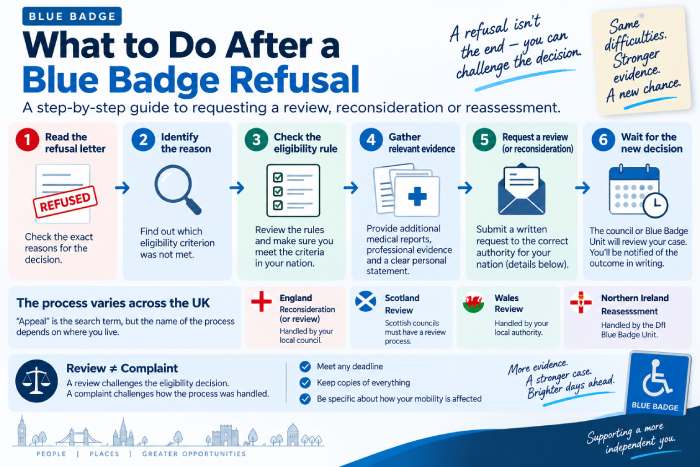
Step 1: Read the refusal letter carefully
Do not start by writing a general letter saying:
“I disagree and think I deserve a Blue Badge.”
Instead, find the exact reason the authority refused the application.
It may say that:
- you did not meet the relevant eligibility criterion;
- your walking difficulty was not considered sufficiently severe;
- there was insufficient evidence;
- the evidence did not demonstrate functional difficulty;
- your non-visible disability did not meet the relevant journey criteria;
- required identity or residency evidence was missing;
- benefit entitlement did not meet an automatic eligibility route;
- or the authority considered your assessment evidence and decided you did not qualify.
Your challenge should respond to the actual reason, not simply repeat your diagnosis.
Step 2: Check the Blue Badge eligibility criterion they used
Before challenging the decision, confirm which eligibility route applies to you.
You may have applied because you:
- automatically qualify through a benefit or other recognised entitlement;
- are unable to walk;
- experience very considerable difficulty walking;
- face a serious risk to your health when walking;
- experience qualifying difficulties during journeys because of a non-visible disability;
- meet a nation-specific eligibility route;
- or are applying under a child, terminal-illness or temporary criterion.
See what illnesses and disabilities can qualify for a Blue Badge.
Step 3: Work out whether evidence was missing or misunderstood
Ask yourself:
- Did the authority have all the documents I submitted?
- Did I clearly describe my walking distance?
- Did I explain pain?
- Did I explain breathlessness?
- Did I explain stopping and recovery?
- Did I explain after-effects?
- Did I explain mobility aids?
- Did I describe how often bad days occur?
- Did I explain what another person does to help?
- For a non-visible disability, did I describe what actually happens during journeys?
- Did my medical evidence explain functional impact rather than diagnosis alone?
See how to answer Blue Badge application questions.
Step 4: Gather relevant evidence
Do not automatically submit a huge amount of new medical paperwork.
Look at the refusal reason first.
Relevant evidence might include:
- consultant or specialist letters;
- occupational therapy reports;
- physiotherapy reports;
- mobility assessments;
- pain-clinic evidence;
- respiratory or cardiac evidence;
- care plans;
- mental-health evidence;
- memory-clinic evidence;
- treatment information;
- medication information;
- or other professional evidence relevant to the refusal.
The evidence is strongest when it explains what happens in practice.
For example:
- walking distance;
- walking speed;
- time;
- pain;
- breathlessness;
- stopping;
- balance;
- risk;
- psychological distress;
- supervision;
- or another relevant functional difficulty.
See what medical evidence can support a Blue Badge application.
Do you need a GP letter to appeal a Blue Badge refusal?
Not automatically.
A GP letter is not a universal requirement and may not be the most useful evidence for your particular refusal.
A generic letter saying:
“This patient has arthritis and would benefit from a Blue Badge.”
may add relatively little if the issue is whether you meet the functional walking criteria.
Evidence from a physiotherapist, occupational therapist, consultant, specialist nurse, mental-health professional or another practitioner may be more relevant depending on your circumstances.
The final eligibility decision remains with the issuing authority.
Step 5: Respond to each refusal reason
A strong review request is structured around the decision letter.
For each reason:
- state what the authority concluded;
- explain why you believe relevant information was overlooked, misunderstood or insufficiently evidenced;
- give a concrete example;
- identify supporting evidence;
- and explain how it relates to the eligibility criterion.
Example structure
If the council says your walking difficulty was not shown to be very considerable, your response might address:
- your normal walking distance;
- how long it takes;
- how frequently you stop;
- the severity of pain or breathlessness;
- your mobility aid;
- after-effects;
- and supporting professional evidence.
Use your own circumstances. Do not copy another applicant’s appeal wording or figures.
Step 6: Request the correct type of review
The procedure depends on where you live.
How to challenge a Blue Badge refusal in England
GOV.UK says:
You can ask your council to reconsider your case if you do not think all the important information you provided was taken into account.
England does not have a nationally prescribed statutory appeal tribunal for an ordinary Blue Badge eligibility refusal.
Department for Transport guidance actually says “request for review of decision” is more accurate than “appeal”, because a formal appeal usually implies greater independence from the original decision-maker.
DfT strongly recommends that councils operate a fair internal review procedure.
Ideally, the review should be carried out by someone who was not directly involved in the original decision.
What to send in England
Follow the instructions in your council’s refusal letter.
Your request should normally:
- identify the application;
- state that you are requesting reconsideration or review;
- address the refusal reasons;
- explain any information you believe was overlooked;
- include relevant additional evidence;
- and be submitted within any local deadline.
Do not send the appeal to the Department for Transport. DfT does not decide individual Blue Badge applications.
Official GOV.UK application guidance:
GOV.UK — Blue Badge applications and refusals
See how Blue Badge applications work in England.
Can you complain if the England review is unsuccessful?
A complaint and an eligibility review are different things.
A review asks:
“Was the eligibility decision wrong?”
A complaint can ask:
“Was the application or review process handled improperly?”
For example, you might complain if you believe the council:
- failed to consider evidence;
- applied the wrong procedure;
- failed to explain its decision;
- handled an assessment unfairly;
- or caused unreasonable administrative problems.
You normally use the council’s complaints procedure first.
If the complaint remains unresolved, you may be able to approach the Local Government and Social Care Ombudsman.
The Ombudsman considers possible administrative fault. It is not simply another Blue Badge eligibility tribunal that substitutes its own medical opinion for the council’s.
How to appeal a Blue Badge refusal in Scotland
Scotland is different from England because Scottish local authorities are required to have a review process for applicants refused a Blue Badge.
Transport Scotland confirms that:
- local councils administer individual applications;
- local authorities must have a review process;
- Transport Scotland does not decide individual appeals;
- and you should contact the council that refused your application.
Your refusal letter or council Blue Badge page should explain:
- how to request the review;
- where to send it;
- what evidence is accepted;
- and any deadline.
Do not send an individual Blue Badge appeal to Scottish Ministers or Transport Scotland expecting them to overturn the council’s eligibility decision.
Official guidance:
Transport Scotland — Blue Badge scheme
See how to apply for a Blue Badge in Scotland.
What if I am unhappy with the Scottish review?
If the issue is not simply disagreement with eligibility but the way the authority handled your application or review, use the council’s complaints procedure.
After completing the relevant local complaints process, the Scottish Public Services Ombudsman may be able to consider complaints about administrative handling.
Again, an Ombudsman complaint is different from asking for another medical eligibility assessment.
How to appeal a Blue Badge refusal in Wales
Welsh Government says that if your application is unsuccessful, you can ask for a review.
Your local authority’s decision letter should tell you how.
Welsh Blue Badge guidance recommends that councils operate a clear review procedure.
During a review, the authority may ask you to provide:
- additional evidence;
- new medical or professional information;
- clarification of your circumstances;
- or, in some cases, undertake further assessment.
If the application is rejected again, the authority should provide a further explanation.
Welsh Government does not normally intervene in individual eligibility applications.
Official guidance:
See how to apply for a Blue Badge in Wales.
Is there a formal Blue Badge appeal to Welsh Ministers?
Only in very limited circumstances.
For an ordinary refusal because the authority believes you do not meet the disability eligibility criteria, the normal route is the local authority’s review procedure.
Welsh Government guidance identifies a specific appeal to Welsh Ministers in certain cases involving:
- a relevant conviction connected with Blue Badge misuse;
- or certain badge-return decisions involving false representation.
That is different from the normal applicant who has simply been refused because the authority considers the eligibility criteria are not met.
What if I am unhappy with the Welsh review?
If you believe there were procedural problems, first use the local authority’s complaints procedure.
Welsh guidance states that complaints involving possible procedural irregularities can ultimately be taken to the Public Services Ombudsman for Wales.
The Ombudsman focuses on how the public authority acted rather than functioning as a general second Blue Badge eligibility panel.
How to challenge a Blue Badge refusal in Northern Ireland
Northern Ireland calls the process a reassessment.
If your application is unsuccessful, nidirect says:
- you will be told in writing why you are not eligible;
- your £10 application fee will be refunded;
- you can ask for the application to be reassessed if you believe all the information you provided was not taken into account;
- and you can reapply if your mobility difficulties become more serious or you later become automatically entitled.
The process is handled by the Department for Infrastructure Blue Badge Unit.
Northern Ireland Blue Badge Unit
- Phone: 0300 200 7818
- Email: bluebadges@infrastructure-ni.gov.uk
Official guidance:
nidirect — Unsuccessful Blue Badge applications
See how to apply for a Blue Badge in Northern Ireland.
What if the Northern Ireland reassessment is unsuccessful?
If your concern is about the way a public body handled your case rather than simply disagreeing with the eligibility result, you can use the relevant government complaints procedure.
nidirect says complaints about government or public bodies should first be made to the organisation itself.
If the complaint remains unresolved after that process, the Northern Ireland Public Services Ombudsman may be able to consider it.
What evidence can help a Blue Badge review?
There is no universal “appeal evidence pack”.
The best evidence depends on the refusal reason.
| Refusal issue | Evidence that may be relevant |
|---|---|
| Walking distance not considered severe enough | Functional evidence about distance, time, stops, walking aids and symptoms |
| Pain not sufficiently demonstrated | Pain-clinic, consultant, treatment or therapy evidence explaining functional effect |
| Breathlessness not sufficiently demonstrated | Respiratory, cardiac or rehabilitation evidence |
| Hidden disability criteria not demonstrated | Evidence about journey distress, risk, supervision and support |
| Insufficient medical evidence | Relevant clinical or professional information focused on functional difficulty |
| Fluctuating condition misunderstood | Evidence showing frequency, flare-ups and typical good/bad-day pattern |
| Benefit route incorrectly interpreted | Correct entitlement evidence or clarification of award points/components |
| Missing identity/address documents | The exact documents requested by the issuing authority |
Should I submit new evidence?
Only where it helps address the refusal.
A review is not necessarily improved by adding hundreds of pages.
Before uploading another document, ask:
- Does it address the reason I was refused?
- Does it describe my functional difficulty?
- Is it relevant to my current circumstances?
- Does it add something the authority did not already know?
Can personal statements help?
Your own explanation is important, but it should be factual and specific.
Explain:
- what normally happens on a journey;
- how far you walk;
- how long it takes;
- what symptoms occur;
- when you stop;
- what aid or help you need;
- what risks exist;
- what happens afterwards;
- and how often these difficulties occur.
Statements from carers or family members may add context where they regularly provide relevant support, but they should describe actual observations rather than simply saying the applicant “deserves a badge”.
What if my condition fluctuates?
If the refusal appears to have been based on a single assessment or an unusually good day, explain the broader pattern.
Describe:
- how many difficult days you experience;
- how long flare-ups last;
- how your walking changes;
- how your support needs change;
- and whether the assessment day was representative.
Do not claim every day is your worst day if that is not true.
What if I have a hidden disability?
If your application involves a non-visible disability, the review should focus on the applicable journey-related criteria.
This could involve:
- overwhelming psychological distress;
- lack of traffic awareness;
- risk of serious harm;
- behavioural difficulties;
- disorientation;
- need for supervision;
- or another person’s intervention during journeys.
Do not rely on the diagnosis alone.
Explain what actually happens between the vehicle and the destination.
What if I disagree with a mobility assessment?
Read the decision letter and compare it with:
- what happened during the assessment;
- what you told the assessor;
- your supporting evidence;
- and the reasons given for refusal.
You may want to raise specific factual issues such as:
- relevant symptoms not recorded;
- important medical evidence not discussed;
- fluctuation not considered;
- after-effects not considered;
- support needs not recorded;
- or an assessment that did not reflect your usual outdoor mobility.
Avoid simply arguing that the assessor “got everything wrong”. Identify the specific issue and the evidence supporting your position.
See what happens at a Blue Badge assessment.
Should I appeal because I had a Blue Badge before?
A previous Blue Badge does not automatically guarantee a new one.
Renewal is a reapplication and eligibility can be reconsidered.
If you previously held a badge, it may still be relevant to explain:
- whether your condition remains unchanged;
- whether it has deteriorated;
- what evidence supported the previous decision;
- and why you believe you still meet the current criteria.
But “I had one before” is not, by itself, proof of current eligibility.
Can I reapply instead of appealing?
Sometimes, but do not assume repeatedly submitting the same application will produce a different result.
Reapplying may make sense if:
- your mobility has materially worsened;
- you have developed a new disability;
- you now qualify automatically;
- or you have significant new evidence.
Some councils have local policies about how soon an unsuccessful applicant can submit essentially the same application again.
Read your refusal letter first.
Can I appeal because my condition has worsened after the refusal?
If the deterioration happened after the authority made its decision, a new application may sometimes be more appropriate than arguing that the original decision was wrong.
The distinction is:
- Review: the original decision was wrong based on the circumstances and evidence relevant at that time.
- Reapplication: your circumstances have materially changed since the decision.
Your local authority can tell you which route it expects you to use.
How long does a Blue Badge appeal take?
There is no single UK-wide review or appeal timescale.
Each council or authority operates its own process.
Your refusal letter may specify:
- the deadline for requesting review;
- the expected review time;
- what additional evidence can be supplied;
- and how the outcome will be communicated.
If no timeframe is clear, check the authority’s Blue Badge or complaints guidance.
Is there a deadline to appeal a Blue Badge refusal?
There is no single UK-wide deadline that should be applied to every case.
Local procedures differ.
Always use the deadline stated in:
- your refusal letter;
- the local authority’s review policy;
- or the Blue Badge Unit’s instructions.
Do not delay while gathering unnecessary documents if the authority has given you a fixed review period.
Review vs complaint: what is the difference?
| Review / reconsideration | Complaint |
|---|---|
| You think the eligibility decision is wrong | You think the process was handled badly |
| Focuses on eligibility evidence | Focuses on administrative conduct or fairness |
| Handled by the issuing authority | Starts with the authority’s complaints procedure |
| Can result in a new eligibility decision | Can result in findings about how the process was handled |
You may sometimes need both, but they solve different problems.
Can an Ombudsman give me a Blue Badge?
Do not treat an Ombudsman as another ordinary eligibility appeal stage.
Ombudsman services generally investigate issues such as:
- administrative fault;
- failure to follow procedure;
- failure to consider relevant information;
- unreasonable delay;
- or other maladministration.
They generally examine how the decision was made, rather than simply replacing the authority’s properly reached eligibility judgment with their own.
Common mistakes when challenging a Blue Badge refusal
- Sending exactly the same information again.
- Writing only that the decision is unfair.
- Focusing on diagnosis rather than functional impact.
- Ignoring the specific refusal reason.
- Submitting large quantities of irrelevant medical records.
- Paying for a generic GP letter that adds no useful evidence.
- Copying somebody else’s appeal.
- Exaggerating walking distances or symptoms.
- Describing only an exceptional worst day.
- Missing the council’s review deadline.
- Sending an England appeal to DfT or a Scottish appeal to Transport Scotland.
- Confusing a complaint with an eligibility review.
See common Blue Badge application mistakes.
Blue Badge refusal review checklist
- ☑ Read every part of the refusal letter.
- ☑ Identify the exact eligibility criterion involved.
- ☑ Note the review deadline.
- ☑ Check whether important evidence was overlooked.
- ☑ Gather only relevant additional evidence.
- ☑ Address every refusal reason separately.
- ☑ Explain functional impact rather than diagnosis alone.
- ☑ Use real examples from normal journeys.
- ☑ Explain fluctuating symptoms accurately.
- ☑ Keep copies of all evidence and correspondence.
- ☑ Use the correct process for your UK nation.
- ☑ Use the complaints procedure separately if the process itself was mishandled.
Related Blue Badge application guides
- How to apply for a Blue Badge online
- How to answer Blue Badge application questions
- What medical evidence do you need?
- Documents needed for a Blue Badge application
- What happens at a Blue Badge assessment?
- How long does a Blue Badge application take?
- How to track your Blue Badge application
- What illnesses qualify for a Blue Badge?
Official Blue Badge refusal and review guidance
- GOV.UK — What to do if an application is refused
- GOV.UK — England review and complaints guidance
- Transport Scotland — Scottish Blue Badge reviews and complaints
- GOV.WALES — Request a Blue Badge review
- GOV.WALES — Review, complaints and limited appeal rights
- nidirect — Blue Badge reassessment after refusal
The bottom line
A Blue Badge refusal can usually be challenged, but there is no single UK appeal system.
- England: ask the council to reconsider or review the decision.
- Scotland: use the local authority’s Blue Badge review process.
- Wales: request a review from your local authority.
- Northern Ireland: ask the DfI Blue Badge Unit to reassess the application if you believe all your information was not considered.
Start with the refusal letter. Identify precisely why the application failed, then provide relevant evidence addressing that reason.
Do not simply repeat the application, focus only on your diagnosis or send large quantities of unrelated medical paperwork. A focused explanation of your real functional difficulties, supported by relevant evidence, gives the authority a much clearer basis on which to reconsider its decision.
Frequently asked questions
Can I appeal a Blue Badge refusal?
Usually you can challenge the decision, but the process varies across the UK. England uses reconsideration or internal review, Scottish councils must provide a review process, Wales allows applicants to request a review and Northern Ireland allows a reassessment where the applicant believes all relevant information was not taken into account.
How do I appeal a Blue Badge refusal in England?
Read your council’s refusal letter and follow its reconsideration or review procedure. GOV.UK says you can ask the council to reconsider if you believe important information you provided was not taken into account.
How do I appeal a Blue Badge refusal in Scotland?
Contact the local council that refused the application and use its Blue Badge review procedure. Scottish local authorities are required to have a review process for refused applicants.
How do I appeal a Blue Badge refusal in Wales?
Ask your local authority for a review. The refusal letter should explain how to do this. There is generally no statutory appeal for ordinary eligibility refusals, although limited formal appeal rights exist for specific misuse-related decisions.
How do I appeal a Blue Badge refusal in Northern Ireland?
You can ask the Department for Infrastructure Blue Badge Unit to reassess your application if you do not think all the information you supplied was taken into account.
What evidence helps a Blue Badge appeal?
The best evidence addresses the actual refusal reason. This can include professional evidence about walking distance, pain, breathlessness, mobility aids, risk, psychological distress, supervision, treatment or other functional difficulties relevant to the eligibility criterion.
Do I need a GP letter to appeal?
No. A GP letter is not a universal requirement and a generic diagnosis letter may add little. Evidence from another relevant professional may be more useful depending on why the application was refused.
Should I send new medical evidence?
Send additional evidence where it directly addresses the refusal reason or adds relevant information that was not previously considered. More paperwork is not automatically better.
Can I appeal because I already had a Blue Badge?
A previous badge does not automatically guarantee a new one. Explain why you still meet the current criteria and provide relevant evidence about your present circumstances.
What if my condition has worsened after the refusal?
If your circumstances materially changed after the decision, a new application may be more appropriate than arguing that the original decision was wrong. Check the instructions from your issuing authority.
How long does a Blue Badge appeal take?
There is no single UK-wide review timescale. Councils and issuing authorities operate their own procedures, so check your refusal letter or local Blue Badge guidance.
Is there a deadline to appeal?
There is no universal UK deadline. Follow the deadline stated in the refusal letter or the authority’s review or reassessment procedure.
What is the difference between a Blue Badge review and a complaint?
A review challenges the eligibility decision. A complaint concerns how the authority handled the application, assessment or review process. They are separate procedures.
Can I complain to an Ombudsman?
Potentially, after using the relevant authority’s complaints procedure. Ombudsman services generally investigate possible administrative fault or procedural problems rather than acting as another ordinary medical eligibility tribunal.
[…] to reconsider, provide more medical evidence, or reapply if your mobility worsens. Our guide to appealing a Blue Badge refusal walks you through […]
[…] unsuccessful, you can request a review — the decision letter explains how, and our guide to appealing a Blue Badge refusal can […]
[…] reconsider, add further medical information, or reapply if your mobility gets worse. Our guide to appealing a Blue Badge refusal explains the […]
[…] See how to appeal a Blue Badge refusal. […]
[…] The formal procedure to challenge a denied Blue Badge application. If your application is refused, you can follow the steps in our guide on how to appeal a Blue Badge refusal. […]