

When answering Blue Badge application questions, describe what actually happens when you walk or complete a journey rather than simply naming your diagnosis.
Give concrete details about distance, time, pain, breathlessness, stopping, mobility aids, help from another person, safety risks, psychological distress and how often the difficulty occurs.
The aim is not to find the “right words” or copy somebody else’s successful application. The issuing authority needs an accurate picture of your normal functional difficulties so it can decide whether you meet the Blue Badge criteria.
This guide shows how to answer the most common questions clearly and honestly, including walking-distance questions and applications involving non-visible disabilities.
What questions are asked on a Blue Badge application?
The exact questions depend on:
- where in the UK you live;
- your eligibility route;
- the answers you give earlier in the application;
- and the authority processing your application.
If you automatically qualify through a recognised benefit or another automatic route, you may not need to answer the same detailed mobility questions as someone whose eligibility needs further assessment.
If your application needs assessment, you may be asked about:
- your health conditions or disabilities;
- how they affect your walking;
- how far you can walk;
- how long you can walk for;
- your walking speed;
- pain;
- breathlessness;
- balance, coordination or posture;
- mobility aids;
- help from another person;
- medication;
- treatment;
- health or social-care professionals involved in your care;
- risks when walking;
- psychological distress;
- and difficulties travelling between a vehicle and your destination.
The best way to answer Blue Badge questions
A useful answer usually combines seven pieces of information:
- Situation: describe a normal real-world journey.
- Distance or time: explain how far or how long you normally manage.
- Difficulty: describe pain, breathlessness, distress, instability or another relevant problem.
- Support: explain whether you stop, use an aid or need another person.
- Risk: describe any genuine safety issue.
- After-effects: explain what happens after walking or completing the journey.
- Frequency: explain whether this happens every time, most days, occasionally or only during flare-ups.
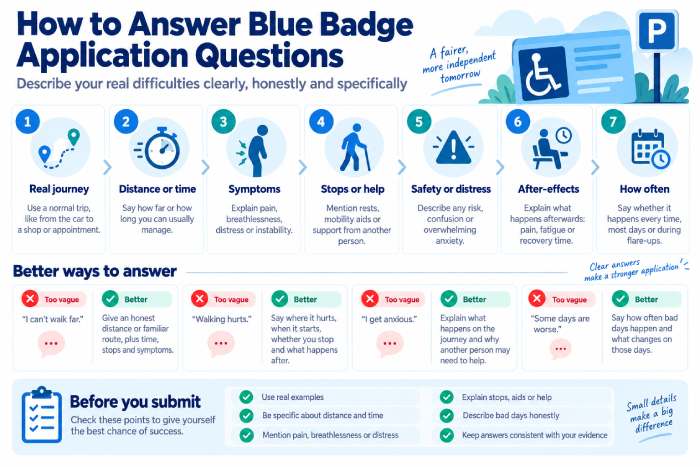
That produces a much clearer picture than a short statement such as:
“I have arthritis and cannot walk far.”
A more informative answer, if it accurately reflects your circumstances, would explain something like:
“On a typical journey I use a walking stick and need to stop several times because pain in my knees increases as I walk. I walk slowly, and after a short journey I usually need to sit and recover before continuing.”
Use your own distances, symptoms, times and experiences. Do not copy example figures that are not true for you.
How to answer “How far can you walk?”
This is one of the most important questions for applicants whose eligibility is based mainly on physical walking difficulty.
Avoid answers such as:
- “not far”;
- “a short distance”;
- “a few minutes”;
- or “it depends”.
Instead, give the authority something it can understand and assess.
Use a familiar real-world distance
You might think about a journey you regularly attempt, such as:
- your front door to your car;
- the supermarket car park to the entrance;
- your home to a nearby bus stop;
- one end of your street to another;
- or another route whose approximate distance you know.
Explain:
- approximately how far it is;
- whether you complete it without stopping;
- how long it takes;
- what mobility aid you use;
- and what symptoms develop.
Do not answer according to a threshold you found online
Do not change your answer because you have read that a particular distance is important.
Official assessment guidance is not identical throughout the UK.
For example, England’s Department for Transport guidance discusses walking below 30 metres and the 30-to-80-metre range as part of a wider assessment, while Welsh guidance uses its own assessment indicators.
The correct approach is therefore to describe what you genuinely manage, including the difficulty involved.
How to estimate your walking distance
If you genuinely do not know the distance you walk, you can estimate it using a familiar route.
For example:
- identify a route you regularly walk;
- estimate or check its approximate distance;
- note whether you stop;
- note how long the route normally takes;
- and describe what symptoms occur.
Do not repeatedly test yourself to exhaustion or place yourself at risk simply to obtain a measurement for the application.
How to answer questions about walking time
Distance does not tell the whole story.
Two people may both walk the same distance, but one might:
- walk at a normal pace without stopping;
- while the other walks extremely slowly, stops several times and experiences severe pain.
If you are asked how long you can walk, explain:
- how long you normally manage before stopping;
- why you need to stop;
- how long you need to recover;
- and whether you can continue afterwards.
How to describe your walking speed
Instead of simply writing “I walk slowly”, give context.
You could explain, if true, that:
- people walking with you regularly have to slow down;
- you take considerably longer than another person to complete a familiar route;
- you take small or hesitant steps;
- you cannot maintain a steady pace;
- or you stop repeatedly.
England’s official assessment guidance specifically considers walking speed alongside distance, time, manner of walking, pain, breathlessness and use of aids.
How to answer questions about pain
Avoid writing only:
“Walking is painful.”
Instead, describe:
- where the pain occurs;
- when it starts;
- whether it becomes worse as you continue;
- how severe it becomes;
- whether it forces you to stop;
- what pain relief or treatment you use;
- how long recovery takes;
- and whether pain continues after the walk has finished.
Pain after walking can still be relevant. England and Wales both recognise that excessive pain may occur during walking or as a direct consequence of the effort of walking.
A useful pain answer explains consequences
For example, instead of:
“I have severe back pain.”
an applicant might accurately explain:
“The pain increases while I walk and eventually forces me to stop. After walking, the pain remains worse for a period and I need to sit or lie down before I can continue with normal activities.”
Only use a description like this if it matches your actual experience.
How to answer questions about breathlessness
If breathlessness affects your walking, describe:
- when it starts;
- what level of activity triggers it;
- whether it happens on level ground;
- whether slight slopes make it substantially worse;
- whether you need to stop;
- how long recovery takes;
- whether you use inhalers, oxygen or other treatment;
- and whether exertion creates a health risk.
England’s Blue Badge guidance specifically considers breathlessness while walking or as a consequence of walking.
It also recognises that some people with serious heart, chest or lung conditions may appear physically capable of walking but should not walk far because of the danger to their health.
How to answer “Do you use a mobility aid?”
If you use an aid, state:
- what it is;
- when you use it;
- whether you use it indoors, outdoors or both;
- whether you can walk without it;
- what problem it helps with;
- and whether you still experience substantial difficulty while using it.
Examples can include:
- walking stick;
- crutches;
- walking frame;
- rollator;
- prosthesis;
- wheelchair;
- or physical support from another person.
Do not assume that using an aid automatically qualifies you. The authority looks at the overall functional difficulty.
How to describe balance, coordination or falls
If balance or coordination is part of your difficulty, describe practical consequences such as:
- unsteadiness;
- difficulty turning;
- frequent loss of balance;
- falls or near-falls;
- need to hold another person;
- difficulty with uneven ground;
- difficulty stepping off kerbs;
- or an altered gait.
If falls happen, explain how often they occur rather than simply writing “I fall a lot”.
How to answer questions about help from another person
Explain exactly what the other person does.
For example:
- physically supports you;
- helps prevent falls;
- carries essential equipment;
- guides you;
- monitors your health;
- reassures you during distress;
- prevents you entering traffic;
- redirects you when disorientated;
- or helps you safely reach the destination.
Writing only “my husband helps me” or “I need my carer” does not explain what support is actually necessary.
How to answer questions about medication
List relevant medication accurately.
Where useful, explain:
- what symptom it treats;
- whether you take it regularly or when needed;
- whether symptoms remain significant despite treatment;
- and any relevant side effects that affect mobility or journeys.
Medication itself does not prove eligibility, but it can provide context for the difficulty you describe.
How to answer questions about treatment
Include relevant treatment you:
- currently receive;
- have recently completed;
- or are due to receive.
This might include:
- physiotherapy;
- occupational therapy;
- pain management;
- cardiac rehabilitation;
- respiratory treatment;
- mental-health treatment;
- surgery;
- specialist clinics;
- or rehabilitation programmes.
Where relevant, explain whether treatment has improved the difficulty, only partly helped, or whether significant limitations remain.
How to answer if your condition varies from day to day
Do not describe only your best day or only your worst day.
Give a realistic picture of your normal pattern.
You can explain:
- how many good and bad days you typically experience;
- what a typical day looks like;
- what happens during a flare-up;
- what triggers deterioration;
- how long flare-ups last;
- and whether your ability to walk or complete journeys changes.
Use frequency, not vague wording
Instead of:
“Sometimes I can’t walk far.”
give an accurate description of frequency, such as:
“My mobility varies. On most days I need to stop repeatedly because of pain, while on better days I can manage further before symptoms become severe.”
If you know the approximate frequency of bad days, you can include it.
How to explain after-effects
One commonly missed part of a Blue Badge application is what happens after the journey.
If walking causes:
- increased pain;
- severe fatigue;
- breathlessness;
- need for prolonged rest;
- worsening symptoms;
- or another relevant consequence;
explain this clearly.
Do not imply that because you technically completed a particular distance you completed it without very considerable difficulty.
How to answer questions about a hidden or non-visible disability
For a non-visible disability, the application may focus less on physical walking distance and more on what happens during the journey between the vehicle and destination.
Depending on the eligibility rules where you live, relevant difficulties can include:
- overwhelming psychological distress;
- extreme fear or anxiety;
- disorientation;
- difficulty following a journey;
- lack of awareness of traffic danger;
- impulsive behaviour near vehicles;
- risk of running into the road;
- risk of serious harm;
- behaviour that could create serious risk to another person;
- or inability to complete the journey without another person’s support.
How to describe psychological distress
Avoid simply saying:
“I get anxious.”
Explain what that means in practice.
You might describe, where genuinely applicable:
- what triggers the distress;
- what symptoms occur;
- whether the distress becomes overwhelming;
- whether you abandon journeys;
- whether another person must intervene;
- whether busy or open spaces create particular difficulty;
- whether you become unable to continue;
- and how parking closer to the destination changes the problem.
England’s official guidance specifically encourages applicants to explain experiences such as very severe anxiety, overwhelming fear of public, open or busy spaces, coping strategies and journeys they avoid because of these experiences.
How to describe risk of serious harm
If your application involves risk, be specific about:
- who is at risk;
- what can happen;
- where it happens;
- how often it happens;
- what triggers it;
- and what another person must do to prevent it.
For example, “he is unsafe outside” is less informative than explaining the actual behaviour or hazard involved.
How to answer a Blue Badge application for autism
Autism itself does not automatically mean that every applicant qualifies.
Where the relevant assessed route applies, describe the actual journey difficulty.
This might include, if true:
- lack of traffic awareness;
- running or moving unexpectedly towards traffic;
- severe sensory overload;
- overwhelming distress;
- difficulty moving safely from the vehicle to the destination;
- need for continuous supervision;
- or behaviour creating a serious safety risk.
Do not rely solely on:
“My child has autism.”
Explain what happens on an ordinary journey and why another person’s intervention is required.
How to answer for dementia or cognitive impairment
Relevant information can include:
- disorientation;
- wandering;
- difficulty recognising danger;
- inability to follow directions;
- need for continual supervision;
- behaviour near traffic;
- distress;
- and what happens if the person is separated from their carer.
Wales also has a specific Severe Cognitive Impairment eligibility route for some applicants who cannot plan or follow a journey without another person’s help.
How to explain why you need to park close to your destination
The Blue Badge scheme exists to help eligible disabled people park closer to their destination.
Your application should therefore make the connection between your disability and the journey from the vehicle.
Explain, where relevant, how a longer distance from the vehicle:
- increases severe pain;
- causes dangerous breathlessness;
- increases falls risk;
- creates serious psychological distress;
- increases exposure to traffic risk;
- or makes the destination effectively inaccessible.
Should I mention a wheelchair or mobility scooter?
Yes, if it accurately describes your mobility.
Explain:
- when you use it;
- why you use it;
- whether you can transfer from the vehicle;
- how far you can walk without it;
- and whether you use different aids in different situations.
A mobility device should be included as part of the full picture rather than treated as automatic proof of Blue Badge eligibility.
Should I mention that I can drive?
Answer every question truthfully.
Being able to drive does not automatically mean you can walk without substantial difficulty.
Driving ability and walking ability are different issues.
However, some specific eligibility routes have rules relating to driving. For example, Scotland’s at risk in traffic route applies to someone using the badge as a passenger and does not apply if they can drive.
What if I can walk further on a good day?
Say so.
A variable condition should be described as variable rather than presented as permanently identical.
Explain:
- what you can usually manage;
- how frequently better days occur;
- how frequently worse days occur;
- and how significantly your mobility changes.
Honest detail about variation is more useful than an absolute statement such as “I can never walk more than X metres” if that is not actually true.
Should I use my worst day when answering?
No. Do not deliberately answer every question using only your worst possible day.
Equally, do not minimise your condition by describing only your best day.
The authority needs to understand your typical circumstances and the way the condition varies.
If bad days are frequent and materially affect your mobility, explain:
- how often they happen;
- what changes;
- and how long they last.
Should I copy a successful Blue Badge application?
No.
Someone else’s wording, symptoms, distances or circumstances may not apply to you.
Copying an answer can also create inconsistencies with:
- your medical evidence;
- benefit information;
- mobility assessment;
- treatment records;
- or other information supplied to the authority.
Use examples only to understand the level of detail that can be helpful.
Should my answers match my medical evidence?
Your answers should be consistent with your genuine circumstances.
They do not need to use exactly the same words as a medical letter.
If there appears to be an important difference, explain it.
For example:
- your condition may have worsened since the letter was written;
- your ability may fluctuate;
- the clinical assessment may have measured indoor rather than outdoor walking;
- or you may have completed a distance but only with severe pain or assistance.
See what medical evidence helps a Blue Badge application.
Should I include examples from real journeys?
Yes. Real examples can be extremely useful.
You can describe situations such as:
- a supermarket trip;
- a hospital appointment;
- walking from a normal parking space to a shop;
- getting from your vehicle into work;
- or walking from your car to a school or community building.
Explain what actually happened:
- distance;
- time;
- symptoms;
- stops;
- support;
- risk;
- and after-effects.
Weak answers vs more useful answers
| Weak answer | More useful approach |
|---|---|
| “I can’t walk far.” | Give an honest approximate distance or familiar route, time, stops and symptoms. |
| “Walking hurts.” | Explain where the pain occurs, when it becomes severe, whether it forces you to stop and any after-effects. |
| “I get breathless.” | Explain what activity triggers it, how quickly, whether you stop and how long recovery takes. |
| “I have autism.” | Explain any actual journey distress, traffic risk, supervision or behavioural difficulty. |
| “I need my husband.” | Explain exactly what assistance the other person provides and why it is necessary. |
| “Some days are worse.” | Explain how frequently bad days occur and what changes on those days. |
| “I use a walking stick.” | Explain when and why you use it and what difficulty remains despite the aid. |
Common Blue Badge application-answer mistakes
When completing the mobility or journey sections, avoid:
- writing only the diagnosis;
- giving no real-world examples;
- using vague terms such as “not far” or “quite painful”;
- forgetting to mention stopping and recovery;
- ignoring after-effects;
- describing only the best day;
- describing an exceptional worst day as though it happens every day;
- not explaining what another person actually does to help;
- not explaining safety risks;
- copying somebody else’s application;
- trying to tailor distances to an eligibility threshold;
- or contradicting supporting evidence without explaining why.
Answer quality is only one part of the application. Before submitting, it is also worth checking the most common Blue Badge application mistakes, including missing documents, weak evidence, incorrect PIP assumptions and failing to respond to requests for more information.
Blue Badge application questions in England
England’s Department for Transport guidance is particularly detailed about what councils should consider for applicants who need further assessment.
For physical walking difficulty, relevant factors include:
- pain;
- breathlessness;
- distance;
- speed;
- walking time;
- manner of walking;
- walking aids;
- outdoor walking ability;
- and danger to health caused by the effort of walking.
For non-visible disabilities, applicants should also have an opportunity to explain:
- psychological distress;
- coping strategies;
- treatment and medication;
- supporting evidence;
- very severe anxiety;
- fear of public, open or busy spaces;
- and journeys they avoid because of their disability.
See how to apply for a Blue Badge in England.
Blue Badge application questions in Scotland
Most Scottish applicants use the GOV.UK application service, but the final decision is made by the local council.
If you do not automatically qualify, your council may ask you to:
- provide more documents about your condition;
- or attend a mobility assessment.
Scotland also has a specific at risk in traffic route.
If applying under this route:
- you must contact the council directly;
- you cannot make that application online;
- and the route applies to someone using the badge as a passenger rather than someone who can drive.
See how to apply for a Blue Badge in Scotland.
Blue Badge application questions in Wales
Wales also considers functional mobility rather than diagnosis alone.
Welsh guidance tells authorities to consider factors including:
- walking aids;
- excessive pain during or after walking;
- breathlessness;
- walking distance;
- oxygen use;
- and certain medication.
The evidence and assessment approach is not identical to England’s, so do not copy an England-specific distance indicator into a Welsh application.
Wales also has specific routes for:
- Severe Cognitive Impairment;
- temporary substantial mobility impairment;
- and terminal illness.
See how to apply for a Blue Badge in Wales.
Blue Badge application questions in Northern Ireland
Northern Ireland uses the separate nidirect application system.
A person may qualify after assessment if they:
- have a permanent disability that means they cannot walk or have a lot of difficulty walking;
- or have difficulty planning and following a journey because it would cause overwhelming psychological distress and they need another person’s help, or because they could be a danger to themselves or others.
A doctor may be asked to confirm eligibility in these circumstances.
See how to apply for a Blue Badge in Northern Ireland.
What happens if the council needs more information?
If your answers and supporting evidence do not give the authority enough information, it may:
- ask additional questions;
- request supporting evidence;
- contact relevant professionals where appropriate;
- review information already held;
- or arrange a mobility or other eligibility assessment.
This does not necessarily mean your application has been refused.
See what happens at a Blue Badge assessment.
What if my Blue Badge application is refused?
If your application is unsuccessful, read the reasons carefully.
Ask yourself:
- Did the authority misunderstand my walking difficulty?
- Was an important symptom missing?
- Did I provide enough detail about distance and time?
- Did I explain variation?
- Did my supporting evidence address functional impact?
- Was there a significant contradiction that needed explaining?
The next step can differ by nation and authority and may be described as a review, reconsideration or reassessment rather than a formal national appeal.
See what to do if your Blue Badge application is refused.
Before you submit: application-answer checklist
- ☑ Have I described what actually happens rather than only naming my diagnosis?
- ☑ Have I given a meaningful idea of walking distance or time where relevant?
- ☑ Have I explained pain or breathlessness?
- ☑ Have I mentioned stops and recovery?
- ☑ Have I explained mobility aids?
- ☑ Have I explained what another person does to help?
- ☑ Have I described any genuine safety risks?
- ☑ Have I included after-effects?
- ☑ Have I explained good and bad days accurately?
- ☑ For a non-visible disability, have I described the journey itself?
- ☑ Are my answers consistent with my supporting evidence, or have I explained important differences?
- ☑ Are all figures and examples genuinely mine?
- ☑ Have I checked the common Blue Badge application mistakes before submitting?
Related Blue Badge application guides
- How to apply for a Blue Badge online
- Documents needed for a Blue Badge application
- What medical evidence do you need?
- What happens at a Blue Badge assessment?
- Can I get a Blue Badge on PIP?
- What illnesses qualify for a Blue Badge?
- Blue Badge application mistakes to avoid
- What to do if your Blue Badge application is refused
Official guidance
- GOV.UK — Blue Badge eligibility and questions about your condition
- GOV.UK — Blue Badge assessment guidance for England
- mygov.scot — Who else can get a Blue Badge
- mygov.scot — How to apply and assessment process
- GOV.WALES — Blue Badge assessment guidance
- nidirect — Northern Ireland Blue Badge eligibility
The bottom line
The best Blue Badge application answers describe what happens in real life.
Where relevant, explain:
- how far you walk;
- how long it takes;
- your walking speed;
- pain;
- breathlessness;
- stopping;
- mobility aids;
- help from another person;
- risk;
- psychological distress;
- after-effects;
- and how frequently the difficulty occurs.
Do not copy another person’s answers or adjust your description to match a threshold you found online. Give an accurate account of your own normal difficulties and support it with relevant evidence where required.
Finally, answering the form well is only part of the process. Check the most common Blue Badge application mistakes before submitting so that good mobility answers are not undermined by missing documents, weak evidence or another avoidable error.
Frequently asked questions
How should I answer Blue Badge application questions?
Describe your real functional difficulties rather than simply naming your diagnosis. Give practical information about distance, time, pain, breathlessness, stops, aids, help from another person, safety risks, psychological distress and how often these problems occur.
What should I write for “How far can you walk?”
Give an honest approximate distance or describe a familiar route. Also explain how long it takes, whether you stop, what aid you use and what symptoms occur. Do not change your answer to match an eligibility threshold you found online.
How do I describe pain on a Blue Badge application?
Explain where the pain occurs, when it starts, how it changes as you continue walking, whether it forces you to stop, what treatment you use and whether pain continues after the journey.
Does pain after walking count?
It can be relevant. Official guidance in England and Wales recognises excessive pain occurring while walking or as a direct consequence of the effort involved.
How should I describe breathlessness?
Explain what level of activity triggers it, whether it occurs on level ground or slopes, how quickly it develops, whether you have to stop, how long recovery takes and any relevant treatment or health risk.
Should I answer using my worst day?
No. Describe your normal pattern accurately. If your condition fluctuates, explain how frequently good and bad days occur and how your ability changes rather than presenting an exceptional day as typical.
How should I answer if I have a hidden disability?
Describe what actually happens during journeys between the vehicle and destination, including psychological distress, disorientation, traffic risk, behavioural difficulties, need for supervision or risk of serious harm where relevant.
What should I write if I have autism?
Do not rely on the diagnosis alone. Where applicable, explain the actual journey-related effect, such as overwhelming distress, lack of traffic awareness, sensory overload, unexpected movement towards traffic or need for continuous supervision.
Should I mention mobility aids?
Yes. State which aid you use, when and why you use it, whether you can walk without it and what substantial difficulty remains despite using it.
Should I include examples from real journeys?
Yes. A familiar journey can help show distance, time, symptoms, stopping, support and after-effects more clearly than vague descriptions.
Can I copy Blue Badge answers from someone else’s successful application?
No. Another person’s circumstances may be very different and copied answers can conflict with your evidence. Use examples only to understand the level of detail that is useful and describe your own circumstances honestly.
What if my medical evidence says something different?
Explain any genuine reason for the difference, such as deterioration since the document was written, fluctuating symptoms, use of assistance or differences between an indoor clinical assessment and everyday outdoor walking.
What happens if I do not give enough information?
The authority may ask for more evidence or information or arrange an assessment before deciding the application. Providing detailed, relevant information from the start can make your circumstances easier to assess.
What other mistakes should I check before submitting?
In addition to answering the mobility questions clearly, check that you have used the correct eligibility route, provided all required documents, included relevant evidence, followed the correct PIP rules for your UK nation and responded to any requests from the issuing authority.