

A Blue Badge assessment is used when the authority needs more information to decide whether you meet the eligibility criteria.
It does not automatically mean you will have to perform a walking test, and not every applicant is asked to attend an assessment in person.
Depending on where you live and the nature of your disability, the authority may decide your application from the form and supporting evidence alone, contact you for more information, consult relevant health or social-care evidence, or arrange a mobility assessment with a healthcare or other suitably qualified professional.
If an in-person assessment is needed, it may involve discussing your condition and observing how you walk, including factors such as distance, speed, pain, breathlessness, balance, mobility aids and stopping. For non-visible disabilities, a physical walking test may be inappropriate, and authorities can use other evidence to understand psychological distress or risk during journeys.
Does everyone have a Blue Badge assessment?
No.
Many Blue Badge applications can be decided without a face-to-face assessment.
You are particularly unlikely to need a mobility assessment if:
- you qualify under an automatic or “without further assessment” route;
- your benefit entitlement clearly establishes eligibility;
- your application and supporting evidence already provide enough information;
- or the authority can make a clear decision through a desk-based assessment.
An assessment is more likely when:
- you are applying under criteria that require further assessment;
- the evidence does not clearly establish whether you qualify;
- your walking difficulty needs further examination;
- the authority needs clarification about risk or psychological distress;
- your evidence contains important gaps or inconsistencies;
- or a suitably qualified professional’s opinion is needed.
What does “Blue Badge assessment” actually mean?
The term can describe several different stages.
| Type of assessment | What may happen |
|---|---|
| Desk-based assessment | Your form and supporting evidence are reviewed without seeing you in person. |
| Further-information check | The authority contacts you to clarify answers or request documents. |
| Professional evidence review | Relevant health or social-care evidence may be considered or verified. |
| Telephone assessment | You may be asked additional questions about your mobility or journeys. |
| In-person mobility assessment | A professional may discuss your condition and observe relevant aspects of your mobility. |
| Specialist/expert assessment | A professional with relevant expertise may provide insight where the case cannot be decided from existing evidence. |
The process is not identical throughout the UK and can also vary between councils.
What happens at a Blue Badge mobility assessment?
A physical mobility assessment will normally focus on the functional difficulty you experience while walking, rather than simply confirming the name of your medical condition.
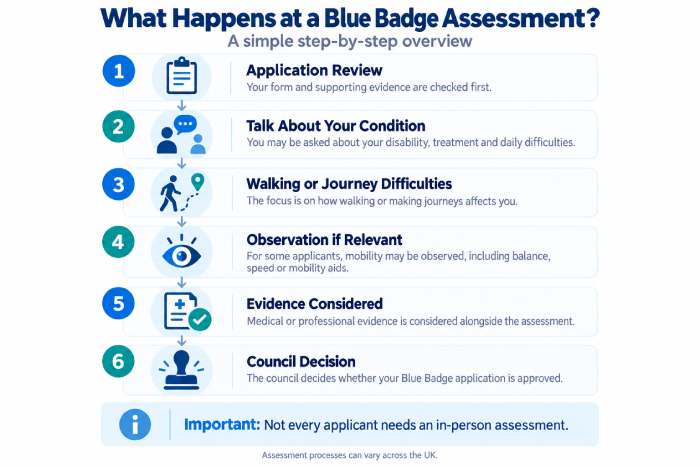
The assessor may:
- Review information from your application.
- Ask about your disability or health condition.
- Discuss medication, treatment and mobility aids.
- Ask about ordinary journeys and walking difficulties.
- Observe how you move or walk where relevant.
- Consider pain, breathlessness, balance, speed and stopping.
- Consider whether walking creates a serious health risk.
- Consider supporting medical or professional evidence.
- Provide assessment information to the issuing authority.
The professional conducting the assessment does not necessarily hand you a Blue Badge at the appointment. The issuing authority makes the final eligibility decision.
Will I have to walk during the assessment?
Possibly, if your application is mainly based on physical walking difficulty.
An assessor may observe:
- how you stand and begin walking;
- how you walk over a relevant distance;
- your pace;
- your gait;
- your posture;
- your balance;
- your coordination;
- your stride;
- whether you need to stop;
- your use of mobility aids;
- pain or discomfort;
- and breathlessness or exertion.
The exact assessment is determined locally.
Is there a fixed Blue Badge walking test?
No. There is not one standard UK-wide walking test that every applicant must pass.
Assessment procedures vary by nation, authority and eligibility route.
In England, Department for Transport guidance gives councils factors they may consider when assessing walking difficulty, including:
- walking distance;
- walking speed;
- how long you can walk;
- pain;
- breathlessness;
- manner of walking;
- mobility aids;
- outdoor walking ability;
- and danger to health caused by walking.
But councils determine their own appropriate assessment procedures within the scheme rules.
How far will I be asked to walk?
There is no guaranteed assessment distance.
Do not assume the assessor will simply ask you to walk exactly 20, 30, 50 or 80 metres.
For England, DfT guidance uses several distance indicators when considering physical walking difficulty:
- being unable to walk 30 metres in total is a strong indicator of very considerable walking difficulty;
- someone walking between 30 and 80 metres can still qualify when other factors create very considerable difficulty;
- distance must be considered alongside pain, breathlessness, speed, manner of walking and other relevant factors.
These are assessment indicators, not instructions for what you should try to achieve during your appointment.
Other UK nations use their own assessment guidance.
Will they time how fast I walk?
They may.
For a physical mobility assessment, walking speed can be relevant.
England’s DfT guidance states that a typical adult walking pace can be compared with the applicant’s actual pace and gives specific reference ranges.
It also says that a pace below approximately 40 metres per minute, including stops, is extremely slow and may be relevant to determining very considerable walking difficulty.
However, speed is only one part of the assessment.
You may still have very considerable difficulty because of:
- severe pain;
- breathlessness;
- poor balance;
- abnormal gait;
- frequent stopping;
- risk to health;
- or other relevant factors.
Will the assessor look at pain?
Yes, where pain is relevant to your walking difficulty.
The assessor may ask:
- where the pain occurs;
- when it starts;
- how severe it becomes;
- whether you have to stop;
- what medication you use;
- what treatment you receive;
- and whether the pain continues after walking.
Official guidance recognises that pain can happen during walking or as a direct consequence of the effort involved.
If your pain becomes worse later, explain that rather than assuming only symptoms visible during the appointment count.
Will they assess breathlessness?
Yes, if breathlessness is part of your mobility difficulty.
The assessor may consider:
- how quickly breathlessness develops;
- the amount of walking that triggers it;
- whether you need to stop;
- how long recovery takes;
- your respiratory response;
- relevant medication;
- and underlying heart, chest or lung conditions.
In England, DfT guidance specifically recognises applicants who may appear physically able to walk but should not walk far because the effort presents a danger to their health.
Will they look at my mobility aid?
They can consider any aid you normally use, including:
- walking stick;
- crutches;
- walking frame;
- rollator;
- prosthesis;
- wheelchair;
- or physical assistance from another person.
The important point is not simply whether you own or use an aid.
The assessor can consider:
- why you need it;
- how you use it;
- whether it improves your walking;
- and what substantial difficulty remains despite using it.
Should I use my walking stick or usual aid during the assessment?
Use the mobility aid you would normally use for the type of journey being assessed, unless the assessor gives you different instructions.
Do not deliberately:
- leave an aid at home to make your mobility appear worse;
- attempt to walk without an aid when doing so would be unsafe;
- or use equipment that you do not normally rely on simply to influence the assessment.
The aim is to show your genuine functional mobility.
Can they assess you indoors?
Yes.
England’s DfT guidance explicitly says a mobility assessment does not have to take place outdoors.
However, the assessment should allow the professional to form a view about how you would cope when walking outdoors.
Outdoor conditions can involve:
- uneven surfaces;
- slopes;
- kerbs;
- greater distances;
- crowds;
- and changing environmental conditions.
If your indoor mobility differs significantly from your normal outdoor mobility, explain why.
What questions might the assessor ask?
You may be asked about:
- your diagnoses;
- when your disability began;
- whether it is expected to continue;
- your usual walking distance;
- walking time;
- walking speed;
- pain;
- breathlessness;
- falls;
- balance;
- stopping and recovery;
- mobility aids;
- help from another person;
- medication;
- treatment;
- typical journeys;
- good and bad days;
- and what happens after walking.
If you have not already prepared for these types of questions, read how to answer Blue Badge application questions.
What happens if your condition fluctuates?
A short appointment may not capture every aspect of a fluctuating condition.
Tell the assessor:
- how often your symptoms vary;
- what your normal day is like;
- how frequently bad days occur;
- how long flare-ups last;
- what triggers deterioration;
- and whether your ability at the appointment is typical.
For example, if you can walk further on the day of the assessment than you usually can, say so and explain the normal pattern.
Equally, if the appointment happens on an unusually difficult day, explain that too.
What if I have a non-visible disability?
An ordinary physical walking test may not be the best way to assess a non-visible disability.
This is particularly important in England.
DfT guidance recognises that people with developmental, behavioural or mental-health conditions may:
- experience overwhelming psychological distress;
- be at risk of serious harm;
- pose a serious risk to another person;
- or experience other very considerable difficulties while walking during a journey despite being physically capable of walking.
It also recognises that an in-person mobility assessment can be inappropriate or unnecessarily stressful in some such cases.
How are hidden disabilities assessed?
Rather than relying solely on watching you walk, an authority may consider a combination of:
- your written application;
- additional questions;
- telephone contact;
- care plans;
- medical evidence;
- social-care information;
- information from specialist nurses;
- memory-clinic evidence;
- information from schools or relevant professionals;
- existing council records where appropriate;
- and expert professional insight.
The assessment should focus on what happens during the journey between the vehicle and destination.
What might they ask about psychological distress?
Relevant questions can cover:
- what situations cause severe distress;
- what happens during an episode;
- how frequently it occurs;
- whether you avoid journeys;
- whether busy or open environments create overwhelming fear;
- whether another person must reassure or guide you;
- which coping strategies you use;
- and whether those strategies work reliably.
How is serious risk assessed?
If your application is based on serious risk during a journey, the authority may need to understand:
- what the risk is;
- who is at risk;
- how serious the potential harm is;
- how often the behaviour or situation occurs;
- what triggers it;
- whether another person can prevent it;
- and how parking closer to the destination would reduce the problem.
Relevant evidence can be particularly important for non-visible conditions. See what medical evidence can support a Blue Badge application.
Can someone come to the Blue Badge assessment with me?
Ask the authority arranging your appointment.
Where assistance is genuinely needed, you should tell the assessment service beforehand.
This can be particularly important if you need:
- physical assistance;
- communication support;
- help understanding questions;
- support because of cognitive impairment;
- or reassurance because of severe distress.
If another person regularly helps you during journeys, their role can also be relevant to understanding your normal circumstances.
Can I request reasonable adjustments?
If you have accessibility or communication needs, tell the council or assessment provider when the appointment is arranged.
Depending on your needs and the service available, appropriate arrangements could relate to:
- physical access;
- communication;
- information format;
- support from another person;
- or whether an alternative assessment approach would be more appropriate.
This is especially important where a face-to-face assessment itself could create substantial distress.
What should I bring to a Blue Badge assessment?
Follow your appointment letter first.
Depending on what the authority requests, useful items may include:
- the assessment appointment letter;
- identification;
- your current Blue Badge if reapplying;
- your usual mobility aid;
- relevant medication information;
- additional medical or professional evidence requested by the authority;
- and any information specifically listed in the appointment instructions.
Do not turn up with your entire medical history unless you have been asked to provide it.
Relevant evidence is normally more useful than a large amount of unrelated paperwork.
Should I prepare examples before the assessment?
Yes — real examples can help you explain your circumstances accurately.
Think about ordinary journeys such as:
- car park to supermarket;
- vehicle to hospital entrance;
- home to car;
- car to school;
- or another journey you regularly make.
Be ready to explain:
- distance;
- time;
- stops;
- symptoms;
- mobility aids;
- support;
- risks;
- and after-effects.
Do not memorise a script. The purpose is simply to avoid forgetting relevant details under pressure.
Should I practise walking before my assessment?
You do not need to practise or deliberately push yourself beyond your normal ability.
You should not:
- walk to exhaustion beforehand;
- stop medication;
- avoid your normal mobility aid;
- or deliberately worsen your symptoms.
The assessment needs to reflect your genuine circumstances as safely as possible.
What if walking during the assessment would be unsafe?
Tell the assessor.
Do not deliberately attempt an activity that creates an immediate safety risk merely because you think you have to prove your disability.
Where the effort of walking itself creates a serious health risk, that fact can be directly relevant to Blue Badge eligibility.
Supporting medical evidence may be particularly important in these cases.
Can the assessor stop the walking assessment?
A professional assessment should take account of safety and your observed difficulty.
If you experience:
- severe pain;
- significant breathlessness;
- dizziness;
- loss of balance;
- or another concerning symptom;
tell the assessor immediately rather than attempting to conceal it or continue unsafely.
Can the assessor contact my GP?
The process varies by nation and authority.
In England, councils can consider information from an applicant’s own GP, but DfT guidance says a GP should not be the only evidence used to determine eligibility and cannot fulfil the formal role of expert assessor.
The authority may also obtain insight from:
- occupational therapists;
- physiotherapists;
- specialist nurses;
- social workers;
- mental-health professionals;
- memory clinics;
- or other relevant professionals.
Who carries out a Blue Badge assessment?
This depends on the authority and type of assessment.
For physical mobility assessments in England, DfT guidance describes occupational therapists and physiotherapists as professionals traditionally used for independent mobility assessments.
The broader “expert assessor” framework also allows authorities to use professionals whose expertise is more appropriate to non-visible disabilities.
In Wales, GOV.WALES describes a mobility assessment as a meeting with a healthcare professional.
Scottish councils determine the local assessment arrangements.
Does the assessor decide whether I get the badge?
The final decision belongs to the issuing authority.
An assessor may provide:
- observations;
- professional findings;
- functional mobility information;
- or expert insight.
The council or relevant Blue Badge authority then determines whether the statutory eligibility criteria are met.
What happens after the assessment?
After the assessment, the authority will consider:
- your original application;
- supporting evidence;
- any additional information;
- assessment findings;
- and the applicable eligibility criteria.
You will then receive a decision.
The exact timing varies by nation and authority.
See how long a Blue Badge application takes.
Does being invited to an assessment mean I will be approved?
No.
An assessment means the authority needs further information to decide your application.
The eventual outcome could be:
- approval;
- a request for more information;
- or refusal if the authority concludes that the eligibility criteria are not met.
Does being called for an assessment mean something is wrong with my application?
No.
Applicants who do not qualify automatically can legitimately require further assessment.
An appointment does not by itself mean:
- the authority thinks you are lying;
- your medical evidence has been rejected;
- or your application will fail.
It simply means that more information is needed before the decision can be made.
Can you fail a Blue Badge mobility assessment?
It is more accurate to say that the authority may decide that you do not meet the Blue Badge eligibility criteria.
There is not necessarily a simple pass/fail physical test.
The assessment forms part of the evidence considered by the authority.
Someone may walk a particular distance but still have relevant very considerable difficulty because of:
- severe pain;
- breathlessness;
- very slow pace;
- manner of walking;
- serious health risk;
- psychological distress;
- or another applicable criterion.
What if my application is refused after the assessment?
Read the decision letter carefully.
It should explain why the authority decided you did not meet the eligibility criteria and what options are available.
Depending on the nation and authority, the next process may be described as:
- a review;
- reconsideration;
- or reassessment.
There is not one universal UK Blue Badge appeal tribunal.
See what to do if your Blue Badge application is refused.
What happens at a Blue Badge assessment in England?
England distinguishes between people who are:
- eligible without further assessment; and
- eligible subject to further assessment.
For applications requiring further assessment, the council first reviews the information provided.
DfT guidance says an expert assessor would normally be expected only where the council cannot satisfy itself from the evidence that the applicant does or does not meet the criteria.
This means an England assessment can involve:
- desk-based review;
- contacting the applicant;
- considering existing relevant records;
- seeking information from healthcare or social-care professionals;
- expert assessment;
- or an in-person mobility assessment.
Physical conditions in England
For primarily physical walking difficulties, relevant factors can include:
- distance;
- speed;
- walking duration;
- pain;
- breathlessness;
- posture;
- rhythm;
- coordination;
- balance;
- stride;
- mobility aids;
- and danger to health.
Non-visible disabilities in England
DfT guidance says an in-person physical mobility assessment may be less appropriate where the main problem is:
- very considerable psychological distress;
- or risk of serious harm to the applicant or another person.
In these cases, councils can use additional information and professional evidence rather than relying solely on observing physical walking.
See Blue Badge applications in England.
What happens at a Blue Badge assessment in Scotland?
Your Scottish local council decides whether you qualify.
mygov.scot states that if you do not automatically qualify, the council may ask you to:
- provide documents about your condition;
- or have a mobility assessment.
There is no single Scotland-wide description saying that every mobility assessment must follow one identical appointment format.
Follow the instructions sent by your local council.
Most Scottish councils take around 12 weeks to decide an application, although cases can take longer.
See how to apply for a Blue Badge in Scotland.
What happens at a Blue Badge assessment in Wales?
Welsh Government gives a clear description:
A mobility assessment is a meeting with a healthcare professional who checks:
- whether you are eligible for a Blue Badge;
- and whether you are receiving the support you need to get around.
Your council will tell you if you need to attend one.
Welsh assessment guidance can consider:
- walking aids;
- pain during and after walking;
- breathlessness;
- walking distance;
- oxygen use;
- relevant medication;
- and healthcare-professional evidence.
Welsh Government recommends using appropriate healthcare-professional evidence and not relying solely on generic GP letters.
Wales also has an Independent Assessment Service for some cases, including certain temporary mobility applications and other applications referred for specialist advice.
See how to apply for a Blue Badge in Wales.
What happens at a Blue Badge assessment in Northern Ireland?
Northern Ireland uses a different system administered by the Department for Infrastructure Blue Badge Unit.
nidirect does not describe one standard face-to-face mobility assessment that every assessed applicant must attend.
Instead, where you apply because:
- a permanent disability means you cannot walk or have a lot of difficulty walking;
- or planning and following a journey would cause overwhelming psychological distress and you need another person’s help;
- or you could be a danger to yourself or others;
a doctor may be asked to confirm your eligibility.
If more information is required, including a GP referral, the Blue Badge Unit will contact you and the application can take longer than the usual 6 to 8 weeks.
See how to apply for a Blue Badge in Northern Ireland.
Blue Badge assessment rules across the UK
| Nation | Can an assessment be required? | Key point |
|---|---|---|
| England | Yes | Can be desk-based, professional evidence review or in-person; expert assessor generally used when evidence is insufficient to decide. |
| Scotland | Yes | Council may ask for condition evidence or a mobility assessment. |
| Wales | Yes | Mobility assessment is a meeting with a healthcare professional; specialist independent assessment can be used in some cases. |
| Northern Ireland | Further assessment/evidence can be required | A doctor may be asked to confirm assessed eligibility; nidirect does not describe one universal face-to-face mobility test. |
Blue Badge assessment checklist
Before your appointment:
- ☑ Read the appointment instructions carefully.
- ☑ Check where and when the assessment takes place.
- ☑ Tell the service about accessibility or communication needs.
- ☑ Use your normal mobility aid.
- ☑ Take only documents requested or genuinely relevant.
- ☑ Know your current medication and treatment.
- ☑ Think about ordinary real-world journeys.
- ☑ Be ready to describe distance, time, pain and breathlessness.
- ☑ Explain stops and recovery.
- ☑ Explain good and bad days accurately.
- ☑ Explain after-effects that may not be visible during the appointment.
- ☑ For non-visible disabilities, explain distress, risk and support needs.
- ☑ Do not push yourself into an unsafe activity.
- ☑ Do not exaggerate or minimise your difficulties.
Related Blue Badge application guides
- How to answer Blue Badge application questions
- What medical evidence do you need?
- Documents needed for a Blue Badge application
- How to apply for a Blue Badge online
- How long a Blue Badge application takes
- How to check your application status
- What to do if your Blue Badge application is refused
Official Blue Badge assessment guidance
- GOV.UK — Blue Badge assessment guidance for England
- mygov.scot — Blue Badge applications and mobility assessments
- GOV.WALES — What happens after you apply
- GOV.WALES — Blue Badge assessment guidance
- nidirect — Northern Ireland Blue Badge eligibility criteria
- nidirect — Northern Ireland application and further evidence
The bottom line
A Blue Badge assessment is not one universal UK walking test, and many applicants never need a face-to-face assessment at all.
If further assessment is required, the authority may:
- review your application and evidence;
- ask additional questions;
- seek professional evidence;
- contact you by phone;
- or arrange an in-person mobility assessment.
For a physical mobility assessment, expect the focus to be on your real walking difficulty — including distance, speed, pain, breathlessness, balance, stopping, mobility aids and any danger to your health.
For a non-visible disability, authorities can use other evidence to understand psychological distress, serious risk and the support you need during journeys. A physical walking test may not be appropriate.
Attend as you normally are, use your normal aids, explain your typical circumstances accurately and do not deliberately push yourself beyond what is safe.
Frequently asked questions
What happens at a Blue Badge assessment?
The assessor or authority reviews how your disability affects walking or journeys. Depending on your case, this can involve questions about your condition, medication, treatment, distance, pain, breathlessness, mobility aids, support and safety, and may include observation of your walking.
Does everyone have to attend a Blue Badge assessment?
No. Many applications are decided from the application and supporting evidence alone. Further assessment is generally used when the authority needs more information before it can decide whether the eligibility criteria are met.
Will I have to walk at a Blue Badge assessment?
Possibly, particularly where your application is based on physical walking difficulty. The assessor may observe your distance, speed, manner of walking, balance, stopping, pain, breathlessness and mobility aids. A physical walking test may be inappropriate for some non-visible disabilities.
How far do you have to walk in a Blue Badge assessment?
There is no single UK-wide test distance. England uses distance alongside factors such as speed, pain, breathlessness, gait and stopping when assessing physical walking difficulty. Other UK nations have their own assessment arrangements.
Can you fail a Blue Badge walking assessment?
The process is not simply a pass-or-fail walking test. The issuing authority decides whether the overall evidence shows that you meet the Blue Badge eligibility criteria.
What should I bring to a Blue Badge assessment?
Follow your appointment instructions. You may need identification, your normal mobility aid, relevant medication information and any additional medical or professional evidence specifically requested by the authority.
Should I use my walking stick during the assessment?
If you normally use a walking stick or another aid for that type of journey, use it unless the assessor instructs otherwise. The assessment should reflect your normal functional mobility rather than an artificially worsened or improved situation.
What if I am having a good day at the assessment?
Explain that your condition fluctuates and describe your typical pattern, including how often worse days occur, what changes and how long flare-ups last. The authority should consider the broader evidence rather than one moment in isolation.
What if I cannot safely complete the walking assessment?
Tell the assessor. Do not deliberately continue an activity that presents an immediate safety risk. If walking itself creates a serious health risk, that information and relevant medical evidence may be important to your eligibility assessment.
Are hidden disabilities assessed differently?
They can be. For non-visible conditions, a physical walking test may not show the actual difficulty. Authorities may instead consider psychological distress, serious risk, supervision needs, supporting evidence and information from relevant professionals.
Who carries out a Blue Badge mobility assessment?
This varies. Physical mobility assessments may be carried out by professionals such as occupational therapists, physiotherapists or other healthcare professionals. The appropriate professional depends on the authority and the type of disability being assessed.
Does the assessor make the final decision?
The final Blue Badge eligibility decision is made by the issuing authority. The assessor provides evidence, observations or professional insight that can inform that decision.
How long after a Blue Badge assessment will I get a decision?
There is no single UK-wide post-assessment deadline. The assessment forms part of the overall application process, and processing times vary by nation and authority.
What happens if I am refused after the assessment?
You should receive reasons for the decision and information about what you can do next. Depending on the nation and authority, you may be able to request a review, reconsideration or reassessment.