

The best medical evidence for a Blue Badge application does more than confirm your diagnosis.
It should help show how your disability or health condition affects your ability to walk, complete journeys safely, manage pain or breathlessness, or avoid serious harm.
Useful evidence can include consultant or clinic letters, occupational therapy or physiotherapy reports, care plans, patient summaries, prescriptions, treatment information, mobility assessments and evidence from other health or social-care professionals who understand your difficulties.
You do not always need medical evidence. If you qualify automatically through a recognised benefit or another automatic eligibility route, benefit evidence or electronic verification may be enough. Medical evidence becomes particularly important when the authority needs to assess the functional effect of your condition.
What medical evidence do I need for a Blue Badge?
There is no single medical document that every Blue Badge applicant must provide.
The evidence depends on:
- which part of the UK you live in;
- which eligibility route you are using;
- whether you qualify automatically;
- whether your difficulties are physical, non-visible or both;
- and whether the issuing authority already has enough evidence to make a decision.
If your eligibility needs further assessment, useful medical or professional evidence may include:
- consultant or specialist letters;
- clinic letters;
- patient summaries;
- occupational therapy reports;
- physiotherapy reports;
- mobility assessments;
- care plans;
- treatment plans;
- prescriptions or medication records;
- evidence from a specialist nurse;
- evidence from a mental-health professional;
- information from a memory clinic;
- relevant social-care evidence;
- or other professional evidence explaining how your disability affects you.
What counts as good Blue Badge medical evidence?
Good evidence connects your condition to the actual Blue Badge eligibility difficulty.
It should help answer questions such as:
- How far can you walk?
- How long can you walk for?
- How quickly do you walk?
- Do you experience severe pain?
- Do you become breathless?
- How often must you stop?
- Do you need a walking aid?
- Do you need another person’s assistance?
- Are you at risk of falling?
- Does walking create a serious risk to your health?
- What happens after you walk?
- Does a non-visible disability cause overwhelming distress?
- Do journeys create a risk of serious harm?
- What supervision or support do you require?
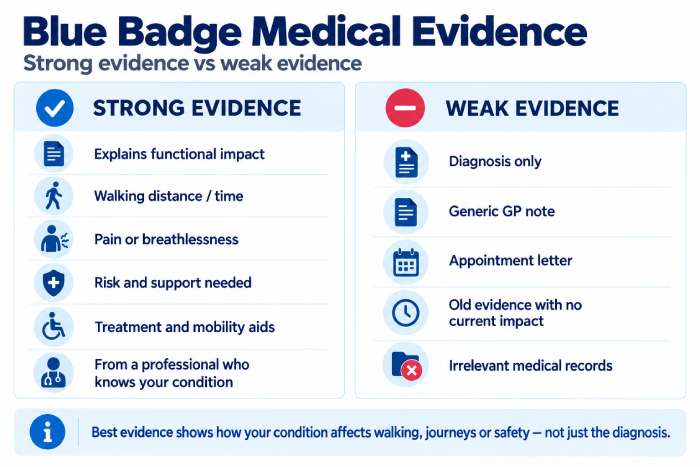
For example, compare these two types of evidence:
Less useful:
“The patient has arthritis.”
Much more useful:
“The patient’s condition causes significant pain and reduced mobility when walking. They normally require a walking aid, need to stop frequently and have difficulty walking from standard parking areas to their destination.”
The second statement gives the issuing authority information that relates directly to mobility.
A diagnosis alone does not prove Blue Badge eligibility
There is no universal list of diagnoses that automatically produces a Blue Badge.
Two people with the same diagnosis can experience very different levels of mobility difficulty.
For applicants who need further assessment, the issuing authority is interested in the functional effect of the disability.
This means a diagnosis letter can be useful, but it is usually stronger when combined with information about:
- walking ability;
- pain;
- breathlessness;
- balance;
- risk;
- journey difficulties;
- treatment;
- mobility aids;
- and assistance from other people.
For a broader explanation, see what illnesses and conditions can qualify for a Blue Badge.
What is weak Blue Badge medical evidence?
Evidence may be less useful if it:
- only names your diagnosis;
- does not describe your mobility or journey difficulties;
- is an appointment letter rather than clinical evidence;
- contains no information about your functional limitations;
- is unrelated to the reason you are applying;
- is so old that it no longer reflects your current circumstances;
- contradicts important parts of your application without explanation;
- or contains large amounts of medical information that do not help establish Blue Badge eligibility.
More paperwork is not necessarily better evidence.
A small number of relevant documents can be more useful than dozens of pages of unrelated medical records.
Who can provide useful medical evidence?
Evidence does not always have to come from your GP.
Depending on your condition, useful evidence may come from:
- a hospital consultant;
- a specialist doctor;
- a specialist nurse;
- a physiotherapist;
- an occupational therapist;
- a pain clinic;
- a respiratory service;
- a cardiac service;
- a community psychiatric nurse;
- a psychiatrist;
- a psychologist;
- a behavioural therapist;
- a memory clinic;
- a social worker;
- a care worker or key worker;
- a mobility service;
- or another professional involved in your treatment or support.
The most useful professional is often the one who can best explain the difficulty relevant to your application.
Do I need a letter from my GP?
No. A GP letter is not a universal Blue Badge requirement.
This is particularly important because applicants are sometimes told to pay for a private GP letter before finding out whether the council actually needs one.
England
Department for Transport guidance says councils may consider information from an applicant’s GP, but a GP should not be the only source of evidence used to determine eligibility.
A GP also cannot perform the statutory role of an expert assessor simply because they are the applicant’s doctor.
GP evidence can still be helpful where it provides context about how a person’s disability affects them.
Wales
Welsh Government guidance goes further and recommends that local authorities should not rely on GP letters when deciding walking-difficulty applications.
The reason is that Blue Badge eligibility depends on functional mobility rather than diagnosis alone.
Welsh guidance recommends using relevant evidence from health professionals involved in areas such as mobility, rehabilitation and specialist treatment.
Scotland
Scottish councils decide individual applications. If you do not qualify automatically, your council may ask you to provide documents about your condition or attend a mobility assessment.
The exact evidence requested therefore depends on your local authority and circumstances.
Northern Ireland
In Northern Ireland, nidirect says a doctor may be asked to confirm eligibility for applicants applying because they cannot walk, have great difficulty walking, or have relevant planning-and-following-journey difficulties.
If more supporting information such as a GP referral is required, the application can take longer.
Should I pay for a GP letter before applying?
Usually, check what your issuing authority wants first.
A paid GP letter is not automatically required and may not be the strongest evidence available.
Before requesting one:
- check your council or Blue Badge authority’s evidence instructions;
- look at documents you already have;
- consider whether a specialist, therapist or clinic already has more relevant evidence;
- and only obtain additional documentation where it will genuinely help demonstrate eligibility.
What evidence should I provide for walking difficulties?
If your application is based on being unable to walk or experiencing very considerable difficulty walking, evidence should help describe your real-world walking ability.
Relevant evidence can address:
Walking distance
Evidence can support how far you can normally walk before your difficulty becomes severe.
Do not focus only on the longest distance you have ever managed.
The authority needs to understand what walking is realistically like for you.
Walking speed
An extremely slow walking pace may contribute to the overall picture of very considerable difficulty.
Time
Explain how long it takes you to walk a familiar distance and whether you need prolonged stops.
Pain
Evidence can show:
- the condition causing pain;
- pain treatment;
- medication;
- pain-clinic involvement;
- and how pain affects walking.
Pain that occurs after walking can also be relevant if it is a direct result of the effort involved.
Breathlessness
Relevant evidence can connect breathlessness with conditions such as serious respiratory or cardiac disease and explain how exertion affects you.
Balance and falls
Evidence from physiotherapy, falls services, occupational therapy or another relevant service can help describe instability and risk.
Mobility aids
Explain what you use, for example:
- walking stick;
- crutches;
- walking frame;
- prosthesis;
- wheelchair;
- or assistance from another person.
The fact that you use a mobility aid does not automatically prove eligibility, but it can form part of the overall evidence.
What evidence should I provide for pain?
Useful evidence can include:
- pain-clinic reports;
- specialist correspondence;
- prescriptions;
- medication lists;
- physiotherapy reports;
- treatment plans;
- or other records showing how pain affects your ability to walk.
What matters is not simply that you experience pain, but how severe the effect is when walking or as a consequence of walking.
What evidence should I provide for breathlessness?
Evidence might include:
- respiratory clinic letters;
- cardiology letters;
- diagnostic information;
- oxygen use;
- medication;
- rehabilitation records;
- or professional information describing the effect of exertion.
In England, official guidance specifically recognises breathlessness and the danger that walking can pose to people with serious chest, lung or heart conditions when assessing walking difficulty.
What if walking is dangerous to my health?
Some people may physically be able to walk but should not walk far because exertion creates a serious health risk.
Evidence should ideally explain:
- the underlying condition;
- why exertion creates a danger;
- what symptoms occur;
- how quickly the risk arises;
- and whether medical intervention is needed if the person’s health deteriorates.
A statement simply saying “the patient should avoid walking” is less informative than professional evidence explaining why.
What medical evidence is useful for a non-visible disability?
A Blue Badge is not restricted to visible physical disabilities.
If a non-visible condition affects journeys, supporting evidence should help describe what happens between the vehicle and the destination.
Depending on the relevant national criteria, evidence may explain:
- very considerable or overwhelming psychological distress;
- extreme anxiety or fear;
- difficulty following a journey;
- lack of awareness of danger;
- risk around traffic;
- behaviour that presents a serious risk;
- risk of harm to the applicant;
- risk of harm to another person;
- the need for supervision;
- the need for another person’s physical or verbal support;
- or why journeys are abandoned or avoided.
Useful evidence for non-visible disabilities can include
- mental-health service letters;
- psychiatric or psychological reports;
- care plans;
- occupational therapy reports;
- memory-clinic evidence;
- social-care assessments;
- education, health and care plans where relevant;
- behavioural support plans;
- or information from professionals who regularly support the person.
Again, the key is the effect on journeys, not merely the diagnosis.
What evidence is useful for autism?
Autism does not automatically produce a Blue Badge simply because there is a diagnosis.
Where an assessed eligibility route applies, relevant evidence can describe:
- awareness of danger;
- distress near traffic;
- sensory or environmental triggers;
- behavioural responses;
- need for continuous supervision;
- risk of running into traffic;
- difficulty transitioning safely from the car to the destination;
- or other journey-related risks.
Evidence could come from health, social-care or education professionals familiar with the applicant.
What evidence is useful for dementia or cognitive impairment?
Useful evidence may come from:
- a memory clinic;
- geriatric or neurological services;
- occupational therapy;
- social services;
- a specialist nurse;
- or another professional involved in the person’s care.
It can explain issues such as:
- disorientation;
- difficulty following journeys;
- lack of traffic awareness;
- wandering;
- need for supervision;
- and risks that arise between the vehicle and destination.
What evidence should I provide if my condition varies?
Many disabilities fluctuate.
A single good day should not be presented as though it represents every day, and a single unusually bad episode should not be presented as though it happens constantly.
Try to give an accurate picture of:
- how often difficult days occur;
- how your walking changes;
- whether your need for help varies;
- what triggers deterioration;
- how long symptoms last;
- and how this affects typical journeys.
Medical or professional evidence that confirms this variability can be useful.
For help describing this accurately in the form, see how to answer Blue Badge application questions.
Does medication count as medical evidence?
Medication can support an application, but medication alone does not normally establish eligibility.
England’s official application process asks applicants who need assessment about relevant medication and treatment.
Medication can help support:
- the severity or ongoing management of a condition;
- pain treatment;
- respiratory or cardiac treatment;
- mental-health treatment;
- or another difficulty relevant to the application.
But the authority still needs to understand how your disability affects your mobility or journeys.
Do treatment records help?
Yes, when they are relevant.
Examples include:
- physiotherapy;
- occupational therapy;
- pain management;
- respiratory rehabilitation;
- cardiac rehabilitation;
- mental-health treatment;
- surgery or planned surgery;
- rehabilitation programmes;
- specialist clinic involvement;
- or mobility services.
A treatment record is most useful when it provides context about the problem relevant to Blue Badge eligibility.
How recent should medical evidence be?
There is no universal UK rule saying all Blue Badge medical evidence must have been written within a specific number of months.
What matters is whether the evidence still accurately describes your current circumstances.
For example:
- an older diagnosis document may still be relevant for a lifelong condition;
- a recent clinic letter may be more useful for showing current mobility;
- and updated evidence may be particularly important if your condition has significantly changed.
Follow any specific date requirements given by your council or issuing authority.
Should I upload my entire medical record?
Usually not unless the authority specifically asks for it.
Choose evidence that directly helps demonstrate eligibility.
A huge medical file can contain:
- irrelevant consultations;
- unrelated diagnoses;
- old information;
- or sensitive information that does not assist the Blue Badge decision.
Relevant evidence is generally more useful than simply submitting the largest amount possible.
What medical evidence is needed in England?
For applicants who do not qualify automatically, GOV.UK says you can be asked for details of:
- relevant medication;
- relevant treatments;
- healthcare or associated professionals involved in your treatment;
- and how your condition affects walking or journeys.
You can also upload supporting documents such as:
- prescriptions;
- diagnosis letters;
- care plans;
- patient summaries;
- professional correspondence;
- education, health and care plans where relevant;
- or other supporting evidence.
The Department for Transport specifically says eligibility is not determined solely by the presence or absence of a particular diagnosis.
For England-specific rules, see how to apply for a Blue Badge in England.
What medical evidence is needed in Scotland?
Scottish local councils make individual Blue Badge eligibility decisions.
mygov.scot says that if you do not automatically qualify, your council may ask you to:
- provide documents about your condition; or
- have a mobility assessment.
Even applicants who automatically qualify may sometimes need to provide copies of documents relating to benefit payments or health.
The exact medical evidence therefore depends on your council and eligibility route.
If you are applying because you are considered at risk in traffic, you must contact the Scottish council directly rather than use the normal online route.
See how to apply for a Blue Badge in Scotland.
What medical evidence is needed in Wales?
Welsh Government guidance is particularly detailed about medical evidence.
For assessed applications, local authorities should consider relevant healthcare-professional evidence such as:
- reports;
- clinical letters;
- summaries;
- functional assessments;
- hospital consultant or specialist evidence;
- physiotherapy;
- occupational therapy;
- specialist nursing;
- pain-clinic evidence;
- community psychiatric nursing;
- memory-clinic evidence;
- psychological or behavioural evidence;
- and relevant social-care evidence.
An appointment letter by itself is not the same as healthcare evidence describing your condition and functional difficulties.
Temporary Blue Badges in Wales
Wales also has a temporary eligibility category for some serious illnesses or injuries.
Evidence should help demonstrate:
- that you cannot walk or have considerable difficulty walking;
- and that the impairment is expected to last for at least 12 months.
This can involve evidence from:
- consultants;
- specialists;
- therapists;
- hospital rehabilitation teams;
- specialist nurses;
- or social services involved in rehabilitation.
See how to apply for a Blue Badge in Wales.
What medical evidence is needed in Northern Ireland?
Northern Ireland uses the separate nidirect Blue Badge system.
Individual applicants can upload:
- a letter of award or entitlement where applying through an automatic benefit route; or
- supporting medical evidence where relevant.
nidirect states that a doctor may be asked to confirm eligibility if:
- you have a permanent disability that means you cannot walk or have a lot of difficulty walking; or
- you have difficulty planning and following journeys because of overwhelming psychological distress or risk to yourself or others.
If the Blue Badge Unit needs additional information, including a GP referral, the application can take longer than the normal 6 to 8 weeks.
See how to apply for a Blue Badge in Northern Ireland.
Do I need medical evidence if I qualify automatically?
Not necessarily.
If you meet an automatic eligibility criterion, the authority may be able to establish your entitlement from benefit or registration evidence.
For example, some automatic routes use:
- PIP;
- DLA;
- ADP in Scotland;
- Child Disability Payment in Scotland;
- War Pensioners’ Mobility Supplement;
- Armed Forces compensation;
- or severe sight-impairment registration.
However, the documents used to prove these routes vary by nation.
See Blue Badge eligibility through PIP and the full Blue Badge document checklist.
What if I do not have medical evidence?
Do not invent evidence or exaggerate your circumstances.
If you do not already have suitable supporting documents:
- complete the application accurately;
- identify the healthcare or social-care professionals involved in your treatment;
- provide any relevant documents you already have;
- follow requests from the issuing authority;
- and attend an assessment if one is required.
Depending on the nation and authority, the council may:
- request additional documents;
- check existing records;
- seek information from a relevant professional;
- or arrange an independent or mobility assessment.
See what happens at a Blue Badge assessment.
Can the council contact my doctor or healthcare professional?
Potentially, where the process allows it and appropriate consent has been obtained.
Blue Badge application forms can ask for:
- the names of professionals involved in your care;
- their contact details;
- and permission to obtain or check relevant information.
Authorities may use professional evidence when the information supplied with the application is insufficient to make a decision.
What should a supporting letter say?
If a healthcare or social-care professional is providing a supporting letter, it is more useful when it covers factual information such as:
- the condition or disability;
- how long it has affected you;
- whether it is expected to continue;
- relevant treatment;
- medication;
- mobility aids;
- walking limitations;
- pain or breathlessness;
- safety risks;
- journey difficulties;
- support from another person;
- and any other functional effect relevant to the Blue Badge criteria.
The professional does not necessarily need to write:
“This person should receive a Blue Badge.”
The final eligibility decision belongs to the issuing authority.
A factual description of your functional difficulties can be more valuable.
Should my evidence match my application answers?
It should be consistent with the circumstances you honestly describe.
Small differences are normal — medical records and personal experiences are not written for the same purpose.
But major unexplained contradictions can make an application harder to assess.
For example, if your application says you can usually walk only a very short distance but a recent clinical report records significantly greater mobility, explain whether:
- your condition has worsened;
- the assessment took place on an unusually good day;
- the clinical distance was achieved with pain or assistance;
- or the report measured something different from ordinary outdoor walking.
Be accurate rather than trying to make every document use identical wording.
Medical evidence checklist
Before submitting, ask:
- ☑ Does the evidence relate to the condition I am relying on?
- ☑ Does it explain functional impact rather than diagnosis alone?
- ☑ Does it describe walking or journey difficulties?
- ☑ Does it support relevant pain, breathlessness or safety problems?
- ☑ Does it describe support or mobility aids where relevant?
- ☑ Is the evidence still representative of my current circumstances?
- ☑ Is every uploaded page readable?
- ☑ Have I included relevant treatment or medication information?
- ☑ Have I avoided uploading large amounts of irrelevant medical information?
- ☑ Have I followed the evidence instructions for my nation and authority?
Related Blue Badge application guides
- What documents do I need for a Blue Badge application?
- How to answer Blue Badge application questions
- What happens at a Blue Badge assessment?
- How to apply for a Blue Badge online
- Can I get a Blue Badge on PIP?
- What illnesses qualify for a Blue Badge?
- Common Blue Badge application mistakes
Official guidance on Blue Badge medical evidence
- GOV.UK — Blue Badge eligibility and supporting information
- GOV.UK — Blue Badge local authority guidance for England
- mygov.scot — Blue Badge documents and assessment
- GOV.WALES — Blue Badge evidence and assessment guidance
- nidirect — Northern Ireland Blue Badge eligibility criteria
- nidirect — Supporting evidence for a Northern Ireland application
The bottom line
The strongest Blue Badge medical evidence explains how your disability affects your mobility or journeys — not simply what your diagnosis is called.
Useful evidence can show:
- how far and how long you can walk;
- pain or breathlessness;
- walking speed and need for rest;
- mobility aids;
- risk of falling or serious harm;
- psychological distress;
- journey-related risks;
- support from another person;
- treatment and medication;
- and how long the difficulty is expected to continue.
You do not automatically need a GP letter, and a diagnosis alone does not necessarily prove eligibility. Use relevant evidence from the professionals who best understand the functional problem you are relying on, and follow the specific evidence instructions of the authority deciding your application.
Frequently asked questions
What medical evidence do I need for a Blue Badge?
If your eligibility requires assessment, useful evidence can include consultant or clinic letters, care plans, patient summaries, physiotherapy or occupational therapy reports, prescriptions, treatment information and other professional evidence explaining how your condition affects walking, journeys or safety.
Do I need a doctor’s letter for a Blue Badge?
No universal UK rule requires every applicant to provide a doctor’s letter. In England, GP evidence can be considered but should not be the only evidence used to determine eligibility. Wales recommends that councils should not rely on GP letters for walking-difficulty decisions. Northern Ireland may ask a doctor to confirm eligibility in some assessed cases.
Is a diagnosis letter enough for a Blue Badge?
Not necessarily. A diagnosis letter can support your application, but assessed eligibility normally depends on how the disability affects your mobility, walking, journeys or safety. Evidence describing functional impact is generally more useful than diagnosis alone.
What is the best evidence for walking difficulty?
Useful evidence explains walking distance, speed, duration, pain, breathlessness, stopping, balance, mobility aids, assistance and any after-effects or health risks caused by walking.
Can a physiotherapist provide Blue Badge evidence?
Yes. Physiotherapy evidence can be particularly useful where the physiotherapist understands your walking ability, balance, gait, mobility aids or rehabilitation.
Can an occupational therapist provide Blue Badge evidence?
Yes. Occupational therapists can provide relevant functional evidence about mobility, independence, safety and the practical impact of a disability.
Can a mental-health professional provide evidence?
Yes. For applications involving non-visible disabilities, evidence from psychiatrists, psychologists, community mental-health professionals or other relevant practitioners can help explain psychological distress, risk and journey difficulties.
Do I need medical evidence if I get PIP?
Not necessarily. If your PIP award meets an automatic Blue Badge criterion in your nation, benefit evidence or verification may establish eligibility. The automatic PIP rules and evidence processes differ between England, Scotland, Wales and Northern Ireland.
How recent should Blue Badge medical evidence be?
There is no universal UK age limit for all medical evidence. It should be relevant to your current circumstances. Older evidence can remain useful for lifelong conditions, but updated evidence can be important if your mobility or needs have changed.
Should I send my whole medical record?
Usually not unless specifically requested. Relevant documents explaining the disability and its functional effect are normally more useful than a large volume of unrelated medical records.
What if I have no medical evidence?
Complete the application accurately and provide the information you already have. The issuing authority may request more evidence, check other relevant records, contact professionals where appropriate or arrange an assessment if it cannot decide from the information supplied.
Can a GP decide whether I qualify for a Blue Badge?
No. The final eligibility decision is made by the issuing authority. A GP or other professional can provide evidence about your condition and functional difficulties, but they do not normally make the Blue Badge decision themselves.
What evidence is useful for a hidden disability?
Useful evidence explains how the condition affects journeys, including psychological distress, awareness of danger, risk of serious harm, behavioural difficulties, supervision needs or support required between the vehicle and destination.