


You should renew — officially, reapply for — your Blue Badge before the current badge expires, but the correct time to start is not the same throughout the UK.
Scotland recommends reapplying at least 12 weeks before expiry, Wales allows you to reapply 12 weeks before expiry, Northern Ireland allows reapplication up to 8 weeks before expiry, while in England you should apply before expiry and check your council’s recommended renewal window.
A Blue Badge usually lasts for up to 3 years and does not renew automatically. Once the expiry date passes, you should not continue using the old badge while waiting for a new one.
If you want the complete reapplication process rather than just the timing, see our full Blue Badge renewal guide.
When should you renew a Blue Badge? UK comparison
| Nation | When to reapply | General processing guidance |
|---|---|---|
| England | Before your badge expires; GOV.UK advises applying some weeks before and council guidance can vary | Councils usually make a decision within 12 weeks, although it can take longer |
| Scotland | At least 12 weeks before expiry | Most councils take around 12 weeks, but it can take longer |
| Wales | 12 weeks before expiry | A decision usually takes around 12 weeks |
| Northern Ireland | Up to 8 weeks before expiry | Normally 6 to 8 weeks, but longer if more information is required |
The key point: do not use a blanket “renew exactly 12 weeks before expiry” rule for everyone in the UK.
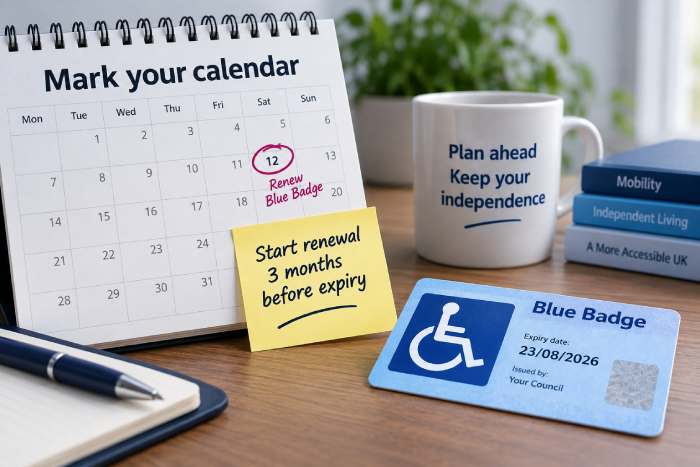
How long does a Blue Badge last?
A Blue Badge usually lasts for up to 3 years.
However, some badges can have a shorter validity period depending on:
- the eligibility route;
- the duration of a qualifying entitlement;
- or the type of badge issued.
For example, Wales also has a specific temporary qualification route under which a Blue Badge can be issued for 12 months.
The date that matters for you is the expiry date printed on your own badge.
When to renew a Blue Badge in England
In England, you must reapply before your current Blue Badge expires.
Official GOV.UK guidance says you should reapply through your local council some weeks before it runs out.
There is not a single national rule requiring every English badge holder to submit a reapplication exactly 12 weeks before expiry.
Because GOV.UK says councils usually make a decision within 12 weeks, it is sensible to check your council’s current renewal guidance early.
Your council may specify:
- how early it accepts reapplications;
- its current processing time;
- what evidence it requires;
- and how payment is handled.
For the England-specific application rules, see how to apply or reapply for a Blue Badge in England.
When to renew a Blue Badge in Scotland
Scotland has particularly clear official guidance.
mygov.scot says:
Reapply at least 12 weeks before your Blue Badge expires if you still need one.
Most Scottish councils take around 12 weeks to make a decision, although applications can take longer.
This means waiting until only a few weeks remain on your badge creates a real risk that the current badge will expire before the new application is decided.
See how to apply or reapply for a Blue Badge in Scotland.
When to renew a Blue Badge in Wales
In Wales, official Blue Badge guidance says you can reapply 12 weeks before your badge runs out.
Welsh Government also says an application can take around 12 weeks to process.
Starting at the beginning of that 12-week window is therefore the safest approach if you want to reduce the risk of being left without a valid badge.
A standard Welsh Blue Badge is usually valid for 3 years, although temporary Blue Badges can have a shorter validity period.
See how to apply or reapply for a Blue Badge in Wales.
When to renew a Blue Badge in Northern Ireland
Northern Ireland is different from Great Britain.
nidirect says you can reapply for a Blue Badge up to 8 weeks before it is due to run out.
You should use the Northern Ireland application system through nidirect, not the GOV.UK council service used in England, Scotland and Wales.
The normal published processing time is 6 to 8 weeks, although it can take longer if the Blue Badge Unit needs additional evidence or information.
That means the 8-week renewal window is important: apply when your renewal becomes available rather than waiting until the final weeks.
See how to renew a Blue Badge in Northern Ireland.
Why should you renew before the badge expires?
Submitting your application before expiry does not mean your current badge automatically stays valid until the new one arrives.
Your existing badge is valid only until the expiry date printed on it.
If the current badge expires before the replacement application is approved, you could be left temporarily without Blue Badge parking concessions.
This is why starting at the appropriate time matters.
Can you use a Blue Badge after it expires?
No.
An expired Blue Badge should not continue to be displayed or used as though it were valid.
This applies even if:
- you have already submitted a renewal;
- your application is still being assessed;
- you previously qualified for a badge;
- or the delay is outside your control.
For example, Welsh Government specifically warns that using an expired badge can result in enforcement action, and England and Northern Ireland require expired badges to be returned to the issuing authority.
See what to do if your Blue Badge has expired.
Is there a grace period after a Blue Badge expires?
There is no general UK-wide grace period that allows you to continue using an expired Blue Badge while waiting for a new one.
The expiry date printed on the badge remains the relevant date.
Do not:
- alter the expiry date;
- continue displaying the expired badge;
- or assume that proof of a pending renewal gives you the same parking concessions.
Will your current Blue Badge be extended while you wait?
Not automatically.
Submitting a reapplication does not create a general national extension of your existing badge.
If processing is taking longer than expected:
- check the published processing time for your issuing authority;
- keep your application reference;
- contact the authority if the normal timeframe has passed;
- and do not continue using the badge once it has expired.
See how to check your Blue Badge application or renewal status.
Will you get a reminder to renew your Blue Badge?
You may receive a reminder, but do not rely on one.
Reminder arrangements vary between issuing authorities and systems.
You might receive:
- an email;
- a letter;
- a text message;
- or another courtesy reminder.
But your responsibility is to know the expiry date printed on the badge and reapply at the correct time.
A simple way to avoid forgetting
When you receive a new badge:
- check its expiry date;
- add the date to your phone or calendar;
- set an earlier reminder based on the rules where you live;
- and check official guidance when the reminder appears in case the process has changed.
What if you have already left it too late?
If your badge is close to expiry and you have not reapplied:
- start the correct reapplication as soon as you are allowed to;
- make sure all supporting documents are ready;
- respond quickly to requests for additional evidence;
- keep your confirmation or reference number;
- and contact the issuing authority if you need information about current processing times.
If the badge expires before the new one arrives, stop using the expired badge.
Does renewing early cancel your existing Blue Badge?
No general rule says that submitting a reapplication immediately cancels an otherwise valid current badge.
You can continue using your existing badge while it remains valid and you continue to meet the conditions for its use.
The important date is the expiry date printed on that badge.
Do you have to prove eligibility again when renewing?
Yes, your eligibility can be checked again.
Blue Badge renewal is effectively a reapplication.
You may need to provide:
- your current badge details;
- a new photograph;
- identity and address information;
- current benefit information;
- and supporting evidence if further assessment is needed.
Your circumstances may have changed since your previous application, and having held a badge before does not automatically guarantee another one.
For the complete process, see how to renew a Blue Badge step by step.
How long does a Blue Badge renewal take?
Renewal processing varies across the UK.
- England: councils usually make decisions within 12 weeks, but local times can vary.
- Scotland: most councils take around 12 weeks.
- Wales: around 12 weeks.
- Northern Ireland: normally 6 to 8 weeks.
It can take longer if:
- evidence is incomplete;
- the authority asks for more information;
- benefit entitlement needs checking;
- or an assessment is required.
See how long a Blue Badge application or renewal takes.
Renewal or replacement: which do you need?
Do not confuse renewing an expiring badge with replacing a badge that has been lost, stolen or damaged.
Renewal
Use the reapplication process when your existing badge is approaching expiry.
Replacement
Use the replacement process when the current badge is:
- lost;
- stolen;
- damaged;
- or badly faded.
For England, Scotland and Wales, GOV.UK says that if a lost, stolen or damaged badge is due to expire in less than 3 months, you should reapply rather than request a replacement.
If it has more than 3 months remaining, the replacement process is normally appropriate.
See:
Quick renewal timing checklist
- ☑ Check the expiry date printed on your badge.
- ☑ Do not assume every UK nation uses a 12-week renewal window.
- ☑ England: check your council and reapply before expiry.
- ☑ Scotland: reapply at least 12 weeks before expiry.
- ☑ Wales: reapply 12 weeks before expiry.
- ☑ Northern Ireland: reapply up to 8 weeks before expiry.
- ☑ Do not rely on receiving a renewal reminder.
- ☑ Prepare documents before starting.
- ☑ Keep your application confirmation.
- ☑ Stop using the old badge when it expires.
Related Blue Badge renewal guides
- How to renew a Blue Badge step by step
- What to do if your Blue Badge has expired
- How long a Blue Badge renewal takes
- How to check your renewal status
- Lost, stolen or damaged Blue Badges
- How long a replacement Blue Badge takes
Official renewal information
- GOV.UK — Apply for or reapply for a Blue Badge
- GOV.UK — Reapplying for a Blue Badge in England
- mygov.scot — Blue Badge reapplication timing
- GOV.WALES — Expiry and reapplication rules
- nidirect — Renewing a Blue Badge
The bottom line
Do not wait for your Blue Badge to expire before reapplying, but also do not assume that “12 weeks before expiry” is a universal UK rule.
- England: reapply before expiry and check your council’s current renewal window.
- Scotland: reapply at least 12 weeks before expiry.
- Wales: you can reapply 12 weeks before expiry.
- Northern Ireland: you can reapply up to 8 weeks before expiry.
Your old badge does not automatically stay valid while a new application is being processed. If it reaches its expiry date first, stop using it until you have a valid replacement badge.
Frequently asked questions
When should I renew my Blue Badge?
It depends on where you live. Scotland recommends reapplying at least 12 weeks before expiry, Wales allows reapplication 12 weeks before expiry, Northern Ireland allows you to reapply up to 8 weeks before expiry, and in England you should reapply before expiry and check your council’s recommended timing.
Should everyone renew a Blue Badge 12 weeks before it expires?
No. Twelve weeks is appropriate official guidance in Scotland and Wales, but it is not a universal UK rule. Northern Ireland uses an 8-week reapplication window, while English councils can have different local timing arrangements.
How long does a Blue Badge last?
A Blue Badge usually lasts for up to 3 years, although some badges may have a shorter validity period depending on the applicant’s entitlement or eligibility route.
Will I get a reminder to renew my Blue Badge?
You may receive a reminder from your issuing authority, but reminder arrangements vary and you should not rely on one. Check the expiry date printed on your badge and set your own reminder.
Can I use my Blue Badge after it expires while waiting for a new one?
No. An expired Blue Badge should not continue to be used simply because a reapplication is still being processed.
Is there a grace period after my Blue Badge expires?
There is no general UK-wide grace period allowing continued use of an expired Blue Badge while waiting for a renewal.
Will my Blue Badge automatically be extended if my renewal is delayed?
No general national rule automatically extends the expiry date because a renewal application is pending. The printed expiry date remains the relevant date.
How long does a Blue Badge renewal take?
England, Scotland and Wales commonly advise around 12 weeks for a decision, although individual cases can take longer. Northern Ireland normally advises 6 to 8 weeks.
Does renewing early cancel my current Blue Badge?
Submitting a reapplication does not normally cancel an otherwise valid existing badge. You can continue using it until its printed expiry date, provided it remains valid and is being used correctly.
Do I have to prove my eligibility again?
Yes, your eligibility can be checked again because renewal is effectively a reapplication. Previous ownership of a Blue Badge does not automatically guarantee another one.
Should I renew or replace a lost Blue Badge?
For England, Scotland and Wales, if a lost, stolen or damaged badge has less than 3 months remaining before expiry, GOV.UK says you should reapply. If it has more time remaining, the replacement process is normally used.
[…] date well before you travel and renew early if needed — see how to renew your Blue Badge and when to renew your Blue Badge. Don’t have a badge yet? See how to apply for a Blue Badge […]