


To plan an international road trip with a UK Blue Badge, check recognition and parking rules for every country on your route, not just your final destination. Then prepare your driving and vehicle documents, check parking-disc or local-notice requirements, research restricted-access zones and plan accessible stops, hotels and backup parking before you leave.
A Blue Badge can make an international road trip easier, but the badge does not carry UK parking rules across borders. Every country can have different rules about disabled bays, parking charges, time limits, parking discs, city-centre access and private car parks.
That becomes especially important on a multi-country journey. A route such as:
UK → France → Spain → Portugal
crosses countries with different recognition arrangements, while:
UK → France → Germany → Austria → Italy
ends in a country where recognition of non-EU disabled parking cards is not uniform nationwide.
The best approach is to treat each border as a new set of parking and driving rules.
International Blue Badge road trip checklist
Before setting off, check all of the following:
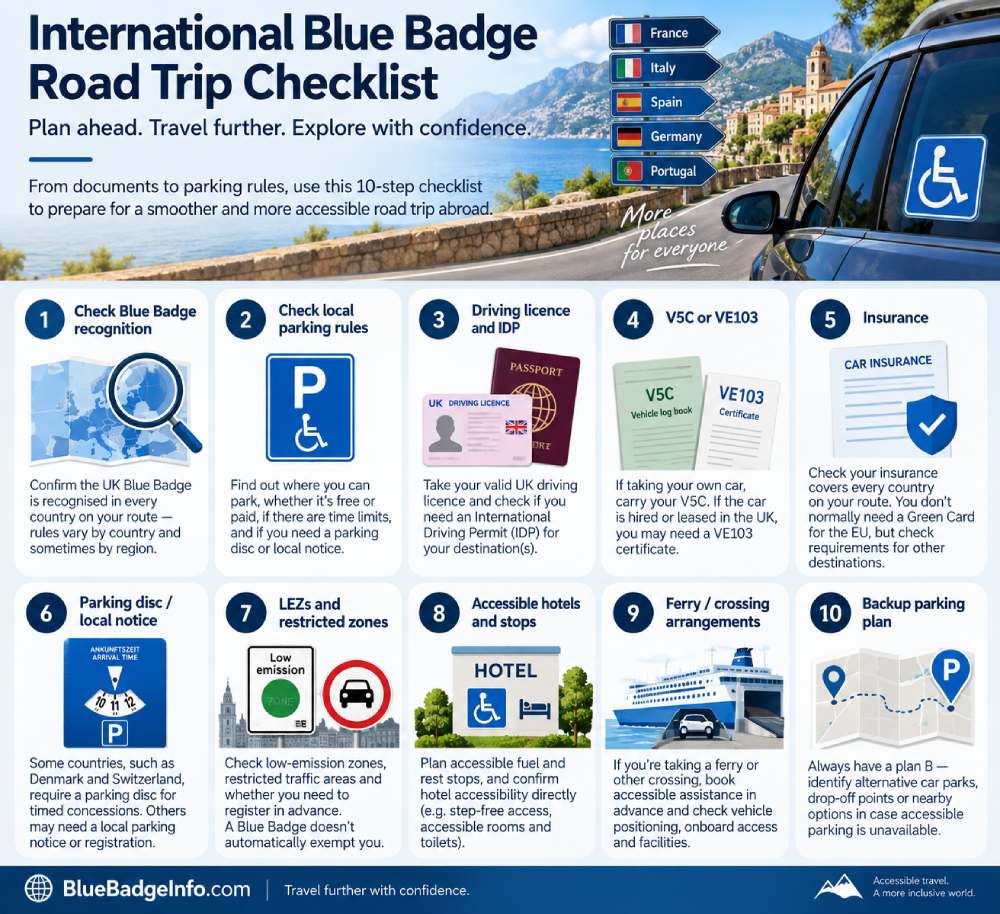
- ☑ Is the UK Blue Badge recognised in every country on the route?
- ☑ What disabled-parking concessions apply locally?
- ☑ Do I need a parking disc or local parking notice?
- ☑ Does any city require advance registration?
- ☑ Are there low-emission or restricted-traffic zones?
- ☑ Is my driving licence valid for every country?
- ☑ Do I need an International Driving Permit?
- ☑ Do I have my V5C or VE103 where required?
- ☑ Does my insurance cover every country?
- ☑ Does the vehicle need a UK identifier?
- ☑ Have I planned accessible fuel and rest stops?
- ☑ Have I confirmed hotel accessibility?
- ☑ Have I checked ferry or cross-Channel arrangements?
- ☑ Is my Blue Badge valid for the entire trip?
- ☑ Do I have a backup plan if accessible parking is unavailable?
1. Check Blue Badge recognition for every country
Do this before planning where you will park.
UK Blue Badge recognition is not uniform across Europe.
Many popular destinations explicitly recognise the UK badge, including:
- France;
- Germany;
- Portugal;
- the Netherlands;
- Belgium;
- Austria;
- Denmark;
- Finland;
- Ireland;
- Norway;
- Sweden;
- and Switzerland.
But two major road-trip destinations need extra care:
- Spain: recognition is decided by local administrations.
- Italy: non-EU disabled parking cards are accepted in some regions only.
See our full country-by-country guide to which countries recognise the UK Blue Badge.
2. Check the parking rules, not just badge recognition
A country recognising your badge does not mean you can park exactly as you would in England, Scotland, Wales or Northern Ireland.
Before entering each country, check:
- where disabled bays are located;
- whether parking is free or paid;
- whether time limits apply;
- whether a parking disc is required;
- whether street parking concessions exist;
- whether restricted streets are excluded;
- how the badge must be displayed;
- and whether municipal rules differ from national guidance.
GOV.UK specifically warns that parking rules can differ between areas even within a country that recognises the UK Blue Badge.
3. Check whether you need a parking disc
Some countries require more than simply displaying the UK Blue Badge.
For example:
- Denmark: GOV.UK says you must use a parking disc when using parking-time concessions.
- Switzerland: a parking disc is also required when using parking-time concessions.
See our guides to:
Do not assume your UK Blue Badge clock automatically satisfies another country’s parking-disc requirement. Check the local instructions before using a timed concession.
4. Check whether a local parking notice or registration is required
GOV.UK warns that some destinations may require you to display a local parking notice alongside the UK Blue Badge.
Other locations may operate:
- visitor parking permits;
- municipal registrations;
- number-plate databases;
- restricted-zone vehicle registration;
- or local disabled-parking authorisations.
This is particularly important where UK Blue Badge recognition is local or partial.
Spain
Recognition is currently decided by local administrations, so check the municipality you intend to visit.
Do not assume that an arrangement confirmed in one Spanish city automatically applies in another.
See using a UK Blue Badge in Spain.
Italy
GOV.UK states that non-EU parking cards are accepted in some Italian regions only.
Italian cities can also have separate rules around restricted traffic areas, so check the city as well as the region.
See using a UK Blue Badge in Italy.
5. Plan your route country by country
Do not treat an international road trip as one continuous parking system.
Create a simple route table before travelling:
| Country | Badge recognised? | Extra requirement | Parking checked? |
|---|---|---|---|
| France | Yes | Check French/local rules | ☐ |
| Spain | Local decision | Check municipality | ☐ |
| Portugal | Yes | Check Portuguese/local rules | ☐ |
For a central-European route, you might instead have:
| Country | Badge recognised? | Main check |
|---|---|---|
| France | Yes | Local parking rules |
| Germany | Yes | Parking and restricted-access rules |
| Austria | Yes | Local parking rules |
| Italy | Partial | Region and city rules |
6. Take the correct driving documents
Your Blue Badge is only one of the documents needed for an international road trip.
If you are driving abroad from the UK, check your driving documents before departure.
Driving licence
Take your valid Great Britain or Northern Ireland driving licence.
Depending on the countries you are visiting, you may also need an International Driving Permit (IDP).
Check using the official GOV.UK International Driving Permit checker.
If you are taking your own car
Take your:
- V5C vehicle log book;
- insurance certificate;
- valid driving licence;
- and any other documents required by the countries on your route.
Your V5C should contain your current UK address.
If the vehicle is hired or leased in the UK
If you are taking a UK-hired or leased vehicle abroad, GOV.UK says you need a VE103 certificate showing that you have permission to use the vehicle abroad.
Do not rely on the rental agreement alone unless the hire company confirms that it satisfies the required documentation.
7. Check your vehicle insurance for every country
UK vehicle insurance provides minimum third-party cover for driving in the EU, including Ireland, as well as several other European countries including Norway and Switzerland.
However, minimum legal cover is not necessarily the same as the level of cover you have at home.
Ask your insurer whether your policy covers:
- accidental damage;
- theft;
- windscreen damage;
- adapted equipment;
- mobility equipment carried in the vehicle;
- and breakdown recovery across every country on the route.
You do not currently need a Green Card for driving in the EU, Ireland, Norway or Switzerland, among several other listed European countries, but one may still be required for some other destinations.
Check GOV.UK vehicle insurance guidance before travelling.
8. Check whether your car needs a UK identifier
A UK-registered vehicle generally needs to display the correct UK identifier abroad.
If your number plate already contains the UK identifier and Union flag, a separate UK sticker is not generally required in many European countries.
However, there are exceptions.
For example, GOV.UK currently says a UK sticker must be displayed when driving in Spain, Cyprus or Malta, regardless of what appears on the number plate.
There is no UK sticker requirement when driving in Ireland.
Check the current GOV.UK driving-in-Europe rules before departure.
9. Check low-emission and restricted-traffic zones
Do not assume a Blue Badge automatically exempts your vehicle from environmental or restricted-access zones abroad.
European cities can operate:
- low-emission zones;
- environmental zones;
- restricted traffic zones;
- pedestrian areas;
- congestion schemes;
- vehicle-registration systems;
- or access permits.
A disabled-parking concession and permission to enter a restricted zone are not necessarily the same thing.
Before driving into a city centre, check:
- whether your vehicle is allowed to enter;
- whether advance registration is required;
- whether foreign vehicles need separate registration;
- whether a disability exemption exists;
- and whether that exemption must be arranged before arrival.
10. Do not assume your Blue Badge gives toll-road discounts
A Blue Badge is principally a disabled-parking permit.
Do not assume it automatically gives free or discounted motorway tolls, bridges, tunnels, ferries or congestion charges abroad.
Where disability concessions exist, they may depend on:
- the vehicle;
- local disability documentation;
- advance registration;
- a national disability card;
- or a separate exemption process.
Check the individual toll or road operator before travelling.
11. Plan accessible fuel and rest stops
Long road journeys can be more demanding than ordinary local travel.
Before departure, identify sensible stopping points for:
- fuel or charging;
- accessible toilets;
- food;
- medication;
- rest;
- mobility-aid adjustment;
- and transfers in and out of the vehicle.
If you need wheelchair transfer space, do not rely solely on a generic “accessible parking” marker.
Where possible, check photographs or contact the service area to confirm:
- bay width;
- side or rear transfer space;
- dropped kerbs;
- step-free access;
- toilet accessibility;
- and distance from the parking area to the building.
12. Verify hotel accessibility directly
“Accessible room” can mean very different things from one hotel to another.
Before booking, check the features that actually matter to you, such as:
- step-free entrance;
- accessible parking;
- lift access;
- door width;
- roll-in shower;
- grab rails;
- bed height;
- space around the bed;
- accessible toilet;
- and distance from the parking area to the room.
If a particular feature is essential, contact the accommodation directly rather than relying only on a booking-site accessibility filter.
13. Plan your ferry or cross-Channel journey
If your road trip begins with a ferry or other vehicle crossing, check accessibility before booking.
Depending on your needs, ask about:
- assistance when boarding;
- accessible vehicle positioning;
- wheelchair access from the vehicle deck;
- accessible toilets;
- lifts;
- accessible cabins on overnight routes;
- mobility equipment;
- and how much notice is required for assistance.
If you cannot safely leave the vehicle without extra space, make that clear when booking rather than waiting until check-in.
14. What if you are hiring a car abroad?
A rental car does not change the rules governing your Blue Badge.
If your UK Blue Badge is recognised at the destination, it may be used for your journey in the rental vehicle subject to the local parking rules.
But check the hire vehicle separately for:
- automatic or manual transmission;
- seat and boot height;
- space for a wheelchair or scooter;
- hand controls or other adaptations;
- insurance;
- cross-border permission;
- additional-driver rules;
- and whether the vehicle can enter every country on your itinerary.
If you intend to collect a rental car in one country and drive it into another, confirm cross-border permission with the rental company.
15. Check private car parks separately
Even where a country recognises the UK Blue Badge, privately operated parking can have its own rules.
This can affect:
- hotels;
- airports;
- shopping centres;
- theme parks;
- visitor attractions;
- hospitals;
- and privately operated city car parks.
Check whether you need to:
- pay;
- take a ticket;
- register the number plate;
- validate parking at reception;
- display the Blue Badge;
- or obey a separate maximum stay.
Blue Badge recognition does not automatically mean private parking is free.
16. Carry useful supporting documents
GOV.UK recommends carrying supporting documentation that may be required, particularly when travelling to countries with stricter disabled-parking rules.
Depending on the destination, useful documents may include:
- your original valid Blue Badge;
- a translation of the Blue Badge;
- a doctor’s note if specifically useful or required;
- local visitor-permit documentation;
- confirmation of any restricted-zone exemption;
- and contact details for the local parking authority.
A translation is useful supporting material, but it does not itself make the badge legally recognised.
17. Make sure the badge remains valid for the whole trip
Check the expiry date before booking a long international journey.
Do not assume another country will accept:
- an expired Blue Badge;
- a renewal confirmation;
- a photograph of the badge;
- or a photocopy.
If your badge will expire before or during the trip, deal with the reapplication before travelling where possible.
See:
18. Take appropriate travel and health insurance
If you have medical or accessibility needs, check that your travel insurance reflects them.
For eligible travellers in Europe, a valid UK GHIC or eligible EHIC can provide access to certain medically necessary state healthcare.
However, GHIC and EHIC are not substitutes for travel insurance.
Travel insurance may cover costs that the health card does not, including:
- private healthcare;
- medical repatriation;
- changes to accommodation or travel;
- and other emergency costs.
Check the GOV.UK travel insurance guidance before travelling.
19. Prepare a parking backup plan
Even with perfect research, accessible parking may be:
- occupied;
- temporarily suspended;
- too small for your vehicle;
- inside a restricted zone;
- or further from the destination than expected.
For important stops, identify:
- a second accessible car park;
- a suitable drop-off point;
- a nearby standard car park;
- public transport alternatives;
- or another entrance to the destination.
This is particularly useful for:
- city centres;
- tourist attractions;
- historic towns;
- ports;
- and busy summer destinations.
Example: UK to Spain and Portugal road trip
Imagine your route is:
UK → France → Spain → Portugal → Spain → France → UK
Your planning could look like this:
France
The UK Blue Badge is recognised, but French parking rules apply.
See using a Blue Badge in France.
Spain
Recognition is decided by local administrations, so check every municipality where you plan to rely on the badge.
See using a Blue Badge in Spain.
Portugal
The UK Blue Badge is recognised, subject to Portuguese and local parking rules.
See using a Blue Badge in Portugal.
You would also need to check:
- the French and Spanish stops on both outbound and return journeys;
- restricted-access zones;
- tolls;
- accommodation;
- accessible service areas;
- and the correct vehicle documents.
Example: UK to Italy road trip
A common route could involve:
UK → France → Germany → Austria → Italy
France, Germany and Austria recognise the UK Blue Badge.
Italy requires additional planning because GOV.UK says non-EU disabled-parking cards are accepted in some regions only.
Before reaching Italy, identify:
- the regions you will enter;
- the cities where you will park;
- local disabled-parking recognition;
- restricted traffic zones;
- and any vehicle-registration procedure.
See using a UK Blue Badge in Italy.
What should you do if your badge is not clearly recognised?
Do not assume you can simply apply for a temporary local permit.
Visitor-permit systems differ widely.
If recognition is unclear:
- check the country’s official disabled-parking guidance;
- check the specific region or municipality;
- contact the relevant parking authority if necessary;
- ask whether foreign permits are recognised;
- ask whether a visitor permit is available;
- find out what documents are required;
- and prepare alternative parking if no visitor scheme exists.
A local temporary permit is therefore one possible solution, not a universal solution.
Blue Badge road trip: what to keep in the car
Depending on your route, your travel folder might contain:
- valid Blue Badge;
- driving licence;
- IDP if required;
- passport;
- V5C or VE103 where applicable;
- insurance certificate;
- breakdown-cover information;
- parking disc where required;
- local permit or parking notice where required;
- Blue Badge translation where useful;
- restricted-zone registration confirmations;
- hotel accessibility confirmations;
- ferry or crossing assistance booking;
- GHIC or valid eligible EHIC where applicable;
- travel-insurance details;
- and emergency contact numbers.
Official guidance to check before travelling
- GOV.UK — Using a Blue Badge in Europe
- GOV.UK — Driving abroad
- GOV.UK — Taking your vehicle abroad
- GOV.UK — Vehicle insurance abroad
- GOV.UK — International Driving Permits
- GOV.UK — Driving in the EU
- GOV.UK — Travel insurance
The bottom line
A successful international Blue Badge road trip is about much more than checking whether the badge is recognised.
Before travelling:
- check recognition for every country;
- research the local parking rules;
- check parking discs and local notices;
- prepare your driving and vehicle documents;
- confirm insurance and breakdown cover;
- check restricted-access and environmental zones;
- plan accessible rest stops and accommodation;
- confirm ferry or crossing assistance;
- and prepare alternative parking.
Most importantly, never assume that because your UK Blue Badge worked in one country, the same concessions will apply after you cross the next border.
Use our UK Blue Badge recognition by country guide as your starting point, then check the country and local rules for every major stop on your route.
Frequently asked questions
How do I plan an international road trip with a Blue Badge?
Check recognition and local parking rules for every country on your route. Then check driving documents, insurance, parking-disc requirements, restricted zones, accessible stops, accommodation, crossings and backup parking before you travel.
Is my UK Blue Badge recognised across Europe?
It is recognised in many European countries, but not under one uniform rule. Spain currently leaves recognition to local administrations, while Italy accepts non-EU disabled parking cards in some regions only. Always check each destination.
Do I need a parking disc abroad?
Sometimes. GOV.UK specifically states that Denmark and Switzerland require a parking disc when using parking-time concessions. Other destinations may have their own local display requirements.
Do I need an International Driving Permit for Europe?
It depends on the country and the driving licence you hold. Use the GOV.UK International Driving Permit checker for every country on your route rather than assuming one rule applies everywhere.
What vehicle documents do I need for a European road trip?
If taking your own UK vehicle abroad, you generally need your driving licence, V5C and insurance certificate. If taking a UK-hired or leased vehicle abroad, you may need a VE103 certificate. Other requirements depend on the destination.
Do I need a Green Card to drive in Europe?
Not for the EU, including Ireland, or several other countries including Norway and Switzerland. Some other destinations can still require one, so check your route and insurer before travelling.
Does my Blue Badge exempt me from low-emission zones?
Do not assume so. Disabled-parking rights and permission to enter an environmental or restricted-traffic zone are separate issues. Check the rules and any registration requirements for each city.
Does a Blue Badge give me free motorway tolls abroad?
Not automatically. Toll, bridge, tunnel and congestion-charge concessions can have separate eligibility and registration rules. Check the individual operator before travelling.
Can I use my Blue Badge in a rental car abroad?
If your Blue Badge is recognised at the destination, it can generally be used for a journey involving you regardless of whether the vehicle is your own or a rental car, subject to local parking rules. Check the rental company’s vehicle and cross-border conditions separately.
Should I carry a translation of my Blue Badge?
It can be useful. GOV.UK recommends carrying supporting documentation that may be required, such as a translation or doctor’s note, particularly in destinations with stricter parking rules.
Can I get a temporary parking permit if my UK Blue Badge is not recognised?
Sometimes, but there is no universal visitor-permit system. Check the relevant national, regional or municipal authority to see whether foreign permits are accepted or whether a temporary visitor permit is available.
Should I check private car parks separately?
Yes. Hotels, airports, attractions and private parking operators may impose their own charges, registration requirements and time limits even where the country recognises the UK Blue Badge.
What happens if my Blue Badge expires during the trip?
Do not rely on an expired badge abroad. Check the expiry date before departure and arrange reapplication in sufficient time if your badge will expire before or during your journey.
[…] Check the latest position on the official gov.uk guide to using a Blue Badge in Europe, and make sure your badge stays valid for the whole trip — see how to renew your Blue Badge. For the full country-by-country picture, see which countries honour the UK Blue Badge scheme, and if you’re driving on, our guide to planning an international road trip. […]
[…] Check the current position on the gov.uk guide to using a Blue Badge in Europe, and make sure your badge is valid for your whole trip — see how to renew your Blue Badge. For the wider picture, see which countries honour the UK Blue Badge scheme and our guide to planning an international road trip. […]
[…] Check the current position on the gov.uk guide to using a Blue Badge in Europe, and make sure your badge stays valid for your trip — see how to renew your Blue Badge. For the full list of destinations, see which countries honour the UK Blue Badge scheme, and if you’re driving further afield, our guide to planning an international road trip. […]
[…] Check the current position on the gov.uk guide to using a Blue Badge in Europe, and make sure your badge stays valid throughout — see how to renew your Blue Badge. For the full picture, see which countries honour the UK Blue Badge scheme and our guide to planning an international road trip. […]
[…] Check the current position on the gov.uk guide to using a Blue Badge in Europe, and make sure your badge stays valid throughout — see how to renew your Blue Badge. For the full picture, see which countries honour the UK Blue Badge scheme and our guide to planning an international road trip. […]