


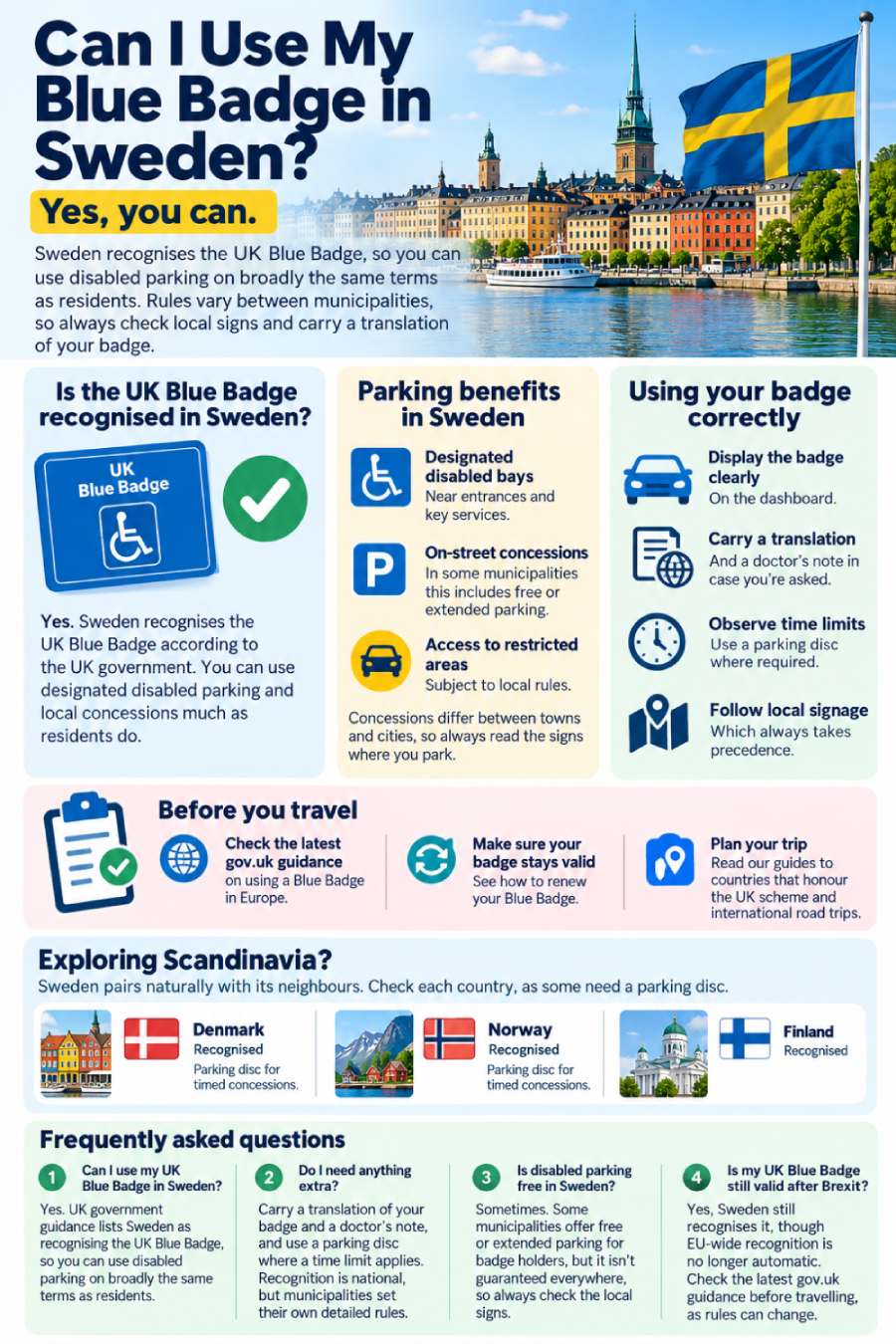
Yes, you can use your UK Blue Badge in Sweden. Current GOV.UK guidance lists Sweden as a country that recognises the UK Blue Badge, and Sweden provides several useful parking concessions for recognised disability parking permits.
The most important national rules are straightforward.
A recognised disability parking permit can generally allow you to:
- park for up to 3 hours where parking is prohibited by a local traffic regulation or normally allowed for less than 3 hours;
- park for up to 24 hours where parking is normally allowed for at least 3 hours but less than 24 hours;
- use parking spaces specifically reserved for disability permit holders, while respecting any maximum stay shown for that space;
- and park for up to 3 hours on a pedestrian street, provided you are otherwise legally allowed to drive there.
There is one major point to understand before travelling:
parking charges are not nationally standardised.
Some Swedish municipalities provide free parking for disability permit holders, while others require payment.
Stockholm, Gothenburg and Malmö are good examples of how different the local rules can be.
Is the UK Blue Badge recognised in Sweden?
Yes.
Current GOV.UK guidance lists:
Sweden — UK Blue Badge recognised: Yes.
Sweden’s disability parking system is based on the European-model parking permit, but Sweden also recognises qualifying foreign permits.
Guidance referenced by FIA states that non-EEA parking cards displaying the international accessibility symbol can be used in Sweden when they are issued in certain languages, including:
- English;
- Swedish;
- Danish;
- Norwegian;
- French;
- and German.
A standard UK Blue Badge is issued in English, so a UK visitor does not normally need an authenticated Swedish translation simply to use the recognised badge.
The foreign-permit guidance is intended for visitors rather than someone who has been living in Sweden long term.
For the wider international position, see which countries recognise the UK Blue Badge.
Sweden Blue Badge parking rules at a glance
| Parking situation | General rule in Sweden |
|---|---|
| UK Blue Badge recognised? | Yes |
| Designated disabled bays | Yes, subject to any specific maximum stay |
| Parking prohibited by local traffic regulation | Up to 3 hours |
| Parking normally allowed for less than 3 hours | Up to 3 hours |
| Parking normally allowed for 3 to 24 hours | Up to 24 hours |
| Pedestrian streets | Up to 3 hours, but the badge does not itself grant vehicle access |
| Spaces reserved for another purpose or vehicle type | No general concession |
| Parking fees | Vary by municipality |
| Parking disc | No general nationwide Blue Badge requirement; follow signs where a p-skiva is required |
| Stockholm street parking | Parking fees normally apply according to local signage |
| Gothenburg municipal paid parking | Free with a valid disability parking permit |
| Malmö municipal parking | Parking fees generally still apply |
| Private land and garages | No automatic concession |
| Stockholm/Gothenburg congestion tax | Separate system; do not assume your UK Blue Badge provides an exemption |
Can I use disabled parking bays in Sweden?
Yes.
Parking spaces reserved for people with disability parking permits are marked with the international wheelchair symbol.
Display your original UK Blue Badge clearly in the front of the vehicle so that it can be read from outside.
There is an important restriction:
if the disabled parking bay has its own maximum stay, you must obey that limit.
The national extended-parking concessions do not allow you to ignore a specific maximum stay attached to the disabled bay itself.
Can I park for 3 hours where parking is prohibited?
In certain locations, yes.
Swedish national rules allow a vehicle using a recognised disability parking permit to park for up to:
3 hours
where a local traffic regulation:
- prohibits parking; or
- normally allows parking for less than 3 hours.
This is an important distinction.
It does not mean that a Blue Badge allows you to ignore every Swedish no-parking or no-stopping rule.
General traffic prohibitions and safety restrictions still apply.
Can I park where stopping is prohibited?
No.
A disability parking permit does not give you a general exemption from places where stopping itself is prohibited.
You must still obey national traffic rules and restrictions relating to places such as:
- pedestrian crossings;
- junctions;
- bus stops;
- cycle facilities;
- unsafe locations;
- and other places where stopping or parking is prohibited under Sweden’s general traffic rules.
Do not interpret the 3-hour concession as permission to park anywhere displaying a prohibition sign.
What if parking is normally limited to less than 3 hours?
If a local traffic regulation normally allows parking for less than 3 hours, a vehicle displaying a recognised disability parking permit can generally stay for:
up to 3 hours.
For example, a locally regulated parking area with a shorter maximum stay may therefore receive the national 3-hour concession.
Always check the signs for:
- additional restrictions;
- specific vehicle requirements;
- payment conditions;
- or a parking-disc requirement.
What if parking is normally allowed for between 3 and 24 hours?
The Swedish national rules provide another useful extension.
Where a local traffic regulation allows parking for:
at least 3 hours but less than 24 hours
a recognised disability parking permit can generally allow parking for up to:
24 hours.
Again, this is a time concession.
It does not automatically remove any parking charge that applies at the location.
Do I need a parking disc in Sweden?
There is no general nationwide rule requiring UK Blue Badge holders to display a parking disc whenever they use Sweden’s disability parking concessions.
This differs from countries such as Denmark, where GOV.UK gives visitors a specific parking-disc warning.
However, Sweden does use parking discs — known as a:
p-skiva
— at locations where the signs require one.
Swedish parking signs can specify both:
- a maximum parking time; and
- that a parking disc must be used to record the arrival time.
Therefore:
follow the parking signs at the specific location.
If a p-skiva is required and no local disability exemption says otherwise, use one correctly.
It can still be useful to keep a standard European parking disc in the vehicle, particularly on a wider Scandinavian road trip.
Is disabled parking free in Sweden?
Not necessarily.
This is one of the most important differences between Swedish municipalities.
The Swedish Transport Agency states that parking charges are decided at municipal level.
Its general rule is that:
a parking fee must normally be paid.
However, some municipalities choose not to charge vehicles displaying a valid disability parking permit.
That means you should never assume that:
disabled bay = free parking.
Check the:
- parking sign;
- payment machine;
- municipal parking website;
- and any parking app or operator instructions.
Can I park free in Stockholm with a UK Blue Badge?
Do not assume so.
Stockholm requires parking fees to be paid according to the signs at the location.
This also applies to parking spaces reserved for people with disability parking permits when the space is marked as chargeable.
Stockholm does operate a separate:
reduced parking fee scheme
for holders of valid disability parking permits.
Under the current scheme, the reduced fee is:
SEK 250 per year.
Once approved, it can cover qualifying paid street parking in Stockholm for registered vehicles.
However, this is a separate application-based local arrangement, not an automatic concession simply because you arrive with a UK Blue Badge.
A short-term UK visitor should therefore not rely on it without first confirming eligibility and completing the required registration.
The reduced fee also does not automatically apply to:
- private land;
- private garages;
- or separately operated parking facilities.
What about parking garages in Stockholm?
Do not assume that Stockholm’s street-parking concessions transfer to garages.
Stockholm Parkering states that disability parking permits can be used in its designated accessible bays, but:
where the parking facility displays a parking fee, that fee must be paid.
This is separate from the reduced annual street-parking arrangement administered by the City of Stockholm.
Always read the rules for the particular garage.
Can I park free in Gothenburg?
Gothenburg is considerably more favourable than Stockholm for municipal parking charges.
Gothenburg City states that parking spaces subject to a fee and managed by its urban environment administration are:
free for people using a valid disability parking permit.
The city’s guidance also confirms the national concessions, including:
- up to 3 hours where parking is prohibited by a local traffic regulation or allowed for less than 3 hours;
- up to 24 hours where parking is normally allowed for between 3 and 24 hours;
- up to 3 hours on pedestrian streets, subject to other local rules;
- and use of designated disabled parking spaces.
However, the free-parking rule does not automatically apply to:
- parking garages;
- private land;
- or facilities operated under separate private conditions.
What about Malmö?
Malmö demonstrates why checking each municipality is important.
Unlike Gothenburg:
Malmö generally requires disability parking permit holders to pay the same parking fee as other drivers.
The city does offer an application-based exemption from parking charges in limited circumstances.
This is intended for a permit holder who, because of their disability, is practically unable to use the available payment methods.
Importantly for foreign visitors, Malmö states that the exemption application can be associated with:
- a Malmö-issued disability parking permit;
- a permit issued by another Swedish municipality;
- or a valid foreign disability parking permit.
The application currently costs:
SEK 250.
This should not be confused with an automatic visitor concession.
Unless you have actually obtained the Malmö exemption, follow the normal payment instructions.
Can I park on a pedestrian street in Sweden?
Swedish national disability parking rules provide a concession allowing parking for up to:
3 hours on a pedestrian street.
However, there is an important distinction between:
permission to park
and:
permission to drive into the street.
Your Blue Badge does not automatically override vehicle-access restrictions.
For example, Malmö explains that some of its pedestrian streets only permit vehicle traffic during specific hours, and the disability parking concession can only be used when that vehicle access is lawful.
Therefore, always check:
- the entry signs;
- permitted vehicle-access hours;
- local restrictions;
- and the parking signs within the pedestrian area.
Can I park in loading bays, taxi spaces or spaces for another vehicle type?
Do not assume so.
The Swedish Transport Agency states that a disability parking permit does not allow parking in a space reserved for:
- a particular purpose;
- or a particular type of vehicle.
Examples can include:
- loading areas;
- taxi spaces;
- bus spaces;
- turning areas;
- or another specially designated parking location.
Always check the additional signs.
Are private car parks free with a Blue Badge?
No automatic concession applies.
Sweden’s disability parking permit primarily provides exemptions from public/local parking regulations.
A private landowner can set separate parking conditions.
This can affect:
- shopping centres;
- supermarkets;
- hotels;
- airport parking;
- private garages;
- tourist attractions;
- residential developments;
- and commercial parking facilities.
A private operator may require you to:
- pay;
- register your number plate;
- use an app;
- obtain a ticket;
- use a parking disc;
- or follow another site-specific condition.
Displaying your UK Blue Badge does not automatically cancel those requirements.
Does my Blue Badge exempt me from Stockholm or Gothenburg congestion tax?
Do not assume that it does.
Sweden operates congestion taxes in:
- Stockholm; and
- Gothenburg.
These taxes are completely separate from Blue Badge parking concessions.
They apply to vehicles registered:
- in Sweden; and
- outside Sweden.
Swedish rules do provide an application process for certain disability parking permit holders to exempt a vehicle from congestion tax.
However, the current published eligibility applies to:
- Swedish disability parking permits; or
- equivalent permits issued within the European Economic Area (EEA).
A UK-issued Blue Badge is not an EEA-issued permit.
Therefore:
do not treat your UK Blue Badge as an automatic congestion-tax exemption.
A UK visitor should expect the normal congestion-tax rules to apply unless the Swedish authorities specifically confirm an exemption.
Can I use my UK Blue Badge in a rental car?
Yes, when the vehicle is genuinely transporting or serving the badge holder.
The Blue Badge relates to the disabled person rather than permanently belonging to one vehicle.
You can therefore use it when travelling in:
- a rental car;
- a family member’s vehicle;
- a friend’s vehicle;
- or another vehicle genuinely being used for the badge holder.
However, remember that separate systems may be linked to the vehicle registration number.
For example:
- private car parks may require number-plate registration;
- parking apps may require the correct rental-car registration;
- and congestion tax is recorded against the vehicle.
Always enter the actual registration number of the rental car where a parking system requires it.
Can someone else use my Blue Badge in Sweden?
Not for their own benefit.
The permit is personal.
It should only be used when the vehicle is genuinely being used in connection with transporting or serving the badge holder.
It should not be used:
- while the badge holder remains at the hotel;
- for another person’s independent shopping trip;
- for the driver’s work;
- or simply to obtain a better parking space or parking concession.
Do I need a translation of my UK Blue Badge?
Normally, no.
Foreign-card guidance for Sweden states that qualifying non-EEA parking permits carrying the international accessibility symbol can be accepted when issued in certain languages.
One of those languages is:
English.
Because a standard UK Blue Badge is issued in English, you do not normally need an authenticated translation simply because you are visiting Sweden.
A translation could still be carried as optional backup, but it should not be presented as a standard Swedish requirement for a UK badge.
Do I need a doctor’s note?
No general Swedish visitor-parking rule requires a doctor’s note simply to use your recognised UK Blue Badge.
The Blue Badge itself is the relevant disability parking document.
Medical documentation may be required for:
- applying for a Swedish disability parking permit;
- another accessibility service;
- or a separate medical matter.
That is different from an ordinary UK visitor using an already recognised Blue Badge.
How should I display my Blue Badge?
Display the original valid UK Blue Badge in the front of the vehicle so that it is clearly visible and readable from outside.
Do not normally rely on:
- a photograph of the badge;
- a screenshot;
- a photocopy;
- an expired badge;
- or proof that a renewal is pending.
If the parking location specifically requires a parking disc, ticket or another item to be displayed, follow those instructions as well.
See how to display your Blue Badge correctly.
Can I use an expired Blue Badge?
No.
Use your original valid Blue Badge when relying on Sweden’s recognition of the UK scheme.
If your badge will expire before or during your journey, see how to renew your Blue Badge before travelling.
What if I receive a parking fine in Sweden?
Before challenging a parking penalty or private parking charge, determine exactly which rule applied.
Check:
- whether your UK Blue Badge was clearly displayed;
- whether the parking space had its own maximum stay;
- whether the location was governed by a local parking restriction or a national prohibition;
- whether a parking fee was required;
- whether a p-skiva was required;
- whether you were on public or private land;
- whether the space was reserved for another purpose or vehicle type;
- and whether a separate number-plate registration requirement applied.
Keep evidence such as:
- photographs of the badge in the windscreen;
- all nearby parking signs;
- road markings;
- payment receipts;
- parking-app confirmations;
- photographs of any parking disc used;
- and screenshots of the relevant municipal or operator guidance.
For a privately issued parking charge, follow the appeal process stated by the operator.
Sweden Blue Badge travel checklist
- ☑ Bring your original valid UK Blue Badge.
- ☑ Display it clearly in the front of the vehicle.
- ☑ Use designated disabled bays where available.
- ☑ Remember the up-to-3-hour concession for qualifying local parking restrictions.
- ☑ Where parking is normally permitted for 3 to 24 hours, the concession can generally extend the stay to 24 hours.
- ☑ Respect any specific maximum stay shown on a disabled bay.
- ☑ Do not assume all disabled parking is free.
- ☑ Check municipal parking charges before leaving the vehicle.
- ☑ Use a p-skiva where the parking signs require one.
- ☑ Do not assume the Blue Badge gives vehicle access to a pedestrian street.
- ☑ Check private car parks separately.
- ☑ Do not assume the badge exempts you from Stockholm or Gothenburg congestion tax.
- ☑ A translation or doctor’s note is not a standard requirement for ordinary UK visitor parking.
- ☑ Only use the badge for a journey genuinely involving the badge holder.
Driving from Sweden into Denmark
Denmark also recognises the UK Blue Badge, but its parking system is different.
One particularly important difference is that GOV.UK specifically tells visitors using Denmark’s timed disability parking concessions to use a:
parking disc.
Denmark also uses different 15-minute and 1-hour concessions.
See using your UK Blue Badge in Denmark.
Travelling from Sweden into Norway
Norway also recognises the UK Blue Badge, but its parking charges, timed concessions and local rules need to be checked separately.
Do not assume Sweden’s:
- 3-hour concession;
- 24-hour concession;
- municipal parking fees;
- or pedestrian-street rules
continue after crossing the border.
See using your UK Blue Badge in Norway.
Travelling onwards to Finland
Finland also currently recognises the UK Blue Badge.
However, Finnish parking concessions are different from Sweden’s and should be checked separately before parking.
See using your UK Blue Badge in Finland.
Planning a wider Scandinavian road trip?
The UK Blue Badge is recognised in several Nordic countries, but the parking concessions are not identical.
Before crossing a border, check:
- how long you can park;
- whether a parking disc is required;
- whether municipal parking is free;
- how private parking works;
- and whether road charging or restricted-access systems are separate from the badge.
See our guide to planning an international road trip with your Blue Badge.
Official guidance
- GOV.UK — Using a Blue Badge in Europe
- Swedish Transport Agency — Disability parking permits
- Your Europe — Disabled parking rules in Sweden
- FIA Disabled Motoring — Sweden
- City of Stockholm — Parking for people with disabilities
- City of Gothenburg — Disability parking rules
- City of Malmö — Parking for people with disabilities
- Swedish Transport Agency — Congestion taxes in Stockholm and Gothenburg
- Swedish Tax Agency — Congestion tax exemption
The bottom line
Yes, Sweden recognises the UK Blue Badge.
The main Swedish disability parking concessions allow you to:
- park for up to 3 hours where a local traffic regulation prohibits parking or normally permits parking for less than 3 hours;
- park for up to 24 hours where parking is normally permitted for at least 3 hours but less than 24 hours;
- use designated disabled parking spaces while respecting any specific maximum stay;
- and park for up to 3 hours on pedestrian streets where your vehicle is otherwise allowed to enter.
The biggest practical issue is parking fees.
There is no single Swedish rule making disabled parking free.
For example:
- Stockholm generally requires payment according to the parking signs and operates a separate reduced-fee application scheme;
- Gothenburg provides free parking on qualifying municipal paid parking spaces for disability permit holders;
- while Malmö generally requires normal payment unless a separate exemption has been approved.
There is also no general Swedish rule requiring a parking disc every time a Blue Badge concession is used. Use a p-skiva where the signs require one.
A standard UK Blue Badge also does not normally need a Swedish translation because it is issued in English, and a doctor’s note is not a general requirement for ordinary visitor parking.
Finally, remember that Stockholm and Gothenburg congestion taxes are separate from disability parking. Do not assume your UK Blue Badge exempts your vehicle from them.
For the wider international picture, see which countries recognise the UK Blue Badge.
Frequently asked questions
Can I use my UK Blue Badge in Sweden?
Yes. Current GOV.UK guidance lists Sweden as recognising the UK Blue Badge. Sweden provides national parking-time concessions, but parking charges and some local arrangements vary between municipalities.
How long can I park with a Blue Badge in Sweden?
You can generally park for up to 3 hours where a local traffic regulation prohibits parking or normally allows parking for less than 3 hours. Where parking is normally permitted for at least 3 hours but less than 24 hours, you can generally park for up to 24 hours.
Can I use disabled parking bays in Sweden?
Yes. You can use spaces reserved for disability parking permit holders, but you must obey any specific maximum stay shown for the individual space.
Is disabled parking free in Sweden?
Not necessarily. Parking charges are decided locally. Some municipalities provide free parking for disability permit holders, while others require payment.
Is parking free in Stockholm with a Blue Badge?
Not automatically. Stockholm generally requires payment according to the signs, including at chargeable disabled parking spaces. The city operates a separate reduced annual parking fee scheme for eligible permit holders.
Is parking free in Gothenburg with a Blue Badge?
Gothenburg states that paid parking spaces managed by the city’s urban environment administration are free for people using a valid disability parking permit. Private land and parking garages can have different rules.
Is parking free in Malmö with a Blue Badge?
Normally no. Malmö generally requires disability parking permit holders to pay the same parking fee as other drivers. A separate exemption can be applied for in limited circumstances.
Do I need a parking disc in Sweden?
There is no general nationwide requirement for UK Blue Badge holders to use a parking disc for every disability parking concession. However, Sweden uses p-skiva parking discs at locations where the signs require them, so always follow the local signage.
Can I park on a pedestrian street?
Sweden’s disability parking rules can allow parking for up to 3 hours on a pedestrian street, but the Blue Badge itself does not give automatic permission to drive into the street. Vehicle-access restrictions must still be obeyed.
Do I need a translation of my UK Blue Badge?
Normally no. Sweden’s foreign-card guidance accepts qualifying non-EEA disability parking cards carrying the international accessibility symbol when they are issued in English or certain other listed languages. A standard UK Blue Badge is issued in English.
Do I need a doctor’s note?
No general Swedish visitor-parking rule requires a doctor’s note simply to use a recognised UK Blue Badge.
Does my UK Blue Badge exempt me from Stockholm or Gothenburg congestion tax?
Do not assume so. Congestion tax is a separate system. The published disability exemption applies after application to Swedish permits or equivalent permits issued within the EEA, so a UK-issued Blue Badge should not be treated as an automatic exemption.
Can I use my Blue Badge in a rental car?
Yes, provided the vehicle is genuinely transporting or serving the badge holder. Make sure the correct rental-car registration number is entered wherever a parking operator or other system requires vehicle registration.