


Yes, you can use your UK Blue Badge in Germany. Current GOV.UK guidance lists Germany as a country that recognises the UK Blue Badge, allowing you to use German disabled-parking concessions subject to German traffic rules and any local restrictions.
Germany has several useful concessions for recognised disability parking permit holders, but they are more specific than simply “use disabled parking like a resident”.
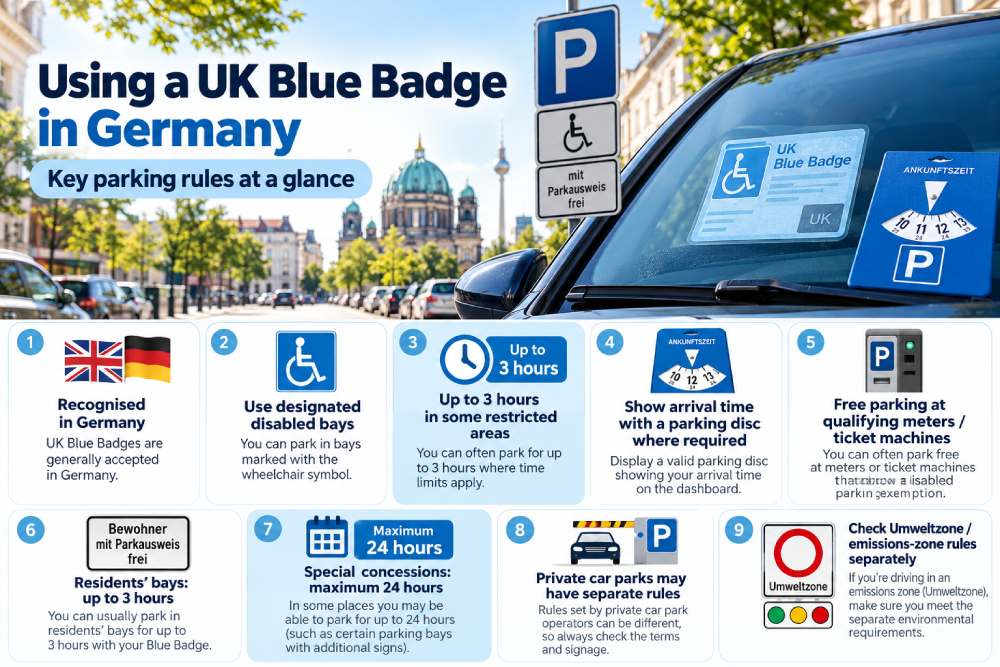
Depending on the type of parking restriction, you may be able to:
- use designated disabled parking spaces;
- park for up to 3 hours in certain areas where parking would otherwise be restricted;
- park beyond an ordinary time limit in some regulated spaces;
- park free at certain parking meters and ticket machines;
- use residents’ parking spaces for up to 3 hours;
- and use other national parking concessions where no suitable alternative parking is available nearby.
Some concessions require you to show your arrival time with a parking disc (Parkscheibe), and the overall maximum stay when relying on these special parking concessions is generally 24 hours.
Is the UK Blue Badge recognised in Germany?
Yes.
GOV.UK currently lists:
Germany — UK Blue Badge recognised: Yes.
Germany has recognised the UK Blue Badge since 2021, and it remains listed as recognised in the current 2026 GOV.UK guidance.
You therefore do not normally need to obtain a German disability parking permit simply because you are visiting from the UK.
However, recognition of the badge does not mean that UK parking rules apply.
You must follow Germany’s own:
- parking signs;
- time limits;
- parking-disc requirements;
- resident-zone rules;
- pedestrian-zone restrictions;
- and environmental-zone rules.
For the wider international position, see which countries recognise the UK Blue Badge.
Germany Blue Badge parking rules at a glance
| Parking situation | General German concession |
|---|---|
| Designated disabled bays | Yes, unless personally reserved for another permit holder |
| Certain restricted parking / waiting areas | Up to 3 hours, with arrival time shown where required |
| Ordinary time-limited parking | You may be allowed to exceed the normal time limit |
| Parking meters / ticket machines | Qualifying parking may be free without the ordinary meter time limit |
| Residents’ parking spaces | Up to 3 hours |
| Traffic-calmed areas | May park outside marked spaces if traffic is not obstructed |
| Pedestrian zones | Only where local rules allow it |
| Maximum stay using special concessions | Generally no more than 24 hours |
| Umweltzone / low-emission zone | Check separately — parking recognition does not automatically prove environmental-zone exemption |
Can I use disabled parking bays in Germany?
Yes.
Disabled parking spaces in Germany are normally marked with the international wheelchair symbol.
You may see:
- a blue parking sign;
- a wheelchair-symbol supplementary sign;
- road markings;
- or a combination of these.
However, not every disabled bay is available to every permit holder.
Do not use a space if it is specifically reserved for another person.
A personalised space may display:
- a person’s name;
- a vehicle registration number;
- a disability permit number;
- or another identifying restriction.
Can I park where parking is normally restricted?
In some circumstances, yes.
German disabled-parking concessions allow recognised permit holders to park for up to:
3 hours
in certain areas where parking or waiting would otherwise be restricted.
When using this concession, you must normally show the time of arrival with a parking disc.
This does not mean you can ignore every no-stopping or safety restriction.
German signs distinguish between different types of stopping and parking prohibition, and the disabled-parking concession does not create unrestricted permission to stop anywhere.
If the restriction is unclear, do not rely on the badge alone.
Do I need a parking disc in Germany?
Yes, for some Blue Badge concessions.
This is an important difference from France.
When you rely on a concession that permits parking for up to 3 hours in certain restricted areas, German guidance requires your arrival time to be shown using a:
Parkscheibe — parking disc.
A parking disc is also useful whenever the relevant sign or concession requires the start time of your parking period to be shown.
For an international road trip through Germany, it is sensible to keep a compliant European-style parking disc in the vehicle.
Do not assume your UK Blue Badge clock automatically satisfies the German parking-disc rules.
Can I park free at parking meters in Germany?
Yes, in qualifying public parking areas.
Official European guidance for Germany says recognised disability parking-card holders can park free in parking spaces or streets where:
- payment would normally be required at a parking meter or ticket machine;
- and ordinary parking is time-limited.
The usual payment requirement and ordinary time restriction can therefore be waived under the disability parking concession.
However, this does not mean the vehicle can remain indefinitely.
German guidance states that the overall maximum stay under these special parking concessions cannot exceed:
24 hours.
Can I stay longer than the normal parking time?
In some time-limited spaces, yes.
Germany allows recognised disabled permit holders to exceed the ordinary parking duration in certain streets and parking zones where a time limit normally applies.
The exact way this works depends on:
- the parking sign;
- the type of regulated space;
- and whether another specific maximum applies.
Do not interpret this as unlimited parking.
The special concessions generally remain subject to the overall 24-hour maximum.
Can I park in residents’ parking areas?
Yes, for a limited period under the German disability parking concessions.
Recognised permit holders may generally park in spaces reserved for residents for up to:
3 hours.
Where the arrival time needs to be established, display the parking disc clearly.
Always check the signs because a personalised, privately allocated or otherwise specially restricted bay may not be included.
Can I park outside marked bays in Germany?
German guidance allows disability parking-card holders, in certain traffic-calmed areas, to park outside marked spaces provided:
- you do not obstruct through traffic;
- the parking is safe;
- and the other requirements of the concession are satisfied.
This should not be treated as general permission to park wherever there is physical space.
Always consider:
- pedestrians;
- cycles;
- emergency access;
- driveways;
- junctions;
- and local signs.
Can I park in pedestrian zones?
Only where the local rules permit it.
Germany does not give Blue Badge holders a blanket right to drive into or park in pedestrian areas.
Official guidance says parking may be possible during periods when loading and unloading is permitted or where local concessions specifically allow disabled parking.
Check:
- the signs at the entrance;
- the permitted access times;
- and municipal rules.
When do the special German parking concessions apply?
There is an important condition that is easy to miss.
Official European guidance says the special concessions apply where there is no suitable alternative parking option nearby.
That means the badge should not simply be used to bypass an ordinary parking option that is reasonably available and suitable.
When a dedicated accessible space or suitable ordinary parking option is available nearby, use it where practical.
Is there a 24-hour maximum?
Yes, for the special parking concessions described in the German guidance.
Even where:
- meter payment is waived;
- an ordinary time limit can be exceeded;
- or another special Blue Badge concession applies,
the maximum stay should not exceed:
24 hours.
This is an important rule for travellers leaving a vehicle overnight or for an entire day.
Can I use my UK Blue Badge in Berlin?
Yes, Germany’s recognition of the UK Blue Badge applies in Berlin for disabled parking purposes.
Berlin also follows Germany’s wider disabled-parking framework, including concessions such as free parking in certain controlled parking areas.
However, Berlin has another issue that visitors need to consider separately:
the Umweltzone.
Do not assume that recognition of your UK Blue Badge for parking automatically establishes that your vehicle is exempt from Berlin’s environmental-zone requirements.
What is an Umweltzone?
An Umweltzone is a German low-emission or environmental zone.
Vehicles entering these zones may need to display the appropriate German emissions sticker, commonly known as an:
Umweltplakette.
German environmental-zone rules are separate from disabled-parking rules.
This distinction is important:
Blue Badge parking recognition does not automatically mean low-emission-zone exemption.
Does my UK Blue Badge exempt me from Germany’s Umweltzonen?
Do not assume that it does.
German federal environmental-zone rules include exemptions for certain vehicles transporting people with specific categories of severe disability.
German official guidance refers to evidence such as:
- particular German disability classifications;
- and, in certain cases, the European blue disability parking permit.
Because the UK Blue Badge is now a non-EU-issued permit, recognition for ordinary parking should not automatically be treated as proof of an Umweltzone exemption.
If your route enters an environmental zone:
- check whether your vehicle needs an Umweltplakette;
- check whether a disability exemption applies to you;
- and confirm what evidence a foreign visitor must display.
This is particularly important in cities that still operate environmental zones.
Do all German cities have Umweltzonen?
No.
Environmental zones have changed over time and some cities have removed them as air-quality conditions have changed.
Others still operate them.
Check the current status for every city on your itinerary rather than relying on an old list.
For a multi-country driving trip, see how to plan an international road trip with your Blue Badge.
Do I need a translation of my Blue Badge in Germany?
Not as a general requirement stated by GOV.UK.
GOV.UK recommends carrying supporting documentation that may be useful when travelling abroad, including:
- a translation of the Blue Badge;
- a doctor’s note;
- or another supporting document where required.
A translation can be useful if an enforcement officer needs clarification, but Germany’s recognition of the UK Blue Badge does not mean every visitor must obtain a translated permit.
Do I need a doctor’s note?
No general German Blue Badge rule requires UK visitors to carry one.
A doctor’s note is mentioned by GOV.UK as possible supporting documentation for international travel, not as a universal requirement for parking in Germany.
Your original valid UK Blue Badge is the key parking permit.
How should I display my Blue Badge in Germany?
Display the original valid UK Blue Badge clearly inside the vehicle so that enforcement officers can inspect it from outside.
Do not rely on:
- a photocopy;
- a screenshot;
- a photograph on your phone;
- an expired badge;
- or proof that you have applied for renewal.
If the parking concession requires the arrival time to be shown, display the appropriate parking disc as well.
See how to display your Blue Badge correctly.
Can I use my Blue Badge in a rental car?
Yes.
The disability parking permit is for the benefit of the holder rather than permanently attached to one vehicle.
You can therefore use your recognised UK Blue Badge in a rental car while the badge holder is genuinely travelling in or being served by that vehicle.
Remember that:
- the Blue Badge does not belong to the rental vehicle;
- another driver cannot use it for their own parking;
- and environmental-zone requirements for the rental vehicle must be checked separately.
Can someone else use my Blue Badge in Germany?
Not for their own parking.
German disability parking permits are person-based, and the concessions are intended for journeys involving the entitled disabled person.
The permit can be used in different vehicles, but the person for whom it was issued must be legitimately involved in the journey.
Are private car parks free?
Not necessarily.
Official European guidance says parking rules in German car parks can vary and advises drivers to check the individual car park notices or ask an attendant.
This is particularly relevant at:
- hotels;
- airports;
- shopping centres;
- hospitals;
- railway stations;
- tourist attractions;
- and private underground garages.
Do not assume that an on-street German concession automatically applies inside a privately operated car park.
Can I use an expired Blue Badge in Germany?
No.
Travel with the original valid badge.
If it will expire before or during your trip, see how to renew your Blue Badge.
What if I receive a parking fine in Germany?
First check:
- whether the space was covered by a disability parking concession;
- whether the badge was displayed correctly;
- whether a parking disc was required;
- whether the 3-hour or 24-hour limit was exceeded;
- whether the space was personally reserved for another permit holder;
- and whether the parking facility had separate private rules.
If you believe the penalty was issued incorrectly, keep:
- photographs of the vehicle;
- the badge as displayed;
- the parking disc;
- parking signs;
- road markings;
- and any payment or permit information.
Follow the appeal instructions given on the German penalty notice.
Germany Blue Badge travel checklist
- ☑ Bring the original valid UK Blue Badge.
- ☑ Carry a suitable parking disc.
- ☑ Look for the wheelchair symbol on disabled spaces.
- ☑ Check that a bay is not personally reserved.
- ☑ Check the 3-hour rule where you rely on a restricted-parking concession.
- ☑ Check the 24-hour overall maximum for special concessions.
- ☑ Check residents’ parking rules.
- ☑ Check private car parks separately.
- ☑ Check pedestrian-zone access separately.
- ☑ Check Umweltzone and Umweltplakette rules separately.
- ☑ Only use the badge for the badge holder’s journey.
Driving from Germany into the Netherlands
The Netherlands also currently recognises the UK Blue Badge, but Dutch parking rules differ from those in Germany.
Do not assume Germany’s:
- 3-hour concessions;
- parking-disc rules;
- meter exemptions;
- or residents’ parking concessions
continue after crossing the border.
See using your UK Blue Badge in the Netherlands.
Driving from Germany into Belgium
Belgium is also currently listed as recognising the UK Blue Badge.
Belgian regions and municipalities have their own parking rules, so check them separately.
See using a UK Blue Badge in Belgium.
Driving from Germany into Austria
Austria recognises the UK Blue Badge as well, but Austrian parking and environmental-access rules differ from Germany’s.
See using a UK Blue Badge in Austria.
Official guidance
- GOV.UK — Using a Blue Badge in Europe
- Your Europe — Disabled parking rules in Germany
- German Federal Portal — Disability parking permits
- German Environment Agency — Environmental zones in Germany
- Berlin — Environmental-zone exemptions
The bottom line
Yes, Germany recognises the UK Blue Badge.
Germany also provides useful national disabled-parking concessions, including:
- designated accessible parking;
- up to 3 hours in certain otherwise restricted parking areas;
- extended time in some time-limited spaces;
- free parking at qualifying meters and ticket machines;
- and up to 3 hours in residents’ parking areas.
However, remember the important conditions:
- a parking disc may be required when using time-limited concessions;
- personalised disabled spaces are not available to other badge holders;
- special concessions generally apply only where no suitable alternative parking is available nearby;
- the overall maximum stay under these concessions is generally 24 hours;
- private car parks can have separate rules;
- and Umweltzone access must be checked separately.
For the wider European picture, see which countries recognise the UK Blue Badge.
Frequently asked questions
Can I use my UK Blue Badge in Germany?
Yes. GOV.UK currently lists Germany as recognising the UK Blue Badge. You can use German disabled-parking concessions subject to German traffic rules and local restrictions.
Can I park in disabled bays in Germany?
Yes. Recognised Blue Badge holders can use qualifying spaces marked with the wheelchair symbol. Do not use a bay that is personally reserved with another person’s name, vehicle registration or permit number.
Is disabled parking free in Germany?
In certain public parking areas, yes. German guidance allows recognised disability parking-card holders to park free at qualifying parking meters and ticket machines. Private car parks can have separate charges.
Do I need a parking disc in Germany?
Yes for certain concessions. For example, when parking for up to three hours in certain restricted areas, you must show your arrival time with a parking disc. Check the local signs and keep a suitable Parkscheibe in the vehicle.
Can I park for three hours in a restricted parking area?
In certain areas, yes. German disabled-parking rules provide a concession of up to three hours in some places where parking would otherwise be restricted, provided the applicable conditions are met and the arrival time is displayed where required.
Can I park in residents’ spaces?
Recognised disabled parking-card holders may generally use residents’ parking spaces for up to three hours under the German concessions, subject to local signs and conditions.
What is the maximum Blue Badge parking time in Germany?
Official European guidance says the maximum stay under the special German disability parking concessions cannot exceed 24 hours.
Can I park free at a German parking meter?
Qualifying disability parking-card holders can park free in certain spaces where payment would normally be required through parking meters or ticket machines. The overall special-concession maximum still applies.
Does my Blue Badge let me enter an Umweltzone?
Do not assume so. Blue Badge parking recognition and environmental-zone access are separate rules. Check whether your vehicle needs an Umweltplakette or qualifies for a disability exemption before entering an Umweltzone.
Do I need a translation of my Blue Badge?
Not as a general requirement. GOV.UK recommends that supporting documentation such as a translation may be useful when travelling abroad, but Germany’s recognition of the UK Blue Badge does not depend on every visitor carrying one.
Do I need a doctor’s note?
No general German rule requires every UK Blue Badge holder to carry a doctor’s note. It is an example of supporting documentation that may be useful in some circumstances.
Can I use my Blue Badge in a rental car?
Yes. The badge is for the disabled person’s benefit and is not permanently tied to one vehicle. It can be used in a rental car when the badge holder is genuinely travelling in or being served by that vehicle.
Are German private car parks free for Blue Badge holders?
Not necessarily. Rules in private and off-street car parks vary, so check the signs, tariff and operator conditions before parking.
[…] Germany — recognised. See Germany. […]