


Yes, you can use your UK Blue Badge in the Netherlands. Current GOV.UK guidance lists the Netherlands as a country that recognises the UK Blue Badge, so you can use Dutch disabled-parking concessions while visiting.
However, the Netherlands is a country where local parking rules matter a lot.
The national position includes several useful concessions:
- you can use general disabled parking spaces;
- you can park for up to 3 hours in certain places where parking is normally prohibited, using a parking disc;
- you can park without the ordinary time limit in free blue zones;
- but where ordinary street parking is paid, you should generally pay and respect the time limit unless the municipality gives disabled permit holders a better concession;
- and off-street car parks do not provide a nationwide automatic Blue Badge concession.
Amsterdam is an important exception because it offers a separate visitor disability parking permit that can provide free on-street paid parking.
Is the UK Blue Badge recognised in the Netherlands?
Yes.
GOV.UK currently lists:
Netherlands — UK Blue Badge recognised: Yes.
The Dutch system calls its disability parking card a:
Gehandicaptenparkeerkaart (GPK).
Dutch government guidance confirms that disability parking cards can be used for designated disabled parking, while municipalities determine a number of the detailed parking concessions.
Amsterdam also explicitly states that a disability parking card displaying the wheelchair symbol from a country outside the EU can be used in the Netherlands.
This means you do not normally need to obtain a Dutch disability parking card simply because you are visiting from the UK.
However, Dutch parking rules apply rather than UK rules.
For the wider international position, see which countries recognise the UK Blue Badge.
Netherlands Blue Badge parking rules at a glance
| Parking situation | General Netherlands rule |
|---|---|
| UK Blue Badge recognised? | Yes |
| General disabled parking spaces | Yes |
| Personally reserved disabled space | No, unless it is reserved for you |
| Parking where an E1 parking prohibition applies | Up to 3 hours with a parking disc, provided you do not obstruct traffic |
| Paid on-street parking | Normally pay and respect the time limit, unless the municipality provides a concession |
| Free blue-zone parking | Recognised disability parking-card holders can generally park without the ordinary time limit |
| Time-limited disabled bay | Use a parking disc if the sign sets a maximum stay |
| Pedestrian zones | No general Blue Badge access |
| Off-street car parks | No nationwide automatic concession |
| Amsterdam paid on-street parking | Visitors may apply for a separate free disability parking permit |
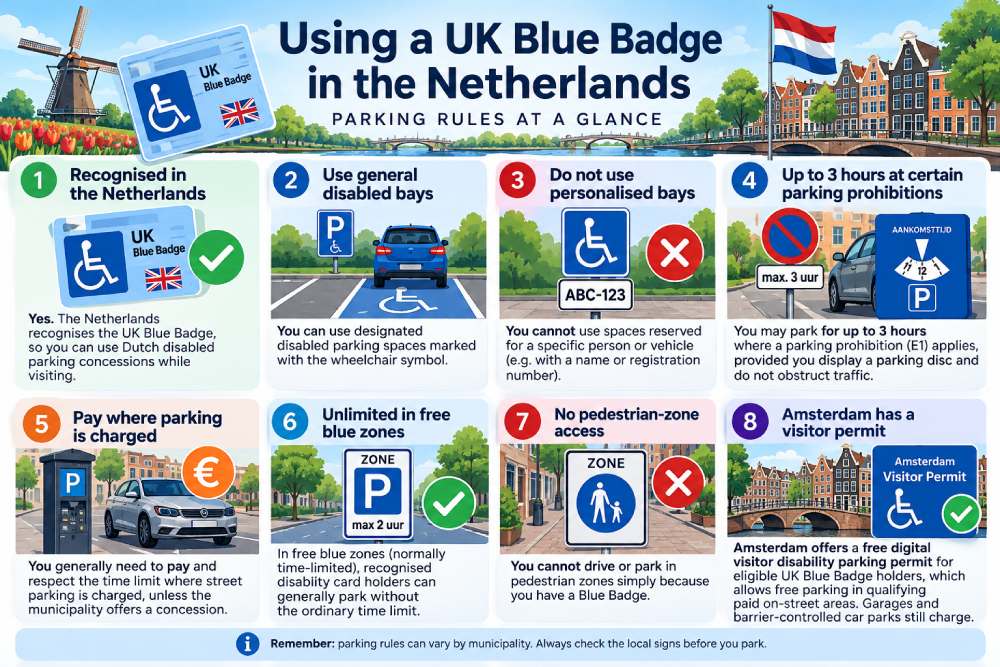
Can I use disabled parking bays in the Netherlands?
Yes.
General Dutch disabled parking spaces are normally marked with:
- a blue parking sign;
- the international wheelchair symbol;
- road markings;
- or a combination of these.
Display your original valid UK Blue Badge clearly at the front of the vehicle.
However, pay close attention to supplementary signs.
Can I use a disabled bay with a number plate or person’s name?
No.
Dutch rules distinguish between general disabled parking spaces and personally reserved spaces.
If the disabled parking sign has a supplementary panel showing:
- a vehicle registration number;
- a person’s name;
- or another specific identifier,
the space is reserved for that permit holder or vehicle.
Your UK Blue Badge does not allow you to use someone else’s personalised parking space.
Can I park where parking is normally prohibited?
In certain circumstances, yes.
Dutch government guidance allows recognised disability parking-card holders to park where the standard E1 “No Parking” sign applies for up to:
3 hours.
There are important conditions:
- the parking must be directly connected with transporting the disabled permit holder;
- you must not obstruct other road users;
- and you must display a parking disc showing your arrival time.
This is not a blanket exemption from every stopping or parking prohibition.
Do I need a parking disc in the Netherlands?
Yes, for some concessions.
The Dutch parking disc is known as a:
parkeerschijf.
You need one in situations such as:
- using the 3-hour concession where an E1 parking prohibition applies;
- parking in a disabled bay that has a specific maximum duration;
- or wherever the sign specifically requires the arrival time to be displayed.
Set the disc to your arrival time and display it clearly.
For a road trip through the Netherlands, keeping a standard European blue parking disc in the vehicle is sensible.
Can I park for free in paid street parking?
Not as a general nationwide rule.
This is one of the main corrections to your previous article.
Official European guidance for the Netherlands says:
- you must pay where parking charges apply;
- you must respect the applicable time limit;
- but local variations may apply.
The Dutch central government similarly states that:
- some municipalities allow GPK holders to park free in ordinary street parking;
- while other municipalities still require payment.
Always check the municipality you are visiting.
What is a blue zone in the Netherlands?
A blue zone is a free parking area where ordinary drivers can only park for a limited period.
It is normally identified by:
- blue road markings;
- a parking-zone sign;
- and instructions requiring an ordinary parking disc.
Official European guidance says recognised disability parking-card holders may park without the ordinary time limit where parking is free but normally time-restricted in a blue zone.
This is different from the 3-hour no-parking concession.
Do I need a parking disc in a blue zone?
For recognised disability parking-card holders, the national visitor guidance says the ordinary time limit in a free blue zone does not apply.
However, local signage and specific disabled-space restrictions can still matter.
If a particular disabled parking bay displays its own maximum-stay sign, use the parking disc as required by that sign.
Can I park in pedestrian zones?
No, not simply because you have a Blue Badge.
Official visitor guidance for the Netherlands states:
do not drive or park in pedestrian zones.
If a municipality provides:
- a local access permit;
- an exemption;
- or another disability-related authorisation,
that is a separate process.
Do not assume Blue Badge recognition itself provides vehicle access.
Can I use my UK Blue Badge in Amsterdam?
Yes.
Amsterdam accepts foreign disability parking cards where the required wheelchair symbol is clearly visible.
The city also explicitly includes the:
United Kingdom, including Gibraltar
among the countries whose disability parking cards can qualify for Amsterdam’s visitor disability parking permit.
This is useful because Amsterdam’s paid street parking is otherwise expensive and widespread.
Can I park free in Amsterdam with my UK Blue Badge?
There are two different situations.
General disabled parking spaces
You can use general disabled parking spaces with your recognised disability parking card.
Amsterdam says these general disabled spaces can be used:
without an ordinary time limit.
The physical GPK or recognised foreign card must be displayed clearly.
Ordinary paid on-street parking
Your Blue Badge alone does not automatically convert every ordinary paid space into free parking.
However, Amsterdam allows eligible disabled visitors to apply for a:
free digital visitor disability parking permit.
With that permit, the vehicle can park free in qualifying on-street areas where paid parking applies.
Can UK visitors apply for Amsterdam’s free disabled parking permit?
Yes, subject to the city’s application conditions.
Amsterdam’s current visitor-permit guidance explicitly lists the United Kingdom among accepted countries.
The application requires information including a copy of the front and back of your disability parking card.
The permit itself is currently:
free.
Amsterdam offers different permit arrangements depending on:
- the type of disability parking card;
- whether the vehicle registration is fixed or can change;
- and the relationship between the vehicle and permit holder.
If you will use a rental vehicle or different vehicles, check the appropriate permit option before travelling.
Is the Amsterdam visitor permit digital?
Yes.
The visitor disability parking permit is digital and can be linked to a vehicle registration.
Depending on the type of permit, you may need to:
- register the vehicle;
- activate parking;
- or update the registration if you change cars.
This is especially important for visitors using a rental car.
Do I still need to display my Blue Badge in Amsterdam?
Yes when using a general disabled parking space.
Amsterdam states that the GPK must be clearly visible when parking in a general disabled bay.
The separate visitor parking permit for ordinary paid street parking is digital.
Do not confuse:
- the physical disability parking card;
- with the digital Amsterdam parking permit.
Where can I park for up to 3 hours in Amsterdam?
Amsterdam applies the Dutch 3-hour concession in certain situations.
With a recognised GPK and a blue parking disc, you may park for up to:
3 hours
in places such as:
- a street covered by a parking-prohibition sign;
- or outside marked spaces in certain residential traffic-calmed areas,
provided doing so is safe and you do not obstruct traffic.
Can I park in Amsterdam garages for free?
No automatic free-parking concession applies.
Amsterdam specifically states that even holders of its disabled parking permits must pay in:
- parking garages;
- and parking facilities with entry and exit barriers.
Check the individual tariff before entering.
What about Rotterdam, The Hague, Utrecht and other Dutch cities?
Your UK Blue Badge remains recognised, but the parking concessions can change by municipality.
Before parking in:
- Rotterdam;
- The Hague;
- Utrecht;
- Eindhoven;
- Maastricht;
- Groningen;
- or another Dutch municipality,
check:
- whether ordinary paid street parking is free for disabled permit holders;
- whether a vehicle registration must be entered;
- whether a local digital permit is required;
- whether a maximum stay applies;
- and whether resident or permit-holder zones offer a concession.
Can I park in permit-holder or residents’ zones?
Do not assume your UK Blue Badge automatically gives access.
Dutch central government guidance specifically warns that municipalities can have additional rules for districts or parking zones.
Some areas may require:
- a parking permit;
- a visitor pass;
- a digital registration;
- or another local authorisation.
Amsterdam, for example, uses its separate digital disability parking permit for several types of regulated parking.
Always check the municipality.
Are private car parks free for Blue Badge holders?
No general concession applies.
Official European guidance for the Netherlands says there are no general concessions for vehicles displaying a disability parking card in car parks.
This can include:
- underground garages;
- shopping centres;
- hotels;
- airports;
- railway stations;
- tourist attractions;
- and commercial parking facilities.
A car park may still provide accessible spaces, but that does not automatically mean parking is free.
Can I use my Blue Badge in a rental car?
Yes.
The disability parking card is for the benefit of the disabled holder rather than permanently tied to one vehicle.
You can therefore use your recognised UK Blue Badge in a rental vehicle when the badge holder is genuinely travelling in or being served by that vehicle.
However, if a municipality uses a digital permit linked to a licence plate, make sure the rental-car registration is correctly registered.
If the rental company changes your vehicle, update the local permit if required.
Can someone else use my Blue Badge?
Not for their own parking.
The Dutch 3-hour parking-prohibition concession, for example, is expressly linked to parking that is directly connected with transporting the disabled permit holder.
The badge should not be used:
- while the holder remains at the hotel;
- for somebody else’s shopping trip;
- for the driver’s own work or errands;
- or simply to obtain convenient parking.
Do I need a translation of my Blue Badge?
No general Dutch rule requires one.
GOV.UK says supporting documentation such as a translation can be useful when travelling internationally, particularly where local rules are stricter.
However, the Netherlands recognises the UK Blue Badge and Amsterdam explicitly accepts foreign disability cards displaying the wheelchair symbol.
A translation can be useful backup information, but it is not a replacement for the original badge.
Do I need a doctor’s note?
No general rule requires a UK visitor to carry a doctor’s note simply to use the Blue Badge in the Netherlands.
Your original valid parking card is the important document.
Additional medical evidence may be relevant to a different service or local application, but it is not part of the ordinary visitor parking rules.
How should I display my Blue Badge?
Display the original valid badge at the front of the vehicle with the relevant side clearly visible for inspection.
Do not rely on:
- a photocopy;
- a screenshot;
- a photograph on your phone;
- an expired badge;
- or a renewal receipt.
If the parking concession also requires a parking disc, display both correctly.
See how to display your Blue Badge correctly.
Can I use an expired Blue Badge?
No.
Use the original current badge.
If your Blue Badge will expire before or during your trip, see how to renew your Blue Badge.
What if I receive a Dutch parking fine?
Before challenging it, check:
- whether your badge was clearly displayed;
- whether the space was general or personally reserved;
- whether payment was required;
- whether a parking disc was required;
- whether you exceeded the 3-hour concession;
- whether a local digital permit or registration was required;
- and whether the parking facility was privately operated.
Keep evidence such as:
- photographs of your Blue Badge;
- the parking disc;
- parking signs;
- road markings;
- payment receipts;
- and digital permit confirmation.
Netherlands Blue Badge travel checklist
- ☑ Bring the original valid UK Blue Badge.
- ☑ Carry a standard European parking disc.
- ☑ Use general disabled bays, not personally reserved spaces.
- ☑ Pay for ordinary street parking unless a local concession clearly applies.
- ☑ Use the parking disc for the 3-hour parking-prohibition concession.
- ☑ Check the sign on time-limited disabled spaces.
- ☑ Do not assume Blue Badge access to pedestrian zones.
- ☑ Check municipal permit and resident-zone rules.
- ☑ Check private car parks separately.
- ☑ If visiting Amsterdam, check whether the free visitor disability parking permit is useful for your trip.
- ☑ Only use the badge for the holder’s journey.
Driving from the Netherlands into Belgium
Belgium also currently recognises the UK Blue Badge, but Belgian parking concessions differ from the Dutch rules.
Do not assume that the Netherlands’ rules on:
- blue zones;
- parking prohibitions;
- parking discs;
- or paid street parking
continue after crossing the border.
See using your UK Blue Badge in Belgium.
Driving from the Netherlands into Germany
Germany also recognises the UK Blue Badge but provides a different set of concessions, including several national 3-hour rules, parking-meter exemptions and residents’ parking concessions.
See using your UK Blue Badge in Germany.
Official guidance
- GOV.UK — Using a Blue Badge in Europe
- Your Europe — Disabled parking rules in the Netherlands
- Rijksoverheid — Where can I park with a disability parking card?
- City of Amsterdam — Disabled parking: where and how
- City of Amsterdam — Visitor disability parking permit
The bottom line
Yes, the Netherlands recognises the UK Blue Badge.
The Dutch rules provide several useful concessions:
- general disabled parking spaces can be used;
- certain parking prohibitions can be used for up to 3 hours with a parking disc;
- free blue-zone time limits generally do not apply to recognised disability card holders;
- and individual municipalities can provide additional concessions.
However:
- paid street parking is not nationally free for Blue Badge holders;
- municipal rules vary;
- personally reserved disabled bays cannot be used;
- pedestrian zones do not have a general Blue Badge exemption;
- and off-street car parks generally provide no automatic concession.
Amsterdam is a particularly important exception because eligible visitors, including UK disability parking-card holders, can apply for a free digital visitor disability parking permit for qualifying paid on-street parking.
For the wider European picture, see which countries recognise the UK Blue Badge.
Frequently asked questions
Can I use my UK Blue Badge in the Netherlands?
Yes. GOV.UK currently lists the Netherlands as recognising the UK Blue Badge. You can use Dutch disabled-parking concessions subject to national and municipal parking rules.
Can I park in disabled bays?
Yes. You can use general disabled parking spaces. Do not use spaces reserved for a specific person or vehicle where the sign displays a name, registration number or other identifier.
Is disabled parking free in the Netherlands?
Not automatically. The national visitor rule is that you normally pay where parking charges apply. Some municipalities provide free parking or other concessions, so check locally.
Can I park for three hours where parking is prohibited?
In qualifying locations, yes. Dutch rules allow a recognised disability parking-card holder to park for up to three hours where the E1 parking-prohibition sign applies, provided the parking is connected with transporting the holder, does not cause an obstruction and a parking disc shows the arrival time.
Do I need a parking disc?
Yes for certain concessions. You need one for the three-hour parking-prohibition concession and when a disabled parking space has a specific maximum stay requiring the arrival time to be shown.
Can I park indefinitely in a blue zone?
Official visitor guidance says recognised disability parking-card holders can park without the ordinary time limit where parking is free but normally time-restricted in a blue zone. Check any specific signs at the location.
Can I drive or park in pedestrian zones?
No general Blue Badge exemption applies. Official guidance says not to drive or park in pedestrian zones unless a specific local authorisation allows it.
Can I use my UK Blue Badge in Amsterdam?
Yes. Amsterdam accepts foreign disability parking cards with a clearly visible wheelchair symbol and explicitly lists the United Kingdom among the countries eligible for its visitor disability parking permit.
Is paid street parking free in Amsterdam?
Not automatically with the Blue Badge alone. Eligible disabled visitors can apply for Amsterdam’s free digital visitor disability parking permit, which provides free parking in qualifying paid on-street areas.
Is Amsterdam’s visitor disability parking permit free?
Yes. Amsterdam currently states that the visitor disability parking permit and changes to it are free of charge, subject to the application conditions.
Are parking garages free in Amsterdam?
No. Amsterdam specifically states that parking garages and parking areas with entry and exit barriers remain chargeable.
Can I use my Blue Badge in a rental car?
Yes. The permit can be used in a vehicle genuinely transporting the holder. If a local digital permit is linked to a registration number, make sure the rental vehicle is correctly registered.
Do I need a translation or doctor’s note?
Neither is a general requirement for ordinary visitor parking. GOV.UK says translations or medical documents can be useful supporting information where required, but the original valid Blue Badge is the key permit.