


Yes, you can use your UK Blue Badge in France. Current GOV.UK guidance lists France as a country that recognises the UK Blue Badge, allowing you to use French disabled-parking concessions subject to French and local parking rules.
France is one of the easier European destinations for UK Blue Badge holders, but there are still important differences from parking in the UK.
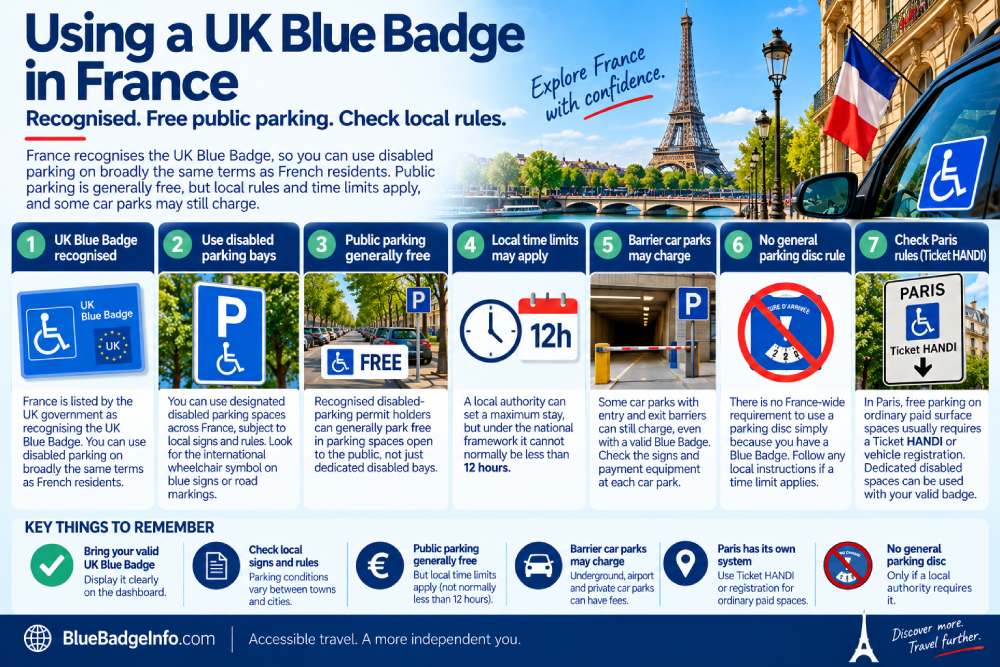
In particular:
- public parking is generally free for recognised disabled-parking permit holders;
- local authorities can impose maximum stays;
- some barrier-controlled car parks can still charge;
- cities can require a free ticket or vehicle registration to activate a parking concession;
- and private car parks can have separate rules.
You should therefore bring your original valid Blue Badge, display it clearly and always check the signs and local instructions before leaving the vehicle.
Is the UK Blue Badge recognised in France?
Yes.
The UK Department for Transport currently lists:
France — UK Blue Badge recognised: Yes.
This means a UK-issued Blue Badge can be used to access the disabled-parking concessions available in France, subject to French and local rules.
France was specifically confirmed by GOV.UK as recognising the UK Blue Badge in 2025, and it remains listed as recognised in the current 2026 country table.
For the wider international position, see which countries recognise the UK Blue Badge.
France Blue Badge parking rules at a glance
| Question | France rule |
|---|---|
| Is the UK Blue Badge recognised? | Yes |
| Can you use disabled bays? | Yes, subject to signs and local rules |
| Is public parking generally free? | Yes, under the French disabled-parking framework |
| Can there be a maximum stay? | Yes. A local authority can impose one, but under the national framework it cannot normally be less than 12 hours |
| Are barrier car parks always free? | No. Certain barrier-controlled car parks may charge |
| Is a parking disc generally required nationwide? | No general France-wide Blue Badge disc rule |
| Can a city require a free parking ticket or registration? | Yes. Paris is an important example |
| Do private car parks have to be free? | No. Check the operator’s rules |
Is disabled parking free in France with a UK Blue Badge?
As a general rule, recognised disabled-parking permit holders benefit from free parking in parking spaces open to the public in France.
French law governing the Carte Mobilité Inclusion – Stationnement provides free use of parking spaces open to the public.
This includes more than just spaces specifically marked for disabled people.
However, there are two important exceptions.
Local authorities can impose a maximum stay
A town or city can impose a maximum duration for free disabled parking.
Under the national French framework, that maximum cannot normally be set below:
12 hours.
The local authority may also require you to record when your parking period started so that the maximum stay can be enforced.
Some barrier-controlled car parks can charge
French law also allows charges in certain car parks where:
- there are entry and exit barriers;
- and the payment equipment can be operated by a disabled person from the vehicle.
So do not assume:
- every underground car park is free;
- every airport car park is free;
- every hospital car park is free;
- or every hotel car park is free.
Can I use disabled parking bays in France?
Yes.
Once your UK Blue Badge is recognised, you can use qualifying spaces reserved for disabled parking under French rules.
French accessible parking spaces normally display:
- the international wheelchair symbol;
- a blue parking sign;
- and/or the French disabled-parking supplementary sign.
The French road-sign system can also use a no-parking sign with an additional panel showing that the restriction does not apply to qualifying disabled permit holders.
Always inspect the actual sign before parking.
Do I have to use only disabled bays?
No.
One of the important features of the French system is that the parking concession is not limited only to dedicated wheelchair-marked spaces.
French law provides recognised disabled-parking permit holders with free parking in parking spaces open to the public, subject to local rules.
That means you may also be able to use ordinary public paid parking spaces without paying, provided you follow the local procedure.
However, the concession does not transform prohibited parking into permitted parking.
Can I park where parking is normally prohibited?
Do not assume so.
Your UK Blue Badge does not give you the same yellow-line concessions that you may be familiar with in parts of the UK.
French traffic signs and restrictions apply.
Do not use your badge to park:
- where stopping is prohibited;
- where the vehicle would create a danger;
- on pedestrian crossings;
- on pavements;
- in bus stops;
- in loading areas where the restriction applies;
- in front of access points;
- or anywhere local signs prohibit your vehicle.
UK yellow-line rules do not transfer to France.
Do I need a parking disc in France?
There is no general nationwide rule requiring UK Blue Badge holders to use a parking disc simply because they are parking in France.
This is different from countries such as Denmark and Switzerland, where GOV.UK specifically identifies a parking-disc requirement when using parking-time concessions.
French local authorities can, however, require you to record the start of your parking period where a maximum disabled-parking duration applies.
This might be done through:
- a parking meter;
- a mobile parking app;
- vehicle registration;
- a free digital parking session;
- or another local system.
Follow the local instructions rather than automatically using your UK Blue Badge clock.
How long can I park with a Blue Badge in France?
The national French framework provides disabled permit holders with free parking without an automatic nationwide time limit.
However, individual authorities can set a maximum stay.
Where they do, that maximum generally cannot be shorter than:
12 hours.
A city may set a longer period.
That is why the exact maximum stay can differ between destinations.
Check the signs or municipal website if you intend to leave the car parked for a long period.
Can I use my UK Blue Badge in Paris?
France recognises the UK Blue Badge, but Paris has its own parking-enforcement procedure that visitors need to understand.
Paris provides free surface parking for vehicles transporting qualifying disabled-parking permit holders.
There are two types of parking to distinguish.
Dedicated disabled spaces
For dedicated accessible spaces, the original valid disability parking card must be displayed clearly in the vehicle where required.
Ordinary paid surface parking
Paris uses a system called Ticket HANDI to activate free parking on ordinary paid surface spaces.
The ticket is:
- free;
- linked to the vehicle registration;
- available through parking meters and supported parking apps;
- and designed to show enforcement officers that the vehicle is using a disability parking concession.
Paris also operates Handi’Stat, which can reference qualifying vehicles in advance.
Because Paris maintains specific procedures for foreign disability permits, check the current City of Paris guidance before relying on the Blue Badge in an ordinary paid surface space.
How long can I park in Paris?
Paris applies its own maximum periods rather than one simple nationwide time limit.
The city currently uses different maximum stays depending on the type of parking space.
For example, Paris guidance distinguishes between:
- dedicated accessible spaces;
- ordinary paid surface spaces;
- and different categories of street parking.
If you plan to leave the vehicle for many hours or overnight, check the current Paris rule for the specific location.
Do I need a translation of my Blue Badge in France?
It is not a general legal requirement stated by GOV.UK for every trip to France.
GOV.UK recommends carrying supporting documentation that may be useful when travelling in Europe.
This can include:
- a translation of your Blue Badge;
- a doctor’s note;
- or other supporting documentation where required.
A translation can be useful if a parking officer is unfamiliar with the UK badge, but France’s recognition of the UK Blue Badge does not depend on you obtaining a new translated permit.
Do I need a doctor’s note?
No general French rule requires every UK Blue Badge visitor to carry a doctor’s note.
GOV.UK mentions a doctor’s note only as an example of supporting documentation that may be useful or required in some situations.
Your valid UK Blue Badge is the parking permit.
You should therefore not arrange new medical evidence purely for an ordinary holiday in France unless a particular authority or service specifically asks for it.
How should I display my Blue Badge in France?
Display the original valid badge prominently inside the vehicle so it can be checked from outside.
Do not rely on:
- a photocopy;
- a photograph on your phone;
- a screenshot;
- an expired badge;
- or proof that you have applied for renewal.
Where the municipality also requires a free digital parking session, ticket or registration, complete that procedure as well.
See how to display your Blue Badge correctly.
Can I use my Blue Badge in a rental car in France?
Yes.
The Blue Badge belongs to the disabled person, not permanently to one vehicle.
You can therefore use it in a rental vehicle when the badge holder is genuinely travelling in or being picked up or dropped off by that vehicle.
If the city requires the vehicle registration number to activate a parking concession, make sure you use the actual rental-car registration.
If the rental company changes your vehicle, any local registration may need to be updated.
Can someone else use my Blue Badge in France?
Not for their own parking.
The badge can be used when a vehicle is transporting or legitimately serving the journey of the badge holder.
It should not be left with a family member, friend or driver so that they can obtain disabled-parking concessions when the holder is not involved in the journey.
Is private parking free with a Blue Badge in France?
Not necessarily.
The French free-parking rule should not be interpreted as a guarantee of free parking in every privately operated facility.
Check separately at:
- hotels;
- shopping centres;
- airports;
- railway stations;
- tourist attractions;
- hospitals;
- and underground parking garages.
Some barrier-controlled car parks can legally charge even where a disability parking permit is valid.
What about motorway service stations?
French motorway service areas normally provide accessible parking near the main facilities.
However, a Blue Badge does not exempt you from:
- general motorway rules;
- tolls;
- restricted stopping areas;
- or parking conditions imposed by the service-area operator.
Do not assume your Blue Badge provides an automatic motorway-toll discount.
Does a Blue Badge exempt me from France’s low-emission zones?
Do not assume that Blue Badge recognition automatically solves low-emission-zone requirements.
France uses Zones à Faibles Émissions (ZFE) and the Crit’Air vehicle-classification system in a number of urban areas.
French law provides national ZFE exemptions for certain vehicles displaying a French Carte Mobilité Inclusion – Stationnement, but a UK visitor should check the specific city’s current rules before assuming a UK Blue Badge automatically creates the same vehicle-access exemption.
Parking rights and permission to enter an environmental zone are separate issues.
If you are driving through several European cities, see how to plan an international road trip with your Blue Badge.
Can I use an expired Blue Badge in France?
No.
Travel with the original current Blue Badge.
If your badge will expire before or during your trip, arrange your reapplication before travelling where possible.
See how to renew your Blue Badge.
What if I receive a parking ticket in France?
Do not assume that showing a Blue Badge afterwards automatically cancels the penalty.
First establish:
- whether your Blue Badge was displayed correctly;
- whether a local free parking ticket or registration was required;
- whether the maximum stay had been exceeded;
- whether the space was actually open to Blue Badge parking;
- and whether the car park was public or private.
If you believe the penalty was issued incorrectly, keep:
- photographs of the Blue Badge as displayed;
- photographs of the parking signs;
- any parking-meter ticket;
- app or registration confirmation;
- and evidence of the vehicle registration.
Follow the appeal instructions on the French penalty or Forfait de Post-Stationnement notice.
France Blue Badge travel checklist
- ☑ Bring the original valid UK Blue Badge.
- ☑ Check the local parking rules for your destination.
- ☑ Look for designated accessible spaces.
- ☑ Check whether an ordinary paid space requires a free ticket or registration.
- ☑ Check the local maximum stay.
- ☑ Do not automatically use the UK parking clock.
- ☑ Check private and barrier-controlled car parks separately.
- ☑ Check ZFE or Crit’Air rules separately from parking rules.
- ☑ Keep the badge clearly visible while it is being used.
- ☑ Only use the concession for the badge holder’s journey.
Driving from France into Spain
The Blue Badge position changes when you cross the border.
France is currently listed by GOV.UK as recognising the UK Blue Badge.
Spain, by contrast, currently leaves UK Blue Badge recognition to local administrations.
See Can I use my UK Blue Badge in Spain?
Driving from France into Belgium
Belgium is also currently listed as recognising the UK Blue Badge, but Belgian parking concessions and local rules are different from those in France.
See using a UK Blue Badge in Belgium.
Driving from France into Germany
Germany currently recognises the UK Blue Badge as well, but you must switch to German parking rules once you cross the border.
See using a UK Blue Badge in Germany.
Official guidance
- GOV.UK — Using a Blue Badge in Europe
- Service-Public.fr — Carte Mobilité Inclusion and parking rights
- Légifrance — French disabled-parking law
- Ville de Paris — Disabled parking and Ticket HANDI
- French Ministry for Ecological Transition — Low-emission zones
The bottom line
Yes, France recognises the UK Blue Badge.
France also has relatively generous disabled-parking concessions: qualifying permit holders can generally park free in public parking spaces open to the public.
However, remember the important exceptions:
- a local authority can impose a maximum stay, generally not shorter than 12 hours;
- a city may require a free ticket, vehicle registration or another way of recording the parking session;
- barrier-controlled car parks can charge;
- private parking rules can differ;
- and UK yellow-line rules do not apply in France.
There is no general French rule requiring you to use your UK parking clock, carry a translation or carry a doctor’s note on every trip.
Bring the original valid badge, check the local signs and follow the parking system used by the town or city you are visiting.
For the wider European picture, see which countries recognise the UK Blue Badge.
Frequently asked questions
Can I use my UK Blue Badge in France?
Yes. GOV.UK currently lists France as recognising the UK Blue Badge. You can use French disabled-parking concessions, subject to French and local parking rules.
Is disabled parking free in France with a UK Blue Badge?
Public parking is generally free for recognised disabled-parking permit holders under the French system. Local maximum stays can apply, and certain barrier-controlled or private car parks can still charge.
How long can I park for free in France?
French national rules allow local authorities to impose a maximum disabled-parking duration, but it generally cannot be less than 12 hours. Some cities allow longer stays.
Can I use ordinary paid parking spaces for free?
Generally, recognised disabled-parking permit holders can benefit from free parking in public parking spaces open to the public, not only dedicated disabled bays. However, local authorities may require a free ticket or vehicle registration to activate the concession.
Do I need a parking disc in France?
There is no general nationwide requirement for UK Blue Badge holders to use a parking disc in France. A local authority can require another way of recording your parking start time, so check local instructions.
Do I need a translation of my Blue Badge?
Not as a general requirement. GOV.UK says a translation can be useful supporting documentation, particularly where local rules are stricter, but France’s recognition of the UK Blue Badge does not depend on obtaining a translated replacement permit.
Do I need a doctor’s note?
No general rule requires every UK visitor using a Blue Badge in France to carry a doctor’s note. It is only an example of supporting documentation that GOV.UK recommends carrying where it may be useful or required.
Can I use my Blue Badge in Paris?
Yes, but Paris has specific parking-enforcement procedures. Dedicated accessible spaces and ordinary paid surface parking are treated differently, and paid surface parking can require activation through Ticket HANDI or another approved process. Check current Paris guidance before parking.
Is disabled parking free in Paris?
Paris provides free surface parking for qualifying disabled-parking permit holders. For ordinary paid surface spaces, the city uses Ticket HANDI or vehicle referencing to activate the concession. Other types of car park can have separate charges.
Can I use my Blue Badge in a rental car?
Yes. The badge is for the disabled holder rather than permanently linked to one vehicle, so it can be used in a rental car when the holder is travelling in or legitimately being picked up or dropped off by that vehicle.
Can I park on yellow lines in France with my UK Blue Badge?
Do not apply UK yellow-line rules in France. French traffic signs and parking restrictions apply, and the UK Blue Badge does not automatically provide the same prohibited-parking concessions available in parts of the UK.
Are underground and private car parks free?
Not necessarily. French law allows charges in certain barrier-controlled car parks, and private parking operators can have their own conditions and tariffs.
Does my Blue Badge exempt me from Crit’Air or low-emission-zone rules?
Do not assume so. Disabled parking rights and vehicle access to a French low-emission zone are separate issues. Check the ZFE and Crit’Air requirements for the city you plan to enter.