


A hip replacement does not automatically qualify you for a Blue Badge. Whether you can get one depends on how severely your hip condition affects your ability to walk and whether those difficulties meet the eligibility rules where you live in the UK.
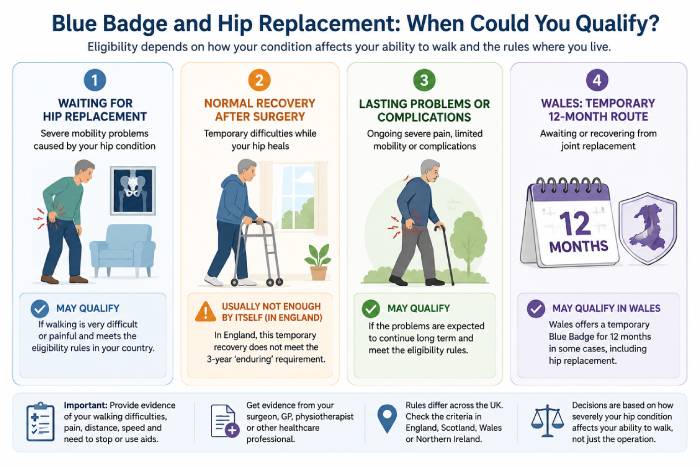
If you are waiting for hip replacement surgery because severe arthritis or joint damage makes walking extremely difficult, you may have grounds to apply. You may also qualify if you have lasting mobility problems or complications after surgery.
However, a normal period of recovery after a successful hip replacement does not automatically qualify. This is particularly important because the rules differ across the UK: England generally requires an enduring disability lasting at least three years under the assessed route, while Wales has a specific temporary 12-month Blue Badge route that can include people awaiting or recovering from joint replacement.
Hip replacement is therefore a good example of why Blue Badge eligibility is based on functional mobility rather than the name of an operation or diagnosis. See our wider guide to what illnesses and disabilities can qualify for a Blue Badge.
Does having a hip replacement automatically qualify you?
No. There is no automatic Blue Badge category simply for having had — or being scheduled to have — a hip replacement.
The decision normally depends on questions such as:
- how far you can walk;
- how much pain you experience while walking;
- how slowly you walk;
- whether you need crutches, a walking stick, frame or another person’s help;
- whether you need frequent stops;
- whether you have balance or fall problems;
- how long your mobility difficulties are expected to last;
- and whether you have other conditions affecting your mobility.
A hip replacement itself is therefore not the qualifying factor. The mobility impairment before or after the operation is what matters.
Can you get a Blue Badge while waiting for a hip replacement?
Potentially, but the answer depends heavily on where you live.
People waiting for hip replacement commonly have osteoarthritis or another serious hip condition causing pain, stiffness and loss of movement. The NHS notes that hip replacement is generally considered when hip pain and reduced movement are affecting everyday life and other treatments have not been effective.
If your hip condition means you can barely walk, need significant assistance or experience severe pain when walking, those limitations may be relevant to a Blue Badge application.
However, the expected duration of those difficulties matters, particularly in England.
Hip replacement and Blue Badge rules in England
England does not have a general temporary Blue Badge route simply because someone is recovering from surgery.
Under the “eligible subject to further assessment” route, the Department for Transport requires an applicant to have an enduring and substantial disability that causes them to:
- be unable to walk during a journey;
- experience very considerable difficulty while walking;
- experience very considerable psychological distress while walking during a journey;
- or be at risk of serious harm, or pose a serious risk to another person, while walking.
For this assessed route, “enduring” means the disability is expected to last for at least three years.
This is an important distinction for hip replacement patients.
If your only mobility problem is a temporary period of reduced walking ability immediately after surgery and you are expected to recover within several months, you would not normally meet England’s three-year assessed criterion on that basis alone.
However, you may still qualify if:
- you already meet an automatic Blue Badge criterion;
- your hip condition forms part of a lasting disability expected to meet the three-year requirement;
- the operation has not resolved your severe mobility difficulties;
- you develop lasting complications;
- or another long-term condition also severely affects your walking.
Wales: hip replacement can qualify for a temporary Blue Badge
Wales is particularly important because its rules are different.
Welsh Blue Badge guidance provides a temporary 12-month badge for some people recovering from or awaiting treatment for serious illnesses or injuries where there is a substantial mobility impairment expected to last at least 12 months.
The official Welsh guidance specifically gives this example:
someone recovering from or awaiting joint replacement — including hip or knee replacement — where mobility is severely limited.
This means that if you live in Wales and are waiting for a hip replacement or recovering from one, you may have a route that would not exist on the same basis in England.
You will normally need evidence from a healthcare professional involved in your treatment, and the local authority may arrange an independent assessment.
A temporary Welsh badge is issued for 12 months. If serious mobility problems remain afterwards, any further application will need to be considered based on your circumstances at that time.
What about Scotland?
In Scotland, you can apply for a Blue Badge even if you do not automatically qualify if you:
- cannot walk;
- or find walking very difficult.
Your local council considers whether you meet the eligibility criteria.
Therefore, having a hip replacement does not itself guarantee a badge. The important issue is the severity of your walking difficulty and the evidence supporting your application.
If you already receive a qualifying disability benefit, you may qualify automatically instead.
What about Northern Ireland?
Northern Ireland operates its own Blue Badge scheme.
One of the assessed eligibility routes covers people who have a permanent disability that means they:
- cannot walk; or
- have a lot of difficulty walking.
This means a routine temporary recovery from hip replacement would not normally fit that permanent-disability route by itself.
However, lasting problems after surgery or another permanent condition affecting your mobility may potentially qualify.
Can I get a Blue Badge while recovering from hip replacement surgery?
A normal recovery period alone will not necessarily qualify you.
The NHS says it can take several months to recover from hip replacement surgery, although recovery varies depending on factors such as age, general health and the operation itself.
After surgery, many patients:
- begin walking with help soon after the operation;
- initially use crutches or a walking frame;
- gradually increase their walking;
- and improve over the following weeks and months.
Temporary use of crutches or difficulty walking during a normal recovery therefore does not automatically demonstrate the kind of lasting disability required by some Blue Badge schemes.
Wales is the notable exception, because its temporary qualification explicitly includes some people recovering from joint replacement where mobility is severely limited.
What if I still cannot walk properly after hip replacement?
This can be much more relevant to a Blue Badge application.
Hip replacement surgery usually improves pain and mobility, but complications or incomplete recovery can sometimes leave someone with continuing problems.
Possible issues can include:
- persistent hip pain;
- reduced mobility;
- leg-length difference affecting gait;
- nerve or tissue damage;
- dislocation;
- problems with the replacement joint;
- continued need for walking aids;
- or another medical condition that continues to restrict walking.
These problems do not automatically qualify either, but lasting functional limitations after the operation may provide a stronger basis for an assessed Blue Badge application.
What does the council look at?
The decision maker is interested in what happens when you actually walk, not simply whether your medical record says “total hip replacement”.
Walking distance
Be specific about how far you can realistically walk before pain, weakness or another symptom makes you stop.
Instead of:
“I can’t walk very far.”
something such as this is more useful:
“I can usually walk around 35 metres using a stick before severe hip pain forces me to stop and rest.”
Pain while walking
Explain the severity of your pain, when it starts and whether it continues after you stop walking.
In England, official Blue Badge guidance specifically lists pain experienced while walking or as a consequence of walking as one of the factors relevant to assessing very considerable difficulty.
Walking speed
If your hip condition causes you to walk very slowly, explain this too.
You may be able to cover a particular distance but take substantially longer than someone without a mobility impairment.
Walking aids
Explain whether you use:
- a walking stick;
- one or two crutches;
- a walking frame;
- a rollator;
- or another person’s assistance.
Also explain whether the aid is temporary during normal recovery or something you are expected to need long term.
Stops and recovery time
Record how frequently you need to stop, how long you need to rest and whether you are able to continue afterwards.
Before surgery vs after surgery
| Situation | Could a Blue Badge be possible? | Main issue |
|---|---|---|
| Severe hip condition before surgery | Possibly | Depends on severity, duration and national eligibility rules |
| Normal short-term recovery after surgery | Usually not enough by itself in England | Temporary recovery does not meet England’s 3-year assessed criterion |
| Waiting for or recovering from joint replacement in Wales | Potentially yes | Wales has a temporary 12-month route where mobility is severely limited |
| Lasting complications after surgery | Possibly | Evidence must show sufficiently severe ongoing mobility difficulty |
| Qualifying disability benefit | Potentially automatic | Check the benefit-specific criteria where you live |
Can arthritis before hip replacement qualify?
Potentially.
Osteoarthritis is one of the most common reasons for hip replacement surgery. Severe arthritis can cause:
- significant pain;
- stiffness;
- reduced range of movement;
- difficulty standing;
- slow walking;
- and reduced walking distance.
If arthritis is the main reason your mobility is severely restricted, read our dedicated guide on getting a Blue Badge for arthritis.
What if osteoporosis or spinal problems also affect my walking?
Include all relevant conditions in your application.
You do not need to pretend that all your mobility problems come from your replaced hip.
For example, someone may have:
- hip osteoarthritis;
- osteoporosis;
- spinal stenosis;
- problems with the opposite hip;
- knee arthritis;
- or balance problems.
The combined effect of several conditions can be relevant when explaining your overall mobility.
See also:
Do you automatically qualify through PIP?
You may qualify without a further mobility assessment if you already receive a qualifying disability benefit.
For example, 8 points or more under the PIP “moving around” activity can provide automatic Blue Badge eligibility.
The rules for the “planning and following journeys” activity vary across the UK, so check our full guide to getting a Blue Badge on PIP rather than relying on a single UK-wide points rule.
What evidence should I provide?
The strongest evidence explains both your medical situation and how it affects your walking.
Useful evidence may include:
- a letter from your orthopaedic surgeon;
- hospital or clinic correspondence;
- your GP medical summary;
- physiotherapy or occupational therapy reports;
- information about your planned surgery or date of surgery;
- your expected prognosis and recovery;
- details of complications if they have occurred;
- information about walking aids;
- and evidence of other conditions affecting your mobility.
For Wales’s temporary route, official guidance specifically refers to a letter from a healthcare professional involved in your treatment as appropriate evidence for people awaiting or recovering from joint replacement.
For the other paperwork normally needed, see our Blue Badge application documents checklist.
How to describe your walking problems
Your application should focus on practical examples.
Try to record:
- how far you can walk;
- how long that takes;
- how severe the pain becomes;
- how many times you need to stop;
- how long you need to rest;
- which walking aid you use;
- whether you can safely manage kerbs, slopes or uneven surfaces;
- and whether the difficulties are improving, stable or expected to continue.
This gives the authority much more useful information than simply stating that you have had a hip replacement.
Should I apply before or after hip replacement surgery?
There is no single answer for everyone.
If you live in Wales and severe mobility problems are caused by waiting for or recovering from joint replacement, the temporary Blue Badge route may be particularly relevant.
If you live in England, you should not assume that applying before surgery is automatically better. If surgery is expected to resolve your mobility problem within a relatively short period, your condition may not meet the three-year “enduring” requirement for the assessed route.
If your disability is expected to remain severe despite surgery, or if you have other lasting conditions, provide evidence explaining that prognosis.
In Scotland and Northern Ireland, check the specific eligibility criteria and provide evidence based on your actual mobility difficulties.
How to apply
- Check which national rules apply based on where you live.
- Check whether you automatically qualify through PIP or another qualifying benefit.
- Gather medical evidence from your surgeon, physiotherapist, GP or other relevant professional.
- Describe your real walking ability, including distance, pain, speed, aids and stops.
- Submit your application using the relevant Blue Badge service.
- Attend an assessment if your issuing authority requests one.
For the complete process, see how to apply for a Blue Badge online.
What if your application is refused?
If you are refused because your mobility problems are considered temporary, check whether the authority applied the correct criteria for the part of the UK where you live.
You should also check whether your application clearly explained:
- the severity of your walking difficulty;
- how long the problem is expected to continue;
- any lasting complications;
- other conditions affecting your mobility;
- and your healthcare professional’s prognosis.
If relevant information was overlooked, you may be able to ask for reconsideration. See what to do if your Blue Badge application is refused.
Official information
- GOV.UK — Blue Badge local authority guidance for England
- GOV.WALES — Blue Badge eligibility
- mygov.scot — Who else can get a Blue Badge
- nidirect — Blue Badge eligibility criteria
- NHS — Recovering from a hip replacement
The bottom line
A hip replacement does not automatically qualify you for a Blue Badge.
You may qualify if severe hip problems before surgery, lasting complications afterwards or another disability cause sufficiently serious walking difficulties.
The most important geographical difference is:
- England: the assessed route requires an enduring and substantial disability expected to last at least three years, so ordinary temporary recovery after hip replacement does not normally qualify by itself.
- Wales: there is a specific temporary 12-month Blue Badge route that can include people awaiting or recovering from hip or knee replacement where mobility is severely limited.
- Scotland: you may apply if you cannot walk or find walking very difficult, subject to the applicable criteria and council assessment.
- Northern Ireland: an assessed physical-mobility route includes people with a permanent disability that means they cannot walk or have a lot of difficulty walking.
Whatever route you use, focus your evidence on what you can and cannot do when walking, rather than simply providing proof that you have had hip replacement surgery.
Frequently asked questions
Does a hip replacement automatically qualify for a Blue Badge?
No. Having or needing a hip replacement is not automatically enough. Eligibility depends on the severity and expected duration of your mobility difficulties and the rules applying where you live.
Can I get a Blue Badge while waiting for a hip replacement?
Possibly. In Wales, the temporary Blue Badge criteria specifically include some people awaiting joint replacement where mobility is severely limited. Elsewhere in the UK, your eligibility depends on the relevant national criteria and the nature and duration of your disability.
Can I get a temporary Blue Badge after hip replacement surgery?
In Wales, potentially yes. Wales offers temporary 12-month badges for certain serious mobility impairments and specifically includes people recovering from joint replacement where mobility is severely limited. England does not have an equivalent assessed temporary route for ordinary surgical recovery.
How long must mobility problems last in England?
For England’s Blue Badge route that requires further assessment, the disability must be enduring and substantial. Department for Transport guidance defines enduring as lasting for at least three years.
What if I still need a walking stick after hip replacement?
Using a walking stick can be relevant evidence but does not automatically qualify you. The authority will consider your overall walking difficulty, including distance, pain, speed, stops and whether the need for the aid is temporary or long term.
Can complications after hip replacement qualify for a Blue Badge?
Potentially. Persistent pain, reduced mobility, nerve problems, leg-length differences or other lasting complications can support an application if they cause sufficiently severe mobility problems and meet the applicable eligibility criteria.
Should I apply before or after hip replacement surgery?
It depends on your circumstances and where you live. In Wales, people awaiting joint replacement may potentially qualify for the temporary route. In England, if surgery is expected to resolve the mobility problem within less than three years, the assessed enduring-disability route may not apply on that basis alone.
What evidence should I provide?
Useful evidence may include orthopaedic or hospital letters, physiotherapy reports, your expected prognosis, details of complications, information about walking aids and a clear description of your walking distance, pain, speed and need to stop.