


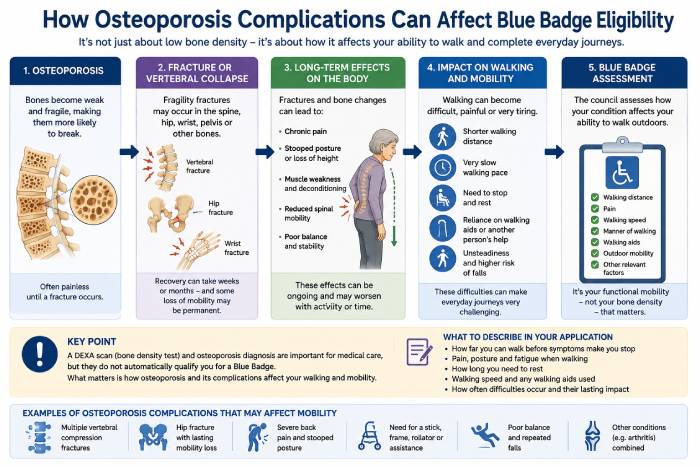
Yes, osteoporosis can contribute to Blue Badge eligibility if fractures, chronic pain, spinal changes or other lasting complications cause severe difficulty walking.
However, osteoporosis does not automatically qualify you simply because you have low bone density or a diagnosis confirmed by a DEXA scan.
This distinction is particularly important with osteoporosis because the condition itself is often painless until a bone fractures. Someone may have significant osteoporosis but walk normally, while another person may have vertebral or hip fractures that cause persistent pain, altered posture, reduced walking distance or loss of mobility.
For Blue Badge purposes, it is those functional consequences that usually matter most.
Osteoporosis is one of many conditions that can potentially contribute to eligibility. See our main guide to what illnesses and disabilities may qualify you for a Blue Badge.
Does osteoporosis qualify you for a Blue Badge?
Potentially, but osteoporosis is not an automatically qualifying diagnosis.
The NHS describes osteoporosis as a condition that weakens bones and makes them more fragile and more likely to break.
Common osteoporotic fractures include:
- hip fractures;
- vertebral or spinal fractures;
- wrist fractures;
- pelvic fractures;
- and fractures in other bones.
For a Blue Badge application, the important question is not simply whether one of these fractures has occurred. The authority needs to understand what lasting effect your condition has on your ability to walk and complete ordinary journeys.
You may have a stronger case if osteoporosis or its complications mean you:
- can only walk a short distance before pain forces you to stop;
- walk very slowly;
- need a stick, frame, rollator or another person’s assistance;
- have persistent mobility problems after a hip or pelvic fracture;
- have spinal fractures that cause chronic pain or altered posture;
- have significant balance or stability problems;
- need frequent rest stops;
- or have another long-term condition that combines with osteoporosis to make walking very difficult.
Osteoporosis itself vs its consequences
This is probably the most important distinction to understand.
| Finding or condition | Does it prove Blue Badge eligibility? | What matters more? |
|---|---|---|
| Osteoporosis diagnosis | No | Whether it causes substantial mobility problems |
| Low DEXA score | No | Your actual walking ability |
| Vertebral fracture | Not automatically | Resulting pain, posture and walking difficulty |
| Hip fracture | Not automatically | Whether lasting loss of mobility remains |
| History of falls | Not automatically | Actual instability, mobility difficulty and use of aids |
In other words:
Osteoporosis diagnosis → not enough on its own.
Osteoporosis causing serious functional mobility problems → potentially relevant.
Can spinal fractures from osteoporosis qualify?
They can contribute to eligibility where they cause lasting mobility problems.
Osteoporosis can cause fractures or partial collapse of the vertebrae in the spine.
The NHS notes that spinal fractures can lead to:
- long-term back pain;
- loss of height;
- a stooped or bent-forward posture;
- and difficulty supporting the weight of the body normally.
These effects may in turn make walking slower, more painful or more tiring.
For a Blue Badge application, explain the practical effect.
For example:
“Because of several vertebral compression fractures, standing upright and walking increases my back pain. I can usually manage around 35 metres before needing to sit.”
That is much more useful than simply writing:
“I have three spinal fractures.”
Can a hip fracture caused by osteoporosis qualify?
Potentially.
A broken hip is a serious injury and is particularly common in people with osteoporosis.
The NHS states that recovery can take weeks or months and that some people do not regain the same strength and movement they had before the fracture.
A previous hip fracture may therefore be highly relevant where it has caused lasting problems such as:
- reduced walking distance;
- persistent hip pain;
- weakness;
- altered gait;
- need for a walking aid;
- or difficulty walking outdoors independently.
The fracture itself is not the automatic qualifying factor. The resulting disability is what matters.
If you have subsequently had a joint replacement, see our guide on whether a hip replacement can qualify for a Blue Badge.
Does chronic back pain from osteoporosis count?
It can.
England’s official Blue Badge guidance specifically tells authorities to consider pain experienced while walking or as a consequence of walking.
This can be relevant where osteoporotic spinal fractures produce persistent back pain.
Explain:
- how far you can walk before pain becomes severe;
- whether walking makes the pain worse afterwards;
- how long the increased pain lasts;
- whether you need to stop or sit;
- and whether the pain changes the way you walk.
For example:
“After walking approximately 40 metres my back pain increases substantially and I have to stop. The increased pain usually continues for 20 to 30 minutes afterwards.”
How far can you walk and still get a Blue Badge?
There is no single UK-wide walking distance that automatically determines eligibility.
England’s Department for Transport guidance does, however, provide useful benchmarks.
- If you cannot walk 30 metres in total, you can be considered to have very considerable difficulty walking.
- If you can walk between 30 and 80 metres, you may still qualify where other factors such as severe pain, an extremely slow pace or an abnormal manner of walking demonstrate very considerable difficulty.
- If you can walk more than 80 metres, other evidence of very considerable difficulty would normally be needed.
These figures are England guidance and not a simple UK-wide pass/fail test.
Do not change or exaggerate your walking distance to fit a threshold. Describe what you can genuinely manage.
Does walking slowly matter?
Yes.
Someone with spinal deformity, previous fractures or persistent pain may cover a particular distance but do so very slowly.
England’s guidance uses walking speed as one of several assessment factors.
- more than 90 metres per minute — brisk;
- 61 to 90 metres per minute — normal;
- 40 to 60 metres per minute — slow;
- less than 40 metres per minute — very slow.
If you cannot walk 40 metres in one minute, including stops to rest, this is considered an extremely slow pace in the England guidance.
Walking speed should still be considered alongside pain, distance, manner of walking, aids and other factors.
Does fear of falling qualify you for a Blue Badge?
Fear of falling by itself does not automatically qualify you.
It is understandable for someone with osteoporosis to worry about falling because a fall can lead to a fragility fracture.
However, the Blue Badge assessment is concerned with the disability you actually experience while walking.
More relevant evidence may include:
- actual balance or stability problems;
- a history of repeated falls;
- difficulty walking safely outdoors;
- need for another person’s assistance;
- use of a walking stick, frame or rollator;
- and another medical condition contributing to instability.
So instead of writing:
“I have osteoporosis and am afraid I will fall.”
explain the actual mobility problem if one exists.
For example:
“I have had three falls in the last six months and now need a rollator outdoors because I am unsteady and cannot safely walk from a distant car park.”
Does using a walking aid help your application?
It can provide useful evidence, but it does not automatically qualify you.
The authority may consider:
- what aid you use;
- why you need it;
- how often you use it;
- how far you can walk with it;
- and how difficult walking remains even with the aid.
Relevant aids might include:
- a walking stick;
- crutches;
- a walking frame;
- a rollator;
- or another person’s physical assistance.
Does a DEXA scan prove that you qualify?
No.
A DEXA scan is useful for diagnosing osteoporosis and measuring bone mineral density, but there is no DEXA score that automatically qualifies someone for a Blue Badge.
This is an important correction because bone density and walking disability are not the same thing.
For example:
- someone can have a very low bone density result but walk normally;
- another person may have osteoporotic fractures that cause severe chronic pain and substantial loss of mobility.
The second situation is generally much more relevant to a Blue Badge assessment.
Your DEXA report can therefore support your medical history, but it should not be the centrepiece of your application.
What evidence is more useful than the DEXA result?
Depending on your circumstances, stronger functional evidence may include:
- fracture clinic or orthopaedic letters;
- details of previous vertebral, hip, pelvic or other fragility fractures;
- your GP medical summary;
- physiotherapy reports;
- occupational therapy reports;
- hospital discharge summaries;
- evidence of walking aids;
- information about persistent pain;
- records of lasting mobility loss after a fracture;
- and evidence relating to other conditions that affect your walking.
The most useful medical evidence links your diagnosis or fracture history to the functional problems you experience now.
Should you keep a walking diary?
A short diary can be useful if you find it difficult to describe your mobility accurately.
| What to record | Example |
|---|---|
| Walking distance | Approximately 45 metres |
| Main problem | Back pain from previous vertebral fractures |
| Walking speed | Very slow |
| Stops | 2 stops between car and surgery entrance |
| Aid | Rollator used outdoors |
| Recovery | Needed to sit for 10 minutes |
| Balance | Unsteady on uneven ground |
Use genuine examples from ordinary journeys rather than trying to produce perfect measurements.
Do you automatically qualify through PIP?
You may automatically qualify if you already receive a qualifying disability benefit.
For someone whose osteoporosis complications affect physical walking, PIP “moving around” is particularly relevant.
Receiving 8 points or more under the PIP “moving around” activity can provide automatic Blue Badge eligibility.
The rules for other PIP mobility descriptors vary across England, Scotland, Wales and Northern Ireland.
See our dedicated guide to getting a Blue Badge on PIP for the full UK breakdown.
Can you get a Blue Badge for osteoporosis without PIP?
Yes.
You do not need PIP to make a Blue Badge application.
If you do not qualify automatically through a benefit, you may still qualify after assessment if your mobility difficulties meet the criteria where you live.
England
In England, the assessed route requires an enduring and substantial disability that means you are unable to walk or experience very considerable difficulty while walking.
For this route, the disability must be expected to last for at least three years.
Authorities can consider factors including:
- pain;
- walking distance;
- walking speed;
- walking time;
- manner of walking;
- walking aids;
- and outdoor walking ability.
Scotland
In Scotland, people who do not automatically qualify may still apply if they:
- cannot walk; or
- find walking very difficult.
The local council assesses the application.
Wales
In Wales, a permanent and substantial disability that means you are unable to walk or have considerable difficulty walking can provide an assessed route to a Blue Badge.
Wales also has a temporary 12-month Blue Badge route for some people recovering from or awaiting treatment for serious illnesses or injuries that substantially affect mobility.
Osteoporosis itself does not automatically qualify for that temporary route, but the nature of a serious fracture or treatment may be relevant depending on the circumstances.
Northern Ireland
Northern Ireland has its own scheme. One assessed route applies where a person has a permanent disability that means they cannot walk or have a lot of difficulty walking.
What if you also have arthritis?
Include it.
Osteoporosis and arthritis are different conditions, but they can occur together.
Arthritis may cause additional:
- joint pain;
- stiffness;
- reduced movement;
- and walking difficulty.
If both conditions affect your mobility, explain their combined effect.
See Can you get a Blue Badge for arthritis?
What if spinal stenosis also affects your walking?
Spinal stenosis and osteoporotic spinal fractures can both cause significant walking problems, but through different mechanisms.
If you have both conditions, describe all relevant symptoms and limitations.
See our guide to getting a Blue Badge with spinal stenosis.
How to apply for a Blue Badge with osteoporosis
- Check whether you automatically qualify through PIP or another qualifying category.
- Identify the mobility problem caused by osteoporosis or its complications.
- Record your walking ability, including distance, pain, speed, stops and walking aids.
- Gather evidence of relevant fractures and lasting complications.
- Include other conditions that contribute to your walking difficulty.
- Apply through the correct Blue Badge service for where you live.
- Attend an assessment if requested.
See our complete guide on how to apply for a Blue Badge online.
Our Blue Badge application documents checklist can also help you prepare.
What if your application is refused?
If your application is refused, read the reason carefully.
Check whether your original application focused too heavily on the diagnosis or DEXA score rather than explaining:
- walking distance;
- pain;
- walking speed;
- rest stops;
- walking aids;
- balance and stability;
- the lasting effects of previous fractures;
- and other conditions affecting your mobility.
If important evidence was overlooked or you have stronger evidence available, you may be able to request reconsideration depending on the process where you live.
See our guide to what to do after a Blue Badge refusal.
Official information
- GOV.UK — Blue Badge guidance for England
- mygov.scot — Other Blue Badge eligibility routes
- GOV.WALES — Blue Badge eligibility
- nidirect — Northern Ireland Blue Badge eligibility
- NHS — Osteoporosis
The bottom line
Osteoporosis can contribute to Blue Badge eligibility when its consequences cause sufficiently severe mobility problems, but osteoporosis itself does not automatically qualify you.
The most important distinction is:
low bone density is not the same thing as walking disability.
A strong application should focus on consequences such as:
- vertebral or hip fractures;
- persistent pain;
- altered posture;
- reduced walking distance;
- very slow walking;
- mobility aids;
- balance or stability problems;
- and lasting loss of mobility.
A DEXA scan can confirm or support your osteoporosis diagnosis, but there is no DEXA threshold that gives you a Blue Badge.
If you automatically qualify through PIP or another benefit, use that route. Otherwise, focus your evidence on what osteoporosis and its complications actually prevent you from doing during everyday journeys.
Frequently asked questions
Does osteoporosis automatically qualify you for a Blue Badge?
No. Osteoporosis is not an automatically qualifying diagnosis. You may qualify through a disability benefit or after assessment if fractures or other complications cause sufficiently severe mobility problems.
Can I get a Blue Badge if osteoporosis causes no pain?
If osteoporosis causes no significant mobility difficulty, the diagnosis alone is unlikely to qualify you. Osteoporosis is often painless until a fracture occurs, so the authority focuses on functional walking problems rather than bone density alone.
Can spinal fractures from osteoporosis qualify?
Potentially. Vertebral fractures can cause chronic pain, loss of height, altered posture and difficulty walking. The relevant issue is how seriously these consequences affect your mobility.
Can a hip fracture caused by osteoporosis qualify?
Potentially. A hip fracture can result in lasting loss of strength or mobility. The fracture itself does not automatically qualify, but persistent walking difficulty afterwards may support an application.
Does a low DEXA score qualify you for a Blue Badge?
No. There is no DEXA score that automatically qualifies someone for a Blue Badge. DEXA results support the diagnosis of osteoporosis, while eligibility depends on the practical effect of your disability.
Does fear of falling qualify you?
Fear of falling alone does not automatically qualify. Actual balance problems, repeated falls, difficulty walking safely, need for assistance or use of mobility aids may be relevant when they demonstrate substantial mobility difficulty.
Can I get a Blue Badge for osteoporosis without PIP?
Yes. PIP is not required for every application. You may qualify after assessment if your osteoporosis-related disability causes sufficiently severe walking difficulties under the rules where you live.
What evidence should I provide?
Useful evidence can include fracture clinic or orthopaedic letters, details of vertebral or hip fractures, physiotherapy or occupational therapy records, evidence of walking aids and a clear description of walking distance, pain, speed, stops and stability.