


Yes, spinal stenosis can qualify you for a Blue Badge if pain, numbness, weakness or other symptoms cause severe and lasting difficulty walking. However, spinal stenosis does not automatically qualify you simply because it appears on an MRI or you have been given the diagnosis.
For many people with lumbar spinal stenosis, the most important issue is walking distance. You may be able to start walking normally, but after a short distance develop increasing pain, heaviness, numbness or weakness in your legs that forces you to stop, sit down or lean forward.
That type of distance-limited walking difficulty can be highly relevant to a Blue Badge assessment.
The authority will normally want to understand how far you can walk, what symptoms make you stop, how long you need to recover, whether you use a walking aid and how frequently this happens.
Spinal stenosis is one of many conditions that can potentially meet the criteria. See our main guide to Blue Badge eligibility for medical conditions for the wider rules.
Does spinal stenosis qualify you for a Blue Badge?
Potentially, yes.
The diagnosis itself is not the qualifying factor. What matters is whether spinal stenosis causes sufficiently severe mobility difficulties under the rules where you live.
You may have a stronger case if spinal stenosis means you:
- can only walk a short distance before needing to stop;
- develop severe leg or back pain while standing or walking;
- experience numbness, tingling, heaviness or weakness in your legs;
- walk substantially more slowly than normal;
- need to sit down or bend forward to relieve your symptoms;
- need a stick, frame, rollator or another person’s assistance;
- have poor balance or feel unsteady when walking;
- or cannot complete ordinary outdoor journeys without considerable difficulty.
Why spinal stenosis is particularly relevant to walking
Spinal stenosis means that space within the spinal canal becomes narrowed. When this affects the lower back, it is known as lumbar spinal stenosis.
Some people with lumbar spinal stenosis develop a characteristic pattern known as neurogenic claudication.
Symptoms can include:
- pain in the buttocks, thighs or calves;
- leg heaviness;
- weakness;
- numbness or tingling;
- and increasing difficulty the longer you stand or walk.
A particularly useful detail for a Blue Badge application is what happens when those symptoms develop.
Many people find that symptoms improve when they:
- sit down;
- bend forward;
- lean on a walking frame or shopping trolley;
- or stop walking for a period before continuing.
This can produce a very recognisable pattern:
walk → symptoms increase → stop or lean forward → symptoms ease → walk again.
If this describes your mobility, explain approximately how far you normally get before the first stop and how many times you need to repeat that cycle during a typical journey.
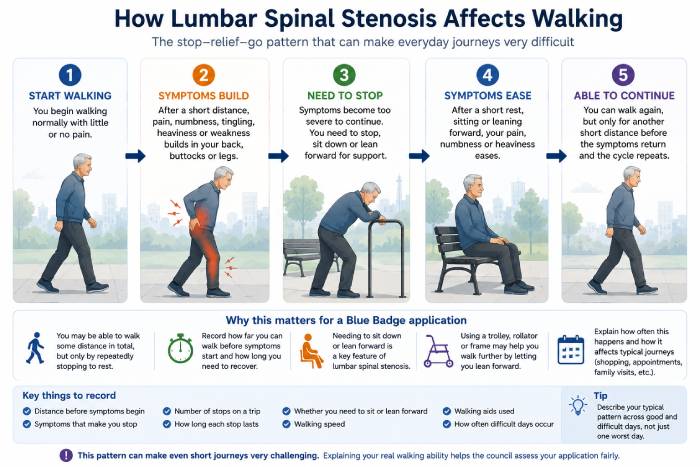
How far can you walk with spinal stenosis?
Walking distance can be particularly informative in spinal stenosis because symptoms often develop after standing or walking for a certain amount of time.
Avoid vague statements such as:
“I cannot walk very far.”
Instead, try to describe your real pattern.
For example:
“I can usually walk approximately 30 to 40 metres before pain and heaviness develop in both legs. I then need to sit or lean forward for several minutes before I can continue.”
Or:
“I need three stops between the disabled parking area and the entrance to my supermarket. If I cannot find somewhere to sit, I struggle to complete the journey.”
Only use distances and examples that genuinely reflect your mobility.
Is there a Blue Badge walking-distance rule?
There is no single UK-wide distance that automatically guarantees or prevents eligibility.
However, Department for Transport guidance in England gives issuing authorities useful benchmarks when assessing very considerable difficulty whilst walking.
- If you are unable to walk 30 metres in total, your walking ability can be considered sufficiently limited to demonstrate very considerable difficulty.
- If you can walk between 30 and 80 metres, you may still qualify where other factors — such as pain, very slow pace or the manner in which you walk — demonstrate very considerable difficulty.
- If you can walk more than 80 metres, other evidence would normally be needed to demonstrate very considerable difficulty.
These figures are guidance used in England, not a simple UK-wide pass/fail test.
Your actual symptoms, walking speed, stops, balance, aids and outdoor mobility should be considered together.
Does needing to stop repeatedly count?
Yes. This can be highly relevant.
Someone with spinal stenosis may technically cover 100 metres eventually but only by:
- walking 20 or 30 metres;
- stopping;
- sitting or leaning forward;
- waiting for symptoms to ease;
- and then walking another short section.
That is very different from being able to walk 100 metres continuously and comfortably.
When describing your mobility, record:
- distance before your first stop;
- number of stops;
- how long each stop lasts;
- whether you need to sit rather than simply stand;
- and whether you can continue after resting.
Does walking speed matter?
Yes.
The England Blue Badge guidance considers walking speed as one part of the assessment.
As a guide:
- more than 90 metres per minute: brisk;
- 61 to 90 metres per minute: normal;
- 40 to 60 metres per minute: slow;
- less than 40 metres per minute: very slow.
If you cannot walk 40 metres in one minute including stops to rest, the England guidance describes this as an extremely slow pace that is likely to make walking very difficult when considered on its own.
This is not an automatic qualification rule, but it can help explain why measuring both distance and time is useful.
Do pain, numbness and weakness all count?
They can all be relevant where they affect your ability to walk.
Pain
England’s official guidance specifically includes pain experienced while walking or as a consequence of walking as a factor in the assessment.
If spinal stenosis causes severe pain after a certain distance, explain:
- where the pain occurs;
- how severe it becomes;
- how far you have walked when it starts;
- and how long it takes to ease.
Numbness and tingling
Numbness or pins and needles may affect confidence, foot placement or your ability to continue walking.
Do not simply list the symptom. Explain its functional effect.
For example:
“After walking for several minutes my left foot becomes numb and I become less confident placing it safely, so I have to stop.”
Leg weakness or heaviness
Weakness or heaviness can also be relevant if it slows you substantially, creates instability or forces you to stop.
Again, describe what actually happens during a journey.
Does leaning forward on a trolley or frame matter?
It can be a useful detail.
NHS spinal services describe improvement when sitting or bending forward as a common feature of lumbar spinal stenosis. Some people therefore find that they can walk farther when leaning over a shopping trolley or walking frame.
If this applies to you, explain both:
- how far you can walk upright without support; and
- how your mobility changes when leaning on a trolley, rollator or frame.
Do not assume that being able to walk farther with support automatically makes you ineligible. The authority should consider your overall mobility and your use of walking aids.
Does using a walking stick or frame automatically qualify?
No.
A mobility aid is relevant evidence, but using one does not by itself guarantee a Blue Badge.
Decision makers may consider:
- why you need the aid;
- how frequently you use it;
- whether it changes your walking distance;
- whether you still experience severe pain or weakness;
- and how normally you are able to walk while using it.
For spinal stenosis, a rollator or frame can be especially relevant if you use it both for support and because leaning forward reduces your symptoms.
Does an MRI scan prove Blue Badge eligibility?
No.
An MRI or other scan can provide useful medical evidence that spinal narrowing exists, but it does not determine Blue Badge eligibility by itself.
This is important because spinal stenosis varies greatly between people.
Some people have narrowing visible on imaging but few or no symptoms. Others experience severe walking limitations.
Therefore:
scan result ≠ walking ability.
Your scan can support the medical context, but the Blue Badge authority still needs evidence showing what happens when you walk.
What medical evidence is useful?
Depending on your circumstances, useful supporting evidence can include:
- a spinal specialist or orthopaedic clinic letter;
- a neurosurgery letter where relevant;
- your GP medical summary;
- physiotherapy or pain clinic reports;
- MRI or scan reports;
- details of nerve root injections or other procedures;
- information about prescribed medication;
- records of walking aids;
- and evidence about any related neurological or musculoskeletal conditions.
Medical evidence is particularly useful when it explains functional mobility, rather than simply confirming that spinal stenosis exists.
Should you keep a walking diary?
A short walking diary can be particularly useful for spinal stenosis because the condition often produces a repeatable walking-distance pattern.
For one or two representative weeks, you could record:
| What to record | Example |
|---|---|
| Distance before symptoms | 35 metres |
| Main symptom | Leg heaviness, pain and tingling |
| What makes you stop | Increasing weakness in both legs |
| Recovery position | Need to sit or lean forward |
| Recovery time | 3–4 minutes |
| Stops during journey | 3 stops between car and shop |
| Aid used | Rollator outdoors |
The aim is not to produce artificially precise numbers. It is to help you explain your typical mobility accurately.
What if symptoms are better on some days?
Explain the variation honestly.
If your walking ability changes, describe:
- how many difficult days you have in a typical week;
- how far you can walk on those days;
- what you can manage on better days;
- whether activity earlier in the day makes later walking harder;
- and whether the pattern is predictable.
In England, official guidance says it can be reasonable to consider whether the qualifying level of difficulty occurs more often than not.
Do not describe only one unusually severe day.
Do you automatically qualify through PIP?
You may qualify automatically if you already receive a qualifying disability benefit.
For someone whose spinal stenosis limits physical walking, the most relevant route is often PIP “moving around”.
Receiving 8 points or more under “moving around” can provide automatic Blue Badge eligibility.
The PIP rules for other mobility activities differ across the UK, so see our full guide to getting a Blue Badge on PIP.
Can you get a Blue Badge for spinal stenosis without PIP?
Yes.
PIP is not required for every Blue Badge application.
If you do not automatically qualify through a benefit, you may still qualify after an assessment of your mobility.
England
In England, the assessed route can apply where an enduring and substantial disability means that you are unable to walk or experience very considerable difficulty while walking.
For this route, an enduring disability is one expected to last for at least three years.
Factors such as pain, distance, walking speed, walking time, manner of walking, walking aids and outdoor mobility can all be considered.
Scotland
In Scotland, people who do not automatically qualify can still apply where they:
- cannot walk; or
- find walking very difficult.
The local council assesses the application.
Wales
In Wales, people with a permanent and substantial disability that means they cannot walk or have considerable difficulty walking may qualify, subject to assessment.
Northern Ireland
Northern Ireland operates its own Blue Badge scheme. One relevant route covers people with a permanent disability that means they cannot walk or have a lot of difficulty walking.
What if spinal stenosis surgery is planned?
Planned surgery does not automatically make you eligible or ineligible.
The important issue is your current disability and, where the applicable eligibility route requires it, how long your mobility problems are expected to continue.
This means you should avoid assuming:
“I qualify because I am waiting for spinal surgery.”
Equally, do not assume:
“I cannot apply because surgery might improve me.”
The authority needs evidence of your individual circumstances and prognosis.
This is particularly important in England, where the assessed route requires an enduring disability expected to last at least three years. If your medical team expects surgery to substantially resolve your mobility problem within a shorter period, that may be relevant to the eligibility decision.
If severe mobility problems are expected to remain despite treatment, provide evidence explaining why.
What if you also have arthritis?
Spinal stenosis commonly occurs alongside degenerative changes in the spine and other musculoskeletal conditions.
If arthritis also affects your hips, knees or spine, include it.
The authority can consider your overall mobility rather than forcing you to attribute every symptom to a single diagnosis.
See our guide to getting a Blue Badge for arthritis.
What if you have hip problems as well?
Hip arthritis, previous hip surgery or other hip conditions may further reduce walking distance and mobility.
If this applies, explain the combined effect.
You can also read Does a hip replacement qualify for a Blue Badge?
How to apply for a Blue Badge with spinal stenosis
- Check whether you qualify automatically through PIP or another qualifying category.
- Measure your typical walking pattern — distance before symptoms, stops and recovery time.
- Describe the symptoms that force you to stop, such as pain, numbness, heaviness or weakness.
- Explain your use of walking aids and whether sitting or bending forward is needed for recovery.
- Gather medical evidence supporting both your diagnosis and mobility limitations.
- Submit your application through the appropriate Blue Badge service.
- Attend an assessment if requested.
For the complete application process, see how to apply for a Blue Badge online.
Before starting, see our Blue Badge documents checklist.
What if your application is refused?
If your application is unsuccessful, read the reason carefully.
Check whether you clearly explained:
- how far you can walk before symptoms develop;
- which symptoms force you to stop;
- how many times you stop;
- how long you need to recover;
- whether sitting or leaning forward is necessary;
- your walking speed;
- your walking aids;
- how frequently severe mobility problems occur;
- and how long your disability is expected to continue.
If important evidence was overlooked or you have stronger evidence available, you may be able to request reconsideration depending on the process where you live.
See what to do after a Blue Badge refusal.
Official information
- GOV.UK — Blue Badge local authority guidance for England
- mygov.scot — Who else can get a Blue Badge
- GOV.WALES — Blue Badge eligibility
- nidirect — Northern Ireland Blue Badge eligibility
- South Tees Hospitals NHS — Lumbar spinal stenosis
The bottom line
Spinal stenosis can qualify you for a Blue Badge when it causes sufficiently severe and lasting difficulty walking, but the diagnosis or MRI result alone does not guarantee eligibility.
For lumbar spinal stenosis, some of the most useful evidence is particularly practical:
- how far you can walk before symptoms begin;
- whether pain, numbness, heaviness or weakness makes you stop;
- how often you need to stop;
- whether you need to sit or bend forward;
- how long symptoms take to settle;
- how slowly you walk;
- and whether you use a stick, rollator, frame or another person’s assistance.
If you automatically qualify through PIP, use that route. If you do not, provide evidence showing the actual effect spinal stenosis has on your ability to complete ordinary outdoor journeys.
And remember: a severe-looking scan does not necessarily mean severe walking disability, while a person’s genuine functional limitations cannot be understood from imaging alone.
Frequently asked questions
Does spinal stenosis automatically qualify you for a Blue Badge?
No. Spinal stenosis is not an automatically qualifying diagnosis. You may qualify automatically through a disability benefit or after assessment if it causes sufficiently severe walking difficulties.
Can I get a Blue Badge if I can walk but need to stop frequently?
Potentially. The authority can consider your distance, number of stops, walking speed, symptoms and recovery time. Being able to cover a total distance only by repeatedly stopping is different from walking it continuously and comfortably.
Does neurogenic claudication help a Blue Badge application?
It can be relevant because neurogenic claudication can cause pain, heaviness, weakness, numbness or tingling during standing and walking, often forcing the person to sit or bend forward. The application should describe the resulting functional walking limitation rather than relying on the medical term alone.
How far can you walk and still get a Blue Badge?
There is no simple UK-wide distance test. In England, someone unable to walk 30 metres in total can be considered to have very considerable difficulty walking. People able to walk 30 to 80 metres may still qualify where other factors show very considerable difficulty.
Does an MRI showing severe spinal stenosis qualify me?
No. MRI findings can support your diagnosis but do not prove Blue Badge eligibility. Some people have spinal narrowing without severe symptoms, so the authority needs evidence showing how the condition actually affects your walking.
Does using a rollator or walking frame qualify?
Not automatically. A walking aid is relevant evidence, particularly if you need it for stability or to lean forward and relieve symptoms, but the authority considers your overall walking ability.
Can I get a Blue Badge if spinal surgery is planned?
Potentially, but planned surgery itself does not determine eligibility. Your current mobility and expected prognosis matter. In England, the assessed route requires an enduring disability expected to last at least three years.
What evidence should I provide for spinal stenosis?
Useful evidence can include spinal specialist or GP letters, physiotherapy reports, MRI or scan reports, treatment information and a clear description of your walking distance, symptoms, stops, recovery time and use of walking aids.