

Yes. In England, Scotland and Wales, you can apply for a Blue Badge on behalf of someone else, such as your child, parent, partner or a person you care for.
The Blue Badge application must still be based on that person’s eligibility, circumstances and evidence.
You are simply helping to complete the application. The person you are applying for is the Blue Badge applicant and eventual badge holder — not you.
This distinction is important because their name, address, photograph, benefit information, medical evidence and mobility or journey difficulties must be used in the application.
Northern Ireland has a separate application system through nidirect, so applicants there should follow the Department for Infrastructure Blue Badge Unit’s instructions.
Can I apply for a Blue Badge for someone else?
Yes.
The official GOV.UK Blue Badge service for England, Scotland and Wales allows you to apply for:
- yourself;
- someone else;
- or an organisation.
You can therefore help someone who:
- does not use the internet;
- has difficulty completing forms;
- has a physical disability;
- has a learning disability;
- has a cognitive impairment;
- has a non-visible disability;
- is elderly;
- is a child;
- needs help gathering documents;
- or simply wants support completing the application.
The official Great Britain application service is available here:
GOV.UK — Apply for or reapply for a Blue Badge
Who can I apply for?
You might apply on behalf of:
- your mother or father;
- your husband, wife or partner;
- your child;
- another relative;
- someone you care for;
- a friend you regularly support;
- or another disabled person who needs help with the application.
You do not become the badge holder simply because you completed the form.
Applying for someone else: whose details do you use?
Use the details of the person the Blue Badge is for whenever the form asks about the applicant.
The Department for Transport’s model Blue Badge application form makes this particularly clear: if you apply for someone else, references to “you” in the applicant questions refer to the person the badge is for.
You should therefore normally provide the badge holder’s:
- full name;
- date of birth;
- home address;
- National Insurance number, if applicable;
- recent photograph;
- benefit details;
- medical information;
- supporting evidence;
- walking difficulties;
- journey difficulties;
- mobility aids;
- and existing Blue Badge details if reapplying.
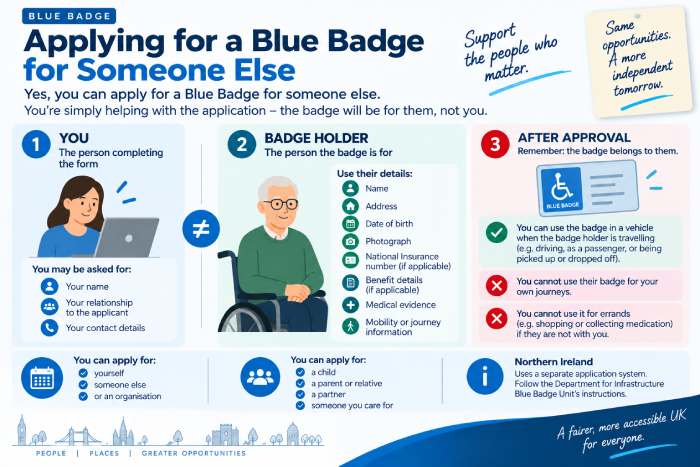
The form may separately ask for your name and your relationship to the applicant.
Do I put my name or their name on the application?
The applicant’s name should be the name of the person who needs the Blue Badge.
If you are completing the application for your mother, for example:
- Applicant: your mother;
- Badge photograph: your mother;
- Home address: your mother’s address;
- Benefit information: your mother’s;
- Medical evidence: your mother’s;
- Mobility answers: your mother’s circumstances;
- Person completing the form: you, where the form asks.
Do not accidentally make yourself the applicant because you are the person typing the answers.
Can I use my email address or phone number?
The application process may allow or request contact information for the person assisting with the application.
Where you are acting on someone’s behalf, make sure it is clear:
- who the badge holder is;
- who is completing the application;
- and which contact details the authority should use.
Do not replace the applicant’s residential address with your own simply because you are filling in the form, unless the application specifically asks for a separate correspondence address.
Do I need the person’s permission?
If an adult understands the application and can make their own decisions, you should normally complete it with their knowledge and agreement.
You will be providing potentially sensitive information about them, including:
- health conditions;
- disability;
- benefits;
- medical professionals;
- and daily mobility difficulties.
The application must accurately reflect their circumstances.
If the person cannot manage the application themselves because of cognitive impairment, learning disability or another reason, follow the instructions given by the authority handling the application and provide any representative information it asks for.
Do I need power of attorney to apply for someone else?
There is no general Great Britain rule saying you need a power of attorney simply to help someone submit a Blue Badge application.
GOV.UK expressly allows an application to be made for someone else.
However, more formal authority may be relevant in particular situations — for example where you are legally managing another adult’s affairs and the council needs to establish your authority to act.
Follow any specific request from the council rather than assuming a power of attorney is always required.
Can I apply for my elderly parent?
Yes.
You can help a parent complete their Blue Badge application.
The application should describe their circumstances, including:
- how far they can walk;
- how long walking takes;
- pain;
- breathlessness;
- balance;
- falls;
- mobility aids;
- help they need from another person;
- and any relevant journey difficulties.
Do not assume that being elderly automatically qualifies someone.
Blue Badge eligibility is based on the applicable disability and mobility criteria rather than age alone.
Can I apply for my husband, wife or partner?
Yes.
You can complete the application on behalf of your partner if they need help.
Again, the badge belongs to them.
This becomes especially important after approval: you cannot use their Blue Badge merely because you are their spouse or because you normally drive them.
Can I apply for my child?
Yes.
A parent or guardian can complete a Blue Badge application for a child.
The application uses the child’s:
- identity details;
- address;
- photograph where required;
- benefit information;
- medical evidence;
- and disability-related circumstances.
The parent’s role is to explain those circumstances accurately.
Can a child under 3 get a Blue Badge?
Yes, in specific circumstances.
In England, for example, a child under 3 can qualify if they have a medical condition that means:
- they must always be accompanied by bulky medical equipment that cannot be carried around without great difficulty;
- or they must always be kept near a vehicle so they can receive emergency medical treatment if necessary.
Other UK nations have comparable but nationally specific rules.
For a very young child, the parent or guardian naturally completes the application on their behalf.
What documents do I need when applying for someone else?
For England, Scotland and Wales, GOV.UK says a standard application normally requires:
- a recent digital head-and-shoulders photograph;
- proof of identity;
- proof of address;
- proof of benefits where relevant;
- the National Insurance number if the applicant has one;
- and current Blue Badge details if it is a reapplication.
These documents should normally relate to the person who will hold the badge, not the person filling in the form.
See what documents you need for a Blue Badge application.
Whose photograph should I upload?
The photograph must be of the person the Blue Badge is for.
Do not upload your own photograph simply because you are completing the application.
The Blue Badge identifies the disabled badge holder.
For Great Britain, GOV.UK asks for a recent digital photograph showing the applicant’s head and shoulders.
Whose National Insurance number do I use?
Use the applicant’s National Insurance number, if they have one.
Do not enter your own National Insurance number unless the form specifically asks for representative information separately.
Whose PIP or DLA details do I use?
The benefit evidence must relate to the person applying for the Blue Badge.
If you are applying for your father because he receives qualifying PIP, for example, the relevant PIP information is his — not yours.
The automatic PIP rules also differ around the UK.
See how Blue Badge eligibility through PIP works.
Can I answer the medical questions for someone else?
Yes, if you are completing their application — but the answers must describe their circumstances accurately.
You may be particularly well placed to help if you:
- regularly accompany them;
- help them walk;
- supervise them during journeys;
- manage their care;
- or regularly observe the difficulties they experience.
However, distinguish between:
- what you personally observe;
- what the applicant tells you;
- and what medical or professional evidence shows.
Do not exaggerate their difficulties because you think it will improve the application.
How should I describe their walking difficulty?
Give concrete information about the person you are applying for.
Where relevant, describe:
- how far they normally walk;
- how long it takes;
- whether they stop;
- pain;
- breathlessness;
- balance;
- falls;
- walking speed;
- mobility aids;
- physical assistance;
- and after-effects.
For help with this section, see how to answer Blue Badge application questions.
How do I apply for someone with dementia?
A family member or carer can help someone with dementia complete a Blue Badge application.
The relevant eligibility evidence may involve more than physical walking.
Depending on the applicable criteria, useful information can include:
- disorientation;
- wandering;
- difficulty following journeys;
- lack of awareness of traffic;
- risk near vehicles;
- need for continual supervision;
- and support required between the vehicle and destination.
Evidence from a memory clinic, occupational therapist, social-care professional or other relevant practitioner may be useful.
See what medical evidence can support a Blue Badge application.
Can I apply for someone with autism or a learning disability?
Yes.
You can complete the application on their behalf.
Where the relevant non-visible-disability criteria apply, describe what happens during journeys.
This might include:
- overwhelming psychological distress;
- lack of traffic awareness;
- risk of serious harm;
- behavioural responses;
- sensory overload;
- difficulty following a journey;
- or the need for another person’s supervision or intervention.
A diagnosis alone does not automatically establish eligibility.
Can a carer apply for a Blue Badge for someone?
Yes, in Great Britain a person caring for someone can complete the application on their behalf.
The official Department for Transport model form describes “someone else” as including a relative or somebody you care for.
You may be asked to provide:
- your name;
- your relationship to the applicant;
- and contact information.
The eligibility information must still relate to the disabled person.
Can a friend apply on my behalf?
The GOV.UK service allows an application for “someone else” and is not limited only to parents or professional carers.
If a friend is helping you, make sure:
- the application uses your information;
- you know what is being submitted where you are able to do so;
- the answers accurately describe your circumstances;
- and any representative details requested are completed correctly.
Can I sign the form for someone else?
The Department for Transport’s model paper application for England specifically provides for someone completing and signing a form on behalf of another applicant.
It also asks for the representative’s name and relationship to the applicant.
However, local paper forms can differ.
If using a paper application, follow the declaration and signature instructions printed on that exact form.
See how to get a Blue Badge paper application form.
Can I apply online for someone else?
Yes in England, Scotland and Wales.
GOV.UK explicitly allows the online service to be used for:
- yourself;
- someone else;
- or an organisation.
You can also save the application and return to it later if you need time to gather documents.
Can I apply for someone else in Northern Ireland?
Northern Ireland uses a separate system, so do not use the Great Britain GOV.UK application route.
nidirect says individual applicants and support organisations can apply online or by post through the Department for Infrastructure Blue Badge Unit.
The Northern Ireland application requires the individual applicant’s information and evidence, including where relevant:
- their photograph;
- their National Insurance number;
- benefit evidence;
- and supporting medical information.
If the applicant cannot complete the Northern Ireland application themselves and you need to act for them, contact the Blue Badge Unit for the correct current procedure rather than assuming the Great Britain representative process applies identically.
Blue Badge Unit:
- Phone: 0300 200 7818
- Email: bluebadges@infrastructure-ni.gov.uk
Official information:
nidirect — Apply for or renew a Blue Badge
See how to apply for a Blue Badge in Northern Ireland.
Can I renew someone else’s Blue Badge?
Yes in Great Britain.
The GOV.UK service allows you to reapply for someone else in the same way that you can help with a first application.
Remember that renewal is really a reapplication.
You may need updated:
- photograph;
- identity information;
- address information;
- benefit evidence;
- medical evidence;
- and current badge details.
See how to renew a Blue Badge.
Can I replace a lost Blue Badge for someone else?
Yes in England, Scotland and Wales through the GOV.UK replacement service.
GOV.UK specifically says you can request a replacement for:
- yourself;
- or someone else.
If the badge was stolen, a crime reference number is required through the Great Britain replacement service.
See what to do if a Blue Badge is lost, stolen or damaged.
If I apply for someone else, can I use their Blue Badge?
No — not for your own journeys.
This is one of the most important rules to understand.
A Blue Badge belongs to the disabled person named on it.
You can use the badge in a vehicle when the badge holder:
- is driving;
- is travelling as a passenger;
- is being picked up;
- or is being dropped off as part of the journey.
You cannot use their badge simply because:
- you applied for it;
- you are their carer;
- you are their spouse;
- you are their parent;
- the badge is normally kept in your car;
- or you are running an errand for them while they remain at home.
Using another person’s badge when the badge holder is not part of the journey can amount to misuse.
See can you share a Blue Badge with a family member?
Does the Blue Badge belong to the person or the car?
The badge belongs to the person, not a specific vehicle.
This means the badge holder can normally use it when travelling in:
- their own car;
- a relative’s car;
- a friend’s car;
- a carer’s vehicle;
- or another vehicle carrying them.
The vehicle itself does not become entitled to Blue Badge concessions when the badge holder is not travelling.
Can I use my parent’s Blue Badge when shopping for them?
Not if your parent is not part of the journey.
Doing someone’s shopping, collecting medication or completing another errand for them does not normally allow you to use their Blue Badge if they remain at home.
The badge is for journeys involving the badge holder.
What if I need to park while picking the badge holder up?
A Blue Badge can be used when the purpose of the parking is genuinely connected with picking up or dropping off the badge holder, subject to the normal parking rules at that location.
Do not use the badge as a general parking permit before or after a journey unrelated to them.
Can I apply for more than one person?
If you care for several eligible people, each individual normally needs their own Blue Badge application and their own eligibility assessment.
For example, if you have two disabled children who both qualify, each child’s circumstances are considered separately.
One person’s Blue Badge cannot simply be shared with another eligible family member.
Can two people in the same household both have a Blue Badge?
Yes, if each person qualifies individually.
Blue Badge eligibility is personal.
There is no one-badge-per-household rule.
Applying for someone else vs an organisational Blue Badge
These are not the same thing.
| Applying for someone else | Organisational Blue Badge |
|---|---|
| A badge for one named disabled person | A badge issued to an eligible organisation |
| You help complete their application | The organisation applies in its own capacity |
| The person’s own eligibility is assessed | The organisation must meet organisational criteria |
| Badge can travel with that person in different vehicles | Badge is used when transporting people who would qualify for a badge |
| Examples: child, parent, partner | Examples can include qualifying care homes, hospices or social-service organisations |
Should a care home apply for the resident or for an organisational badge?
It depends on the circumstances.
If the Blue Badge is intended for one particular resident who qualifies individually, an application can be made for that person.
An organisational badge is different.
GOV.UK says an organisation may qualify where it:
- cares for or assists disabled people who need a Blue Badge; and
- transports those people.
The council must also be satisfied that the organisation has a clear need for an organisational badge rather than simply using individual badges belonging to the people it transports.
See how to apply for an organisational Blue Badge.
Can a taxi company apply for an organisational Blue Badge?
Usually not simply because it transports disabled passengers.
GOV.UK guidance says taxi operators, private-hire companies and community transport operators are unlikely to qualify solely on that basis because they are not normally responsible for the care of the disabled people they transport.
An organisational badge is aimed at organisations that both care for or assist eligible disabled people and transport them.
Can I apply for someone who already has a Blue Badge?
If the badge is approaching expiry, you can help them reapply.
If it is still valid but has been lost, stolen or damaged, use the replacement process instead.
If it has already expired, stop using the old badge and submit a new reapplication.
See:
- how to renew a Blue Badge;
- what to do with a lost, stolen or damaged badge;
- what to do if a Blue Badge has expired.
What if the person qualifies automatically?
You can still complete the application for them.
Automatic eligibility means the relevant entitlement can establish qualification without the same level of further assessment.
However, you still need to:
- submit an application;
- provide identity and address information;
- provide or allow verification of the relevant entitlement;
- supply a suitable photograph;
- and complete the authority’s other administrative requirements.
What if they do not qualify automatically?
You can still apply for them if their circumstances may meet an assessed eligibility route.
The application needs to accurately explain:
- walking difficulties;
- pain;
- breathlessness;
- distance;
- time;
- mobility aids;
- health risks;
- non-visible disability difficulties;
- psychological distress;
- or safety risks during journeys.
The authority may ask for additional evidence or an assessment.
See what happens at a Blue Badge assessment.
Can I speak at the assessment for them?
If the applicant needs support during an assessment, contact the assessment provider beforehand and explain the situation.
A companion or carer can be particularly helpful where the applicant:
- has communication difficulties;
- has a cognitive impairment;
- needs reassurance;
- has difficulty remembering relevant events;
- or relies on that person during normal journeys.
The assessor may still want to understand the applicant’s own experience where possible.
Can I apply without telling the person?
If an adult understands and can make decisions about their own affairs, you should not normally submit sensitive disability and medical information on their behalf without their knowledge.
Where the person lacks capacity or another formal arrangement applies, follow the appropriate legal and local-authority procedure.
The Blue Badge application should never be used to:
- obtain a badge for someone who does not need or want one;
- gain parking concessions for another driver;
- or submit false information.
What if I make a mistake while applying for someone else?
If you notice an important error after submission, contact the authority processing the application.
This is particularly important if you entered incorrect:
- identity information;
- address;
- benefit details;
- walking information;
- medical information;
- or contact details.
Do not submit a second duplicate application simply to correct a mistake unless the authority tells you to do so.
How long does an application for someone else take?
Applying on someone’s behalf does not create a separate national processing timeframe.
Typical published timings remain:
- England: usually within 12 weeks;
- Scotland: around 12 weeks for most councils;
- Wales: around 12 weeks;
- Northern Ireland: normally 6 to 8 weeks from receipt.
Applications needing more evidence or assessment can take longer.
See how long a Blue Badge application takes.
How much does it cost?
The fee does not change simply because another person completes the application.
- England: up to £10;
- Scotland: most councils charge £20;
- Wales: free for individual Blue Badges;
- Northern Ireland: £10.
See how much a Blue Badge costs.
Checklist: applying for someone else
- ☑ Confirm the application is for the disabled person, not you.
- ☑ Use the applicant’s full legal name.
- ☑ Use their home address.
- ☑ Upload their photograph.
- ☑ Use their National Insurance number if applicable.
- ☑ Use their benefit information.
- ☑ Provide evidence about their disability.
- ☑ Describe their walking or journey difficulties.
- ☑ Enter your representative details where requested.
- ☑ Make sure the applicant agrees to the application where they are able to do so.
- ☑ Keep copies or confirmation details.
- ☑ Respond promptly if the authority requests more information.
- ☑ Remember the badge belongs to them.
- ☑ Never use their badge when they are not part of the journey.
Related Blue Badge application guides
- How to apply for a Blue Badge online
- Documents needed for a Blue Badge application
- What medical evidence do you need?
- How to answer Blue Badge application questions
- Can I get a Blue Badge on PIP?
- How to renew a Blue Badge
- How to apply for an organisational Blue Badge
- Can you share a Blue Badge with a family member?
Official guidance
- GOV.UK — Apply for yourself, someone else or an organisation
- GOV.UK — Blue Badge eligibility and applying on behalf of somebody else
- nidirect — Northern Ireland Blue Badge application process
The bottom line
Yes, you can apply for a Blue Badge for someone else in England, Scotland and Wales.
You might complete the form for:
- a child;
- an elderly parent;
- your partner;
- a relative;
- or someone you care for.
But remember the key rule: you are the person completing the form; they are the applicant and badge holder.
Use their identity, address, photograph, benefit information, medical evidence and mobility circumstances. Enter your own details only where the application asks who is completing it or what your relationship to the applicant is.
And after approval, the badge still belongs to them. You cannot use it for your own journeys merely because you applied for it, care for them or normally drive them.
Frequently asked questions
Can I apply for a Blue Badge for someone else?
Yes. The GOV.UK Blue Badge service for England, Scotland and Wales explicitly allows you to apply for yourself, someone else or an organisation. The person you are applying for remains the applicant and badge holder.
Can I apply for my elderly parent?
Yes. You can complete the application for your mother or father. Use their personal details, photograph, benefit information, medical evidence and mobility circumstances.
Can I apply for my child?
Yes. A parent or guardian can complete a Blue Badge application for a child, including applications under the specific eligibility rules for children under 3.
Can a carer apply for a Blue Badge for someone?
Yes in Great Britain. The official application system allows someone else to complete the form, and the Department for Transport model form specifically gives a relative or somebody who cares for the applicant as an example.
Do I need power of attorney?
There is no general Great Britain requirement to hold power of attorney simply to help another person complete a Blue Badge application. The authority may ask for representative information or evidence of authority in particular circumstances.
Whose details do I use when applying for someone else?
Use the details of the person the badge is for: their name, address, photograph, National Insurance number if applicable, benefits, medical evidence and mobility information. Your own details are entered separately where the form asks who is completing the application.
Whose photo should I upload?
Upload a recent photograph of the person who will hold the Blue Badge, not the person completing the application.
Whose National Insurance number should I use?
Use the National Insurance number of the Blue Badge applicant if they have one, not your own.
Can I answer the mobility questions for them?
Yes if you are completing their application, but the answers must accurately describe the applicant’s real circumstances. Give specific information about walking, pain, breathlessness, support, risks or journey difficulties where relevant.
Can I apply online for another person?
Yes in England, Scotland and Wales. GOV.UK explicitly allows the online Blue Badge application service to be used for someone else.
Can I apply for someone else in Northern Ireland?
Northern Ireland uses a separate nidirect system. Individual applications must be based on the disabled person’s details and evidence. If that person cannot complete the application themselves, contact the Department for Infrastructure Blue Badge Unit for the correct representative procedure.
Can I renew someone else’s Blue Badge?
Yes in Great Britain. You can help another person reapply before their badge expires. The renewal is still based on that person’s eligibility and evidence.
Can I use their Blue Badge because I applied for it?
No. The Blue Badge belongs to the disabled person. You can display it only for a journey involving the badge holder, such as when they are driving, travelling as a passenger or being picked up or dropped off.
Can I use my parent’s Blue Badge to shop for them?
Not if your parent is not part of the journey. Running an errand on their behalf does not normally allow you to use their Blue Badge while they remain at home.
Is applying for someone else the same as applying for an organisational Blue Badge?
No. Applying for someone else creates an individual badge for one named disabled person. An organisational badge is issued to a qualifying organisation that both cares for or assists eligible disabled people and transports them.