
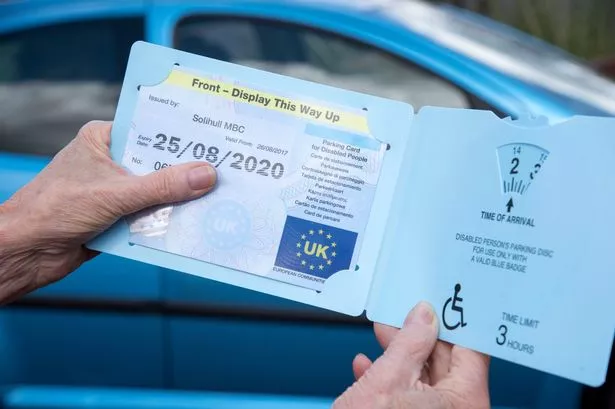

To display your Blue Badge correctly, place it where it can be clearly read from outside the vehicle, with the front/display side facing upwards and the photograph side hidden from view.
In England and Wales, you must also display the blue parking clock when using yellow-line parking or another concession with a time limit.
The exact wording on the badge differs slightly across the UK, but the basic rule is the same: enforcement officers must be able to clearly see and read the valid display side of the badge from outside the vehicle.
Displaying the wrong side, covering the expiry details, using an illegible or expired badge, or forgetting the parking clock when it is required can result in a Penalty Charge Notice.
How do you display a Blue Badge correctly?
Follow these basic steps whenever you are using a Blue Badge parking concession:
- Place the badge on the dashboard or fascia panel, or another clearly visible position if your vehicle does not have one.
- Put the front/display side facing upwards.
- Do not display the photograph side through the windscreen.
- Make sure all information on the visible side can be clearly read.
- Display the blue parking clock when the parking concession requires one.
- Check the parking sign for any local or site-specific display requirements.
Do not cover the badge with:
- parking tickets;
- receipts;
- papers;
- sunshades;
- phone holders;
- or other objects on the dashboard.
Which side of the Blue Badge should face up?
The front/display side — not the side containing the holder’s photograph.
This is one of the most common sources of confusion.
| Nation | Which side should face up? | Should the photo be visible? |
|---|---|---|
| England | Front facing upwards, showing the hologram | No |
| Scotland | Side marked “Front – display this way up” | No need to display the photo side |
| Wales | Front facing upwards, showing the wheelchair symbol | No |
| Northern Ireland | Front facing upwards, showing the hologram | No |
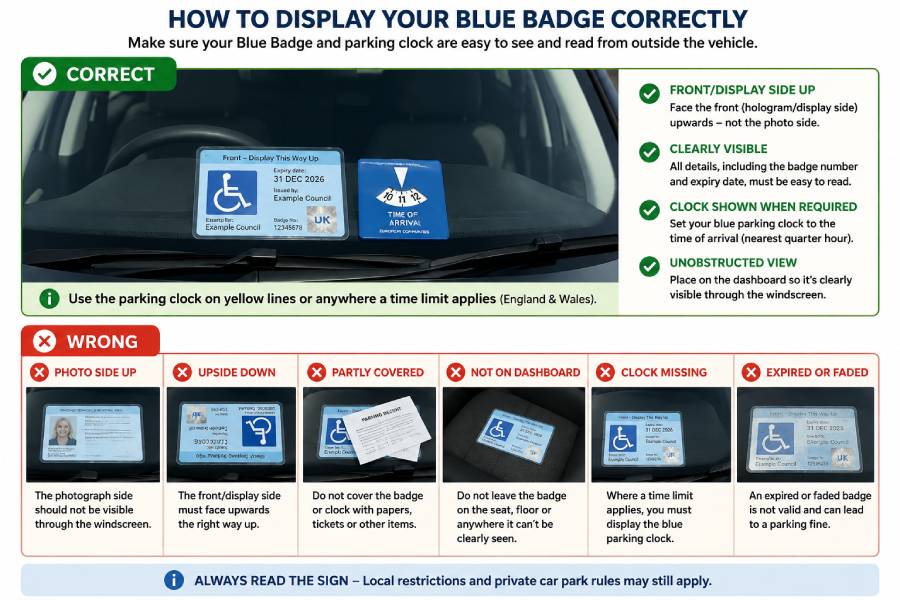
The safest practical approach is simple:
look for the side intended for display and keep the photograph side facing down.
Should the photograph on a Blue Badge be visible?
No.
In England, Wales and Northern Ireland, the official guidance explicitly says the side containing the photograph should not be visible through the windscreen.
The photograph exists so authorised officers can check that the badge belongs to the correct person when necessary.
It is not the side that should normally face upwards while the vehicle is parked.
Where should you put a Blue Badge in the car?
In England, Wales and Northern Ireland, official guidance says the badge should normally be displayed on the:
- dashboard; or
- fascia panel
where it can be clearly read through the front windscreen.
If your vehicle does not have a suitable dashboard or fascia panel, place it somewhere else where it can still be clearly read from outside the vehicle.
Scotland uses the same practical principle: the badge must be completely visible from outside the vehicle.
Does the Blue Badge have to be on the dashboard?
Usually that is the correct place, but visibility is the key requirement.
If your vehicle has a dashboard or fascia panel, use it.
If it does not, official guidance allows the badge to be displayed elsewhere provided it can be clearly read from outside.
This can be relevant for:
- some adapted vehicles;
- motorcycles;
- specialist mobility vehicles;
- and vehicles with unusual dashboard layouts.
In Wales, official guidance specifically states that a badge can be attached to a bike where it can be clearly seen.
Should the badge be visible through the front windscreen?
Yes, where the vehicle has a conventional windscreen and dashboard.
An enforcement officer should not have to:
- open the vehicle;
- look through the side windows;
- move objects;
- or guess whether the badge is valid.
The display side should be easy to inspect from outside.
What information needs to be visible?
The information on the display side must remain clearly legible.
Depending on the badge design, this includes identifying information such as:
- the badge number;
- expiry information;
- security features such as the hologram;
- and other information printed on the front/display side.
You should not place the badge in a position where part of this information is hidden.
What if my Blue Badge is faded or difficult to read?
Do not continue relying on an illegible badge.
Official England and Northern Ireland guidance specifically says that if information becomes unreadable because of fading or wear and tear, the badge should be returned to the issuing authority so that a replacement can be issued.
Displaying an illegible badge can result in a parking penalty.
Check your badge periodically for:
- fading;
- cracking;
- damage;
- water damage;
- an unreadable expiry date;
- or other deterioration.
When do I need to display the Blue Badge parking clock?
This depends on where in the UK you are parking.
England
You need the blue parking clock when:
- parking on single or double yellow lines under the Blue Badge concession;
- or parking somewhere else where the Blue Badge concession has a time restriction.
Wales
Wales uses the same basic principle.
The clock is required when:
- parking on yellow lines;
- or using another parking place with a time restriction.
Scotland
Scotland does not use the same general national parking-clock requirement as England and Wales for its ordinary on-street Blue Badge concessions.
However, individual car parks can set their own rules and may require a parking clock.
Northern Ireland
Northern Ireland does not generally require the Blue Badge parking clock in the same way as England and Wales.
nidirect specifically advises that parking clocks are required in England and Wales under certain circumstances, so Northern Ireland badge holders travelling elsewhere should check the rules before parking.
How do I set the Blue Badge parking clock?
Where the clock is required, set it to show the quarter-hour period during which you arrived.
This is the wording used in the official England and Wales guidance.
Do not set it to:
- the time you expect to leave;
- the end of your permitted stay;
- a later time to gain extra parking;
- or an arbitrary rounded time.
It represents your arrival period.
Where should I put the parking clock?
Where required, display the clock:
- on the dashboard or fascia panel;
- next to or close to the Blue Badge;
- with the time clearly visible;
- and where it can be read through the front windscreen.
If there is no dashboard or fascia panel, place it somewhere else where the time can still be clearly read from outside.
Can I use the parking clock without the Blue Badge?
No.
The parking clock does not provide a parking concession by itself.
When a concession requires both:
- the valid Blue Badge; and
- the parking clock,
you must display both correctly.
Northern Ireland’s official guidance explicitly states that a parking clock cannot be used instead of or without the Blue Badge.
Do I need the parking clock in a disabled bay?
Only if the bay or concession has a time restriction that requires it.
For example, in England an ordinary on-street disabled bay is generally free and without a time limit unless signs say otherwise.
If the sign says something such as:
“Disabled badge holders — 3 hours — no return within 1 hour”
then the time restriction applies and the clock should be used as required.
Always read the upright sign.
Do I need the clock in pay-and-display?
Not automatically.
In England, ordinary on-street pay-and-display parking is generally free and without a time limit for Blue Badge holders, so you do not normally need the parking clock simply because a pay-and-display machine is present.
However, if a local sign specifically imposes a Blue Badge time limit, follow that instruction.
The rules differ elsewhere in the UK.
See Blue Badge pay-and-display rules.
Do I need the clock on double yellow lines?
In England and Wales, yes.
When using the yellow-line concession, display:
- your valid Blue Badge; and
- the blue parking clock showing the quarter-hour period during which you arrived.
England and Wales normally allow up to three hours on single or double yellow lines where:
- no loading restriction applies;
- parking is safe;
- and the other Blue Badge conditions are met.
Scotland and Northern Ireland have different clock rules.
See Blue Badge parking on double yellow lines.
Do you display the Blue Badge differently across the UK?
The core display rule is very similar, but there are some differences worth knowing.
| Nation | Badge display | Clock rule |
|---|---|---|
| England | Front up showing hologram; photo side hidden | Required on yellow lines and where a time restriction applies |
| Scotland | Completely visible; “Front – display this way up” facing upwards | No equivalent general national clock requirement; individual car parks may require one |
| Wales | Front up showing wheelchair symbol; photo side hidden | Required on yellow lines and where a time restriction applies |
| Northern Ireland | Front up showing hologram; photo side hidden | No general requirement equivalent to England/Wales |
Do I need to display the badge in a private car park?
Follow the private car park’s rules.
The national Blue Badge scheme is primarily an on-street scheme.
A supermarket, shopping centre, airport or other private operator may require:
- the Blue Badge to be displayed;
- your number plate to be registered;
- ANPR validation;
- payment;
- a parking ticket;
- or another form of registration.
Displaying your badge correctly does not automatically mean private parking is free.
See using your Blue Badge in private car parks.
Do I need to display my badge in an NHS hospital car park?
The hospital may have its own registration procedure.
For example, a hospital could ask you to:
- display the physical badge;
- register your number plate;
- validate your badge at reception;
- or use an ANPR terminal.
Do not assume that putting the badge on the dashboard automatically registers you for a hospital parking concession.
Should I leave my Blue Badge displayed when I am not using it?
It is better to display the badge only when you are legitimately using a Blue Badge parking concession.
A Blue Badge is a valuable personal document.
Leaving it permanently visible in an unattended vehicle can:
- increase the risk of theft;
- cause confusion about whether a concession is being used;
- or expose the badge to sunlight and fading.
Store it securely when it is not needed.
Can I display my Blue Badge while driving?
A Blue Badge is intended to be displayed when you are using a parking concession.
You do not gain additional driving rights simply by displaying it while the vehicle is moving.
A Blue Badge does not automatically allow you to:
- drive in bus lanes;
- ignore no-entry restrictions;
- use prohibited roads;
- or ignore traffic signs.
Remove or securely store the badge when it is not being used for parking.
What are the most common Blue Badge display mistakes?
| Mistake | Correct approach |
|---|---|
| Displaying the photograph side | Display the front/display side instead |
| Badge upside down | Front/display side facing upwards |
| Part of badge hidden under paperwork | Keep the whole display side visible |
| Badge left on seat or floor | Place it where it can clearly be read from outside |
| Expired badge | Renew before relying on it |
| Faded or unreadable badge | Request a replacement |
| Clock missing on yellow lines in England/Wales | Display badge and correctly set clock |
| Clock set to departure time | Set it to the quarter-hour period during which you arrived |
| Assuming clock is always required | Use it when the concession or sign requires it |
Can I get a parking ticket for displaying my Blue Badge incorrectly?
Yes.
Official guidance in England, Wales and Northern Ireland expressly warns that incorrect or illegible display can result in a parking fine or Penalty Charge Notice.
Examples include:
- displaying the photograph side;
- leaving the badge where it cannot be read;
- obscuring the expiry details;
- displaying an illegible badge;
- or failing to display the required parking clock.
How much is the fine for displaying a Blue Badge incorrectly?
There is no single UK-wide PCN amount for incorrect Blue Badge display.
The amount depends on factors such as:
- the local authority;
- the type of parking contravention;
- the location;
- and whether the parking is public or private.
This is why it is better not to rely on a generic figure such as £70 or £130.
The notice itself should state:
- the amount due;
- any discounted payment period;
- the alleged contravention;
- and your challenge or appeal rights.
Is incorrect display the same as Blue Badge misuse?
No.
There is an important distinction between:
- displaying a legitimate badge incorrectly; and
- misusing a Blue Badge.
Incorrect display could involve:
- putting the badge upside down;
- forgetting the parking clock;
- or accidentally obscuring part of it.
Misuse is more serious and can include:
- using somebody else’s badge;
- allowing family or friends to borrow it;
- using an expired or cancelled badge;
- altering or copying a badge;
- or displaying a badge when the holder is not genuinely involved in the journey.
Relevant Blue Badge misuse offences can lead to prosecution and, in parts of the UK, a fine of up to £1,000.
See can you share a Blue Badge with a family member?
What if my Blue Badge slips off the dashboard?
This can unfortunately still lead to enforcement if the badge cannot be seen when the vehicle is inspected.
To reduce the risk:
- place the badge on a stable, flat area;
- avoid placing it on a steep or slippery dashboard surface;
- close doors carefully so air movement does not dislodge it;
- and check through the windscreen before walking away.
A useful habit is to walk to the front of the vehicle and look through the windscreen yourself.
If you cannot easily read the badge and clock, an enforcement officer may have the same problem.
What if I forgot to display my Blue Badge and received a PCN?
Having a valid Blue Badge does not automatically cancel a parking penalty if the concession required the badge to be displayed.
However, if you believe there are mitigating circumstances, check the challenge process on the notice.
Useful evidence can include:
- a copy or photograph of your valid Blue Badge;
- proof that it was valid on the date of the parking event;
- photographs of the location;
- and an explanation of what happened.
Whether the authority cancels the notice depends on the circumstances and its legal and discretionary powers.
What if the badge was displayed but the officer could not read it?
If you receive a PCN, check:
- whether the badge was facing the correct way;
- whether any part was obscured;
- whether it had faded;
- whether the expiry date was visible;
- and whether the required clock was displayed.
If you have evidence showing that the badge was correctly displayed and legible, include that evidence in any challenge.
What should I do with an expired Blue Badge?
Do not continue displaying it.
A Blue Badge normally lasts for up to three years, although some badges can have a shorter validity period.
The expiry date printed on your badge is what matters.
Using an expired badge can lead to enforcement action and may constitute misuse.
See how to renew your Blue Badge.
Can someone else display the badge for me?
Yes, where they are legitimately driving or assisting the badge holder.
If you are travelling as a passenger, the driver may physically place the badge and clock on the dashboard for you.
The badge holder is still responsible for ensuring the concession is being used correctly.
Official guidance also specifically advises blind badge holders to make sure anyone displaying the badge or clock for them understands how to do it correctly.
Does correct display mean I can park anywhere?
No.
A perfectly displayed Blue Badge does not override a parking restriction where the badge gives no concession.
You can still receive a PCN if you correctly display the badge but park:
- in a loading bay where you are not permitted;
- where a loading restriction applies;
- in a residents’ bay without an applicable exemption;
- on pedestrian crossing zig-zags;
- at a bus stop clearway;
- where parking causes an obstruction or danger;
- or in another prohibited location.
See where you can park with a Blue Badge.
Blue Badge display checklist
Before walking away from your vehicle, check:
- ☑ The badge is valid and in date.
- ☑ The front/display side is facing upwards.
- ☑ The photograph side is not facing the windscreen.
- ☑ The entire badge can be clearly read from outside.
- ☑ Nothing is covering the badge.
- ☑ The parking clock is displayed if required.
- ☑ The clock shows the correct arrival quarter-hour period.
- ☑ You have read the parking sign.
- ☑ The Blue Badge concession actually applies at that location.
Official Blue Badge display guidance
For the current official rules in each part of the UK:
- GOV.UK — How to display a Blue Badge in England
- mygov.scot — Showing your Blue Badge in Scotland
- GOV.WALES — How to display a Blue Badge and parking clock
- nidirect — Displaying a Blue Badge in Northern Ireland
The bottom line
Display your Blue Badge with the front/display side facing upwards and the photograph side hidden.
Make sure the badge:
- is clearly visible from outside;
- is fully legible;
- has not expired;
- and is not covered by anything on the dashboard.
In England and Wales, also display the blue parking clock when parking on yellow lines or using another time-limited Blue Badge concession, setting it to the quarter-hour period during which you arrived.
Scotland and Northern Ireland have different general clock rules, so do not automatically apply England’s parking-clock requirement throughout the UK.
And remember: displaying your badge perfectly does not make an otherwise prohibited parking place legal. Always check the signs before leaving your vehicle.
Frequently asked questions
Which side of a Blue Badge should face up?
Display the front or display side facing upwards. In England and Northern Ireland this is the side showing the hologram; Wales describes the front as showing the wheelchair symbol; Scotland says to display the side marked “Front – display this way up”.
Should the photo on my Blue Badge be visible?
No. Official guidance in England, Wales and Northern Ireland specifically says that the photograph side should not be visible through the windscreen.
Where should I place my Blue Badge?
Normally place it on the dashboard or fascia panel where it can be clearly read through the front windscreen. If your vehicle does not have a suitable dashboard, display it somewhere else where it can clearly be read from outside.
Do I always need to display the parking clock?
No. In England and Wales, the clock is required when parking on yellow lines or using another concession with a time restriction. Scotland and Northern Ireland do not use the same general national clock requirement, although individual parking places can have their own rules.
How do I set the Blue Badge parking clock?
Where the clock is required, set it to show the quarter-hour period during which you arrived. It should show your arrival period, not your planned departure time.
Do I need the clock in a disabled bay?
Only where the disabled bay or local Blue Badge concession has a time restriction requiring the clock. Always check the sign.
Do I need the parking clock in pay-and-display?
Not automatically. For example, ordinary on-street pay-and-display parking in England is generally free and without a time limit for Blue Badge holders. Use the clock if the local restriction specifically requires it.
Can I get a PCN for displaying my Blue Badge incorrectly?
Yes. A badge that is upside down, obscured, illegible or incorrectly displayed can result in a parking penalty. Failure to display the parking clock when it is required can also lead to enforcement.
How much is the fine for displaying a Blue Badge incorrectly?
There is no single UK-wide amount. Penalty Charge Notice levels vary according to the authority, location and parking contravention. Check the notice itself for the amount and challenge or payment options.
What if my Blue Badge falls off the dashboard?
If it cannot be seen when the vehicle is inspected, a PCN may still be issued. Check the badge through the windscreen before leaving the vehicle and use a stable position on the dashboard.
Can I appeal if I forgot to display my Blue Badge?
You can normally submit a challenge according to the procedure on the parking notice, but having a valid Blue Badge does not automatically cancel a PCN where display was required. Provide evidence and explain the circumstances.
Can I use an expired Blue Badge?
No. An expired badge is no longer valid and should not be used to claim Blue Badge parking concessions.
Can I display the Blue Badge while driving?
The badge is intended to be displayed when using a parking concession. It does not provide additional driving rights, so there is normally no reason to display it while driving.