


Yes, fibromyalgia can qualify you for a Blue Badge if its symptoms cause severe and lasting difficulty walking or, in some circumstances, serious difficulties when making journeys. However, fibromyalgia does not automatically qualify you simply because you have been diagnosed with the condition.
For many applicants, the strongest route is showing how widespread pain, fatigue, stiffness and other symptoms reduce walking distance, slow their pace or force them to stop and rest.
Fibromyalgia is also a fluctuating and non-visible condition, which can make an application more difficult to explain. The important thing is to describe what happens across a typical period of time rather than only describing your best day or your worst day.
Fibromyalgia is one of many conditions that can potentially support eligibility. See our main guide to Blue Badge eligibility for medical conditions for the wider criteria.
Does fibromyalgia qualify you for a Blue Badge?
Fibromyalgia is not an automatically qualifying diagnosis.
The NHS describes fibromyalgia as a long-term condition that causes widespread pain. Other common symptoms can include:
- increased sensitivity to pain;
- muscle stiffness;
- severe tiredness or fatigue;
- sleep problems;
- headaches;
- and difficulties with concentration or memory, often known as “fibro fog”.
Symptoms can also change over time, sometimes becoming significantly better or worse.
For Blue Badge purposes, the diagnosis is therefore only the starting point. What matters is how those symptoms affect your ability to walk or complete journeys.
How fibromyalgia can affect walking
Some people with fibromyalgia can walk relatively normally despite their diagnosis. Others experience pain and fatigue after very short distances.
You may have a stronger Blue Badge application if fibromyalgia means you:
- can only walk a short distance before severe pain or exhaustion forces you to stop;
- walk substantially more slowly than other people;
- need frequent rest stops;
- need a stick, crutch, frame or another person’s assistance;
- have difficulty maintaining your walking ability repeatedly throughout the day;
- experience significant pain after walking;
- or regularly have symptoms severe enough that accessing shops, appointments or other destinations is extremely difficult without parking nearby.
The key is to explain your functional mobility, rather than simply stating that fibromyalgia causes pain.
What does the council look at?
The exact rules vary across the UK, but where your application is based on physical walking difficulty, decision makers may consider several factors together.
Walking distance
Explain approximately how far you can realistically walk before symptoms become severe.
Instead of:
“I cannot walk very far because of fibromyalgia.”
a more useful description might be:
“On most difficult days, I can walk approximately 35 metres before widespread pain and fatigue force me to stop. I normally need several minutes before I can continue.”
Only use distances that genuinely reflect your experience.
Pain during or after walking
In England, official Blue Badge guidance specifically tells councils to consider pain experienced while walking or as a consequence of walking.
This is particularly relevant to fibromyalgia because the impact of walking may not always end when you stop moving.
If walking causes pain that lasts afterwards, explain:
- when the pain begins;
- how severe it becomes;
- how long it lasts;
- and how it affects your ability to continue with the journey.
Walking speed
You may technically be capable of covering a certain distance but need much longer than someone without a mobility impairment.
In England, the Department for Transport uses walking speed as one of several assessment factors. Walking at less than around 40 metres per minute, including stops to rest, is considered an extremely slow pace.
This is not a standalone UK-wide pass/fail test, but it shows why recording your actual walking time can be useful.
How long you can walk
Time can matter as well as distance.
If pain and fatigue mean you can only continue walking for a short period before having to stop, explain that clearly.
Walking aids
If you use a:
- walking stick;
- crutch;
- walking frame;
- rollator;
- wheelchair for longer journeys;
- or another person’s assistance;
include that information and explain when and how often you need the aid.
How far must you be able to walk?
There is no single UK-wide distance that automatically determines whether someone with fibromyalgia receives a Blue Badge.
However, England’s Department for Transport guidance provides useful assessment benchmarks:
- if someone is unable to walk 30 metres in total, they can be considered to have very considerable difficulty walking;
- someone able to walk between 30 and 80 metres may still qualify when other factors such as severe pain, extremely slow pace or manner of walking demonstrate very considerable difficulty;
- someone able to walk more than 80 metres may still need other strong evidence demonstrating very considerable walking difficulty.
These figures should not be treated as a simple test to “pass”. Your application should describe your actual ability honestly.
Can fatigue from fibromyalgia count?
Yes, fatigue can be relevant when it materially restricts your ability to walk.
The NHS identifies tiredness and fatigue as a common feature of fibromyalgia, and PIP’s “moving around” assessment specifically considers whether a person can physically move around without severe discomfort such as pain or fatigue.
For a Blue Badge application, avoid simply writing:
“I have extreme fatigue.”
Instead explain the practical result:
“After walking from the car park to the pharmacy, I am often too exhausted to walk back without sitting and recovering first.”
That tells the authority much more about your real mobility.
What if your fibromyalgia symptoms fluctuate?
This is one of the most important parts of a fibromyalgia Blue Badge application.
Fibromyalgia symptoms can change considerably. You might be able to walk reasonably well on one day but struggle severely on another.
In England, Department for Transport guidance says authorities can reasonably consider whether the qualifying level of difficulty occurs “more often than not”.
That means you should not describe only:
- your very best day; or
- an unusually severe day.
Instead, explain the pattern.
For example:
- How many days per week are significantly difficult?
- How far can you normally walk on those days?
- How different are your better days?
- How often do flare-ups occur?
- How long do they normally last?
- Do activities earlier in the day reduce what you can manage later?
- How long does it take you to recover after walking?
A short mobility diary can make this much easier to explain.
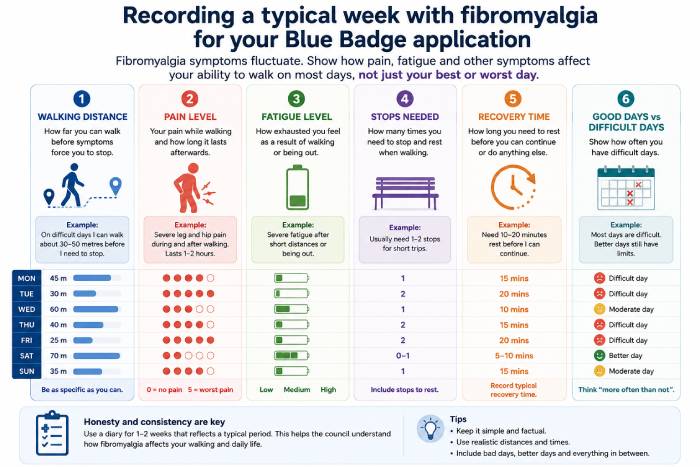
Should you keep a fibromyalgia mobility diary?
It can be very useful.
A diary does not automatically prove eligibility, but it can help you give specific and consistent answers.
For one or two representative weeks, consider recording:
| What to record | Example |
|---|---|
| Walking distance | Approximately 40 metres before stopping |
| Walking time | About 2 minutes including a rest |
| Pain | Severe widespread leg and hip pain after walking |
| Fatigue | Needed to sit for 10 minutes before continuing |
| Stops | Two stops between car and shop |
| Walking aid | Used walking stick |
| Recovery | Pain remained significantly worse for the next hour |
Do not manufacture exact figures if you do not know them. The purpose is to describe your typical experience as accurately as possible.
What about “fibro fog” and hidden disability?
Fibromyalgia is commonly described as a non-visible or hidden condition, and the NHS recognises problems with concentration and memory — often called fibro fog — as possible symptoms.
However, an important distinction needs to be made:
having fibro fog does not automatically mean that you meet the Blue Badge criteria for non-visible disabilities or the PIP “planning and following journeys” rules.
For many people with fibromyalgia, the strongest Blue Badge argument remains the physical effect of pain and fatigue on walking.
If you also have substantial difficulties making journeys, those difficulties can be considered separately where the relevant criteria are met.
Can fibromyalgia qualify through PIP?
Potentially, yes.
A person with fibromyalgia may receive PIP because of the functional impact of the condition. Certain PIP mobility awards can then provide automatic Blue Badge eligibility.
PIP Moving Around
8 points or more under “moving around” can provide automatic Blue Badge eligibility across England, Scotland, Wales and Northern Ireland.
This is often the most directly relevant automatic route for someone whose fibromyalgia severely restricts their physical walking ability.
PIP Planning and Following Journeys
The rules differ by nation.
| Nation | Automatic journey-based PIP route |
|---|---|
| England | Exactly 10 points for descriptor E |
| Scotland | 12 points for planning and following a journey |
| Wales | 12 points for planning and following a journey |
| Northern Ireland | Separate journey-based eligibility criteria apply |
See our complete guide to Blue Badge eligibility on PIP before relying on a particular score.
Fibromyalgia and Descriptor E in England
This point deserves particular care.
In England, automatic eligibility through the PIP journey route requires exactly 10 points for descriptor E under “planning and following journeys”.
Descriptor E applies when someone:
cannot undertake any journey because doing so would cause overwhelming psychological distress.
The official PIP assessment guidance describes overwhelming psychological distress as a very high threshold. Feeling anxious, worried, physically tired or mentally exhausted about travelling does not by itself meet it.
Therefore:
- fibromyalgia does not automatically satisfy descriptor E;
- fibro fog does not automatically satisfy descriptor E;
- fatigue does not automatically satisfy descriptor E;
- and finding journeys physically exhausting does not automatically satisfy descriptor E.
If you have been awarded descriptor E because a relevant mental health or cognitive impairment causes overwhelming psychological distress, then that PIP award can provide automatic Blue Badge eligibility in England.
Otherwise, focus on the eligibility route that actually reflects your difficulties.
Can you get a Blue Badge for fibromyalgia without PIP?
Yes. You do not necessarily need PIP to get a Blue Badge.
If you do not automatically qualify through a disability benefit, you can still apply under the assessed criteria where your disability causes sufficiently severe mobility or journey difficulties.
For example, in England you may qualify after assessment if an enduring and substantial disability causes you to be unable to walk or experience very considerable difficulty while walking.
For this England route, the disability must be expected to last for at least three years.
Fibromyalgia itself is a long-term condition, but the council will still need to assess whether your individual mobility difficulties meet the required level.
What medical evidence should you provide?
There is no single test result that proves Blue Badge eligibility for fibromyalgia.
The NHS also notes that there is no specific test used to diagnose fibromyalgia. Diagnosis is based on symptoms and ruling out other possible causes.
Useful supporting evidence may therefore include:
- your GP medical summary;
- rheumatology, pain clinic or specialist correspondence;
- physiotherapy or occupational therapy reports;
- details of medication and treatment;
- evidence of walking aids;
- a mobility or symptom diary;
- information about other conditions affecting your mobility;
- and professional evidence explaining how your symptoms affect everyday activity.
Medical evidence is most useful when it supports your description of functional difficulty.
A letter saying only:
“This patient has fibromyalgia.”
is much less informative than evidence explaining that severe widespread pain and fatigue substantially restrict walking.
What if you have arthritis as well?
Fibromyalgia can occur alongside other conditions.
If you also have arthritis, include it in your application rather than trying to separate every symptom.
Arthritis can contribute additional:
- joint pain;
- stiffness;
- reduced range of movement;
- and physical walking difficulty.
Read our dedicated guide on getting a Blue Badge for arthritis.
What if you also have lupus?
Fibromyalgia can also coexist with lupus or other autoimmune and chronic pain conditions.
If several conditions contribute to your mobility problems, explain the combined effect rather than assuming the council will consider only one diagnosis.
See Can I get a Blue Badge with lupus?
How to apply for a Blue Badge with fibromyalgia
- Check whether you automatically qualify through PIP or another qualifying benefit.
- Record your typical walking ability, including distance, time, pain, fatigue and stops.
- Explain how symptoms fluctuate across a normal week.
- Gather supporting evidence from healthcare professionals and relevant records.
- Apply through the correct Blue Badge service for where you live.
- Provide additional evidence or attend an assessment if requested.
See our step-by-step guide to how to apply for a Blue Badge online.
Before starting, you can also use our Blue Badge application documents checklist.
What if your application is refused?
Do not assume that a refusal means fibromyalgia can never qualify.
Read the reason for the decision carefully.
If the authority says there was insufficient evidence of very considerable walking difficulty, check whether your application properly explained:
- walking distance;
- pain during or after walking;
- fatigue;
- walking speed;
- stops and recovery time;
- how often difficult days occur;
- walking aids;
- and the combined effect of other conditions.
If significant evidence was overlooked or the authority did not understand your circumstances, you may be able to ask for reconsideration.
See our guide to what to do after a Blue Badge refusal.
Official information
- GOV.UK — Blue Badge local authority guidance for England
- mygov.scot — Automatic Blue Badge eligibility
- GOV.WALES — Blue Badge eligibility
- nidirect — Northern Ireland Blue Badge eligibility
- NHS — Fibromyalgia
The bottom line
You can get a Blue Badge for fibromyalgia if the condition causes sufficiently severe mobility or journey difficulties, but the diagnosis itself does not automatically qualify you.
For many applicants, the strongest evidence will show:
- how far they can walk;
- how severe the pain becomes;
- how fatigue affects walking;
- how slowly they move;
- how often they need to stop;
- how long recovery takes;
- and how frequently difficult days occur.
If you automatically qualify through PIP, use that route. If not, a well-documented application can still succeed where your symptoms meet the assessed criteria.
Most importantly, do not assume that fibro fog, fatigue or anxiety automatically count as a PIP journey route. The criteria for overwhelming psychological distress are much more specific and differ from the physical mobility problems commonly caused by fibromyalgia.
Frequently asked questions
Does fibromyalgia automatically qualify you for a Blue Badge?
No. Fibromyalgia is not an automatically qualifying diagnosis. You may automatically qualify through a qualifying disability benefit, or you may qualify after assessment if fibromyalgia causes sufficiently severe mobility or journey difficulties.
Can fibromyalgia pain qualify me for a Blue Badge?
Potentially. Severe pain while walking or caused by the effort of walking is one of the factors that can be considered when assessing mobility difficulties. Your application should explain the severity, walking distance and practical consequences of the pain.
Can fatigue from fibromyalgia count?
Yes, when fatigue materially restricts your ability to walk. Explain how far and how long you can walk, how often you need to stop and how long you need to recover rather than simply stating that you experience fatigue.
Can I get a Blue Badge for fibromyalgia without PIP?
Yes. PIP is not required for every Blue Badge application. If you do not automatically qualify through a benefit, you may still qualify after assessment if your disability meets the relevant mobility or journey criteria.
Does fibro fog qualify under the PIP planning and following journeys route?
Not automatically. Fibro fog can involve concentration and memory difficulties, but it does not by itself mean that you meet the PIP journey descriptors or Blue Badge criteria. In England, automatic eligibility through descriptor E requires a qualifying PIP award based on overwhelming psychological distress, which has a very high threshold.
What if my fibromyalgia changes from day to day?
Explain how frequently difficult days occur, how severe they are and what you can manage on better days. A short mobility diary can help show the typical pattern rather than relying on one unusually good or bad day.
How far do I need to be able to walk?
There is no simple UK-wide distance test. In England, official guidance says someone unable to walk 30 metres in total can be considered to have very considerable difficulty walking, while people who can walk 30 to 80 metres may still qualify when other factors demonstrate severe difficulty.
What evidence should I provide for fibromyalgia?
Useful evidence can include GP or specialist records, pain clinic or physiotherapy reports, treatment information, evidence of walking aids and a diary showing walking distance, pain, fatigue, stops and symptom fluctuations.