


Yes, heart failure can qualify you for a Blue Badge if it causes severe breathlessness, fatigue or another mobility problem that makes walking very difficult or potentially dangerous to your health. However, having heart failure does not automatically qualify you simply because of the diagnosis.
The key question is what happens when you actually try to walk. Someone who becomes severely breathless after 20 or 30 metres, needs frequent stops or risks a serious deterioration in their health may have a much stronger Blue Badge application than someone whose heart failure is well controlled and does not substantially restrict walking.
Heart failure is one of many medical conditions that can potentially support eligibility. Our main guide explains what illnesses and disabilities may qualify you for a Blue Badge and why the functional effect of the condition matters more than the diagnosis itself.
Does heart failure qualify you for a Blue Badge?
Heart failure can qualify, but it is not an automatic qualifying diagnosis.
Heart failure means the heart is unable to pump blood around the body as effectively as it should. According to the NHS, common symptoms include:
- breathlessness during everyday activities or physical activity;
- severe tiredness or weakness;
- light-headedness or dizziness;
- swelling in the feet, ankles or legs;
- and reduced ability to tolerate physical activity.
For Blue Badge purposes, symptoms such as these become particularly relevant when they cause very considerable difficulty while walking or mean that walking significant distances could be dangerous to your health.
You may therefore have a stronger case if heart failure means you:
- become severely breathless after walking a short distance;
- have to stop and rest repeatedly;
- walk at a very slow pace because of breathlessness or fatigue;
- cannot walk for more than a short period;
- need another person or a mobility aid;
- experience dizziness, weakness or instability while walking;
- or have been advised that significant exertion could seriously affect your health.
Heart failure itself is not enough — the impact on walking matters
There is no Blue Badge rule saying that a particular type or stage of heart failure automatically qualifies.
Two people with the same diagnosis can therefore receive different decisions.
For example:
- Person A has heart failure but can walk several hundred metres at a normal pace without severe breathlessness.
- Person B becomes severely breathless after 25 metres, needs several minutes to recover and has to stop repeatedly.
Person B would generally have much more relevant evidence for a mobility-based Blue Badge application.
This is why simply writing “I have heart failure” on an application is unlikely to be enough. You should explain how the condition affects your ability to walk in real situations.
What does the council look at when assessing heart failure?
When heart failure causes physical walking difficulties, the assessment may consider several factors together.
1. How far you can walk
Try to give a realistic distance rather than saying only that you “cannot walk far”.
For example:
“After approximately 30 metres I become very breathless and have to stop for several minutes before continuing.”
In England, Department for Transport guidance gives local authorities useful benchmarks when assessing very considerable difficulty walking:
- someone unable to walk 30 metres in total can be considered to have very considerable difficulty walking;
- someone who can walk between 30 and 80 metres may still qualify when other factors such as severe breathlessness, very slow pace or the manner of walking demonstrate very considerable difficulty;
- walking more than 80 metres does not automatically rule someone out, but other evidence of very considerable difficulty would be needed.
These are assessment guidelines for England rather than a simple pass/fail walking test. Blue Badge rules and assessment practices differ elsewhere in the UK.
2. How breathless you become
Breathlessness is particularly relevant to people with heart failure.
England’s official Blue Badge guidance specifically tells councils to consider the degree of breathlessness experienced while walking or as a consequence of walking.
The breathlessness does not necessarily need to happen at the exact moment you are walking. What matters is whether it is a direct consequence of the effort of walking.
3. How fast you walk
A person may technically be able to cover a particular distance but take much longer than someone without a mobility limitation.
In England, walking at less than around 40 metres per minute, including stops to rest, is considered an extremely slow pace and can be relevant to the assessment.
4. How often you need to stop
Record approximately:
- how far you walk before stopping;
- how many times you normally stop;
- how long each rest lasts;
- and whether you can continue afterwards.
5. How long you can walk for
Walking time can also matter. Someone who can only walk for a very short period before severe symptoms force them to stop may have considerable difficulty even if they are technically capable of taking steps.
6. Whether walking could be dangerous to your health
This is particularly important for some people with serious heart conditions.
Official guidance in England specifically recognises that a person may be physically capable of walking normally but should not walk very far because the effort could present a danger to their health or cause serious deterioration.
This can be relevant to serious heart or chest conditions where excessive physical effort creates a significant medical risk.
If this applies to you, it is particularly useful to provide medical evidence explaining why significant walking or exertion should be limited.
Do you automatically qualify for a Blue Badge with heart failure?
Not because of heart failure itself.
However, you may qualify without further mobility assessment if you already meet one of the automatic or passported Blue Badge criteria.
One common route is Personal Independence Payment (PIP). For example, receiving 8 points or more under the PIP “moving around” activity can provide automatic eligibility.
Other automatic routes can include certain DLA, disability benefit, visual impairment and armed forces criteria.
The precise PIP rules differ across England, Scotland, Wales and Northern Ireland, particularly for the “planning and following journeys” activity, so see our dedicated guide to getting a Blue Badge on PIP before relying on a particular score.
What if you do not automatically qualify?
You can still apply based on the actual effect of heart failure on your mobility.
This is often the more relevant route for people whose main problem is severe breathlessness or exercise intolerance but who do not receive a qualifying mobility benefit.
Your issuing authority will consider the evidence you provide and decide whether your difficulties meet the criteria that apply where you live.
How long must heart failure affect you to qualify?
This is where it is particularly important not to apply one country’s Blue Badge rules across the whole UK.
England
For the assessed eligibility route in England, the disability causing very considerable difficulty while walking must be enduring and substantial.
Official Department for Transport guidance defines an enduring disability for this route as one expected to last for at least three years.
This means a short period of reduced mobility after a heart attack, operation or temporary illness would not normally qualify under this particular assessed route in England.
Wales
Wales is different because it has a temporary Blue Badge route for some people with a substantial mobility impairment expected to last at least 12 months.
The Welsh guidance includes serious illness and debilitating treatment among situations that may potentially be considered, although every application is assessed individually.
Scotland
In Scotland, people who do not automatically qualify can still apply if they cannot walk or find walking very difficult. The local council decides whether the eligibility criteria are met.
Northern Ireland
Northern Ireland operates a separate Blue Badge scheme. One assessed route covers people with a permanent disability that means they cannot walk or have a lot of difficulty walking.
Because the rules differ, avoid assuming that a duration mentioned for one UK nation automatically applies to another.
Can you get a Blue Badge after a heart attack or heart surgery?
Not necessarily. A heart attack, bypass operation, valve surgery or another cardiac procedure does not automatically qualify you for a Blue Badge.
If your mobility restriction is expected to be temporary while you recover, that may not meet the long-term criteria used by some parts of the UK.
However, if you have ongoing heart failure or another lasting cardiac condition that continues to cause severe breathlessness, fatigue or a medical risk when walking, you may still have grounds to apply.
Residents of Wales should also be aware of the separate temporary badge route mentioned above.
What medical evidence should you provide?
Strong evidence does more than prove that you have heart failure. It should help the decision maker understand how severely the condition affects your mobility.
Useful evidence may include:
- a cardiology clinic letter;
- a letter or medical summary from your GP;
- heart failure specialist nurse correspondence;
- hospital discharge summaries;
- details of medication and treatment;
- evidence of related conditions that also restrict mobility;
- your clinician’s description of your functional limitations;
- and, where recorded by your healthcare team, information such as your functional class or exercise tolerance.
Tests such as an echocardiogram or an ejection fraction measurement can provide medical context, but there is no specific ejection fraction that automatically qualifies someone for a Blue Badge.
The most important evidence for the badge assessment is usually how your condition affects walking and journeys.
Describe your breathlessness clearly
Rather than writing:
“I get breathless when walking.”
A more useful description would be:
“On level ground I can usually walk around 25 to 30 metres before becoming severely breathless. I then need to stop for around three minutes before I can continue. I normally need two or three stops between the car park and my local supermarket.”
Only give figures that genuinely reflect your experience. The aim is to help the authority understand your normal mobility, not to exaggerate your symptoms.
What if your heart failure symptoms vary?
Heart failure symptoms can fluctuate. The NHS notes that symptoms can vary from day to day and week to week.
If your ability to walk varies, explain:
- how many days per week you have significant difficulty;
- what you can manage on better days;
- what happens on worse days;
- whether swelling or breathlessness changes during the day;
- and how often your symptoms force you to abandon or shorten journeys.
A short diary recording walking distance, rest stops and symptoms over one or two weeks can help you provide specific information when completing the application.
What if you have other medical conditions as well?
Include them.
Blue Badge eligibility is based on your overall mobility difficulties rather than requiring you to isolate the effect of one diagnosis.
For example, someone may have heart failure together with arthritis, COPD, spinal disease, balance problems or another condition. The combined effect may be much greater than the effect of heart failure alone.
The broader criteria are explained in our guide to Blue Badge eligibility for medical conditions.
How to apply for a Blue Badge with heart failure
- Check whether you qualify automatically through PIP or another qualifying benefit.
- Gather medical evidence showing both your diagnosis and the effect on your mobility.
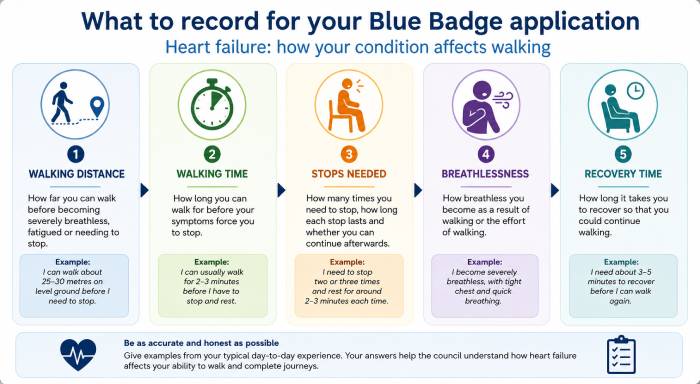
- Write down your realistic walking distance, walking time, number of stops and recovery time.
- Apply through the correct service for England, Scotland, Wales or Northern Ireland.
- Provide additional evidence if the authority requests it.
- Attend an assessment if one is needed.
For the complete process, see how to apply for a Blue Badge online.
Before starting, our Blue Badge documents checklist can help you prepare the information you may need.
What if your application is refused?
If your application is refused, read the decision carefully before applying again.
Possible reasons include insufficient evidence about:
- your actual walking distance;
- the severity of your breathlessness;
- how frequently your difficulties occur;
- the expected duration of your disability;
- or why walking presents a serious health risk.
If you believe relevant evidence was overlooked, you may be able to ask for the decision to be reconsidered. See our guide on what to do after a Blue Badge refusal.
Official information and medical guidance
- GOV.UK — Blue Badge local authority guidance for England
- mygov.scot — Who else can get a Blue Badge
- GOV.WALES — Blue Badge scheme guidance
- nidirect — Blue Badge eligibility criteria
- NHS — Heart failure
The bottom line
Heart failure can qualify you for a Blue Badge when its effects make walking very difficult or when significant walking could pose a serious risk to your health.
The diagnosis alone is not enough. Your application will be stronger if it clearly explains:
- how far you can walk;
- how breathless you become;
- how frequently you need to stop;
- how long you need to recover;
- and whether your medical team has advised you to limit exertion.
Remember that Blue Badge eligibility is not identical throughout the UK. In particular, the assessed route in England requires an enduring disability lasting at least three years, while Wales has a separate temporary route for certain mobility impairments expected to last at least 12 months.
Frequently asked questions
Does heart failure automatically qualify you for a Blue Badge?
No. Heart failure is not an automatically qualifying diagnosis. You may qualify automatically through a qualifying disability benefit, or after an assessment if heart failure causes sufficiently severe difficulty walking or makes walking dangerous to your health.
Can breathlessness qualify me for a Blue Badge?
Yes. Severe breathlessness caused by walking is specifically relevant to Blue Badge mobility assessments. The decision will consider factors such as how far you can walk, your pace, how often you stop and the severity of the breathlessness.
How far do you need to be able to walk to get a Blue Badge?
There is no single UK-wide distance that guarantees a Blue Badge. In England, official guidance says that someone unable to walk 30 metres in total can be considered to have very considerable difficulty walking. People able to walk between 30 and 80 metres may still qualify when other factors such as severe breathlessness or very slow walking demonstrate very considerable difficulty.
Does a low ejection fraction automatically qualify for a Blue Badge?
No. There is no specific ejection fraction threshold for Blue Badge eligibility. Medical test results can support your evidence, but the assessment focuses primarily on how your condition affects your mobility and journeys.
Can I get a Blue Badge while recovering from a heart attack or heart surgery?
It depends on where you live and whether your mobility problems are temporary or long term. In England, the assessed route requires an enduring disability expected to last at least three years. Wales has a separate temporary Blue Badge route for some substantial mobility impairments expected to last at least 12 months.
What evidence should I provide for heart failure?
Useful evidence can include cardiology letters, GP or heart failure nurse records, treatment information and a clear description of your walking distance, breathlessness, rest stops and recovery time. Medical evidence is most useful when it explains the functional effect of your condition rather than simply confirming the diagnosis.
Can I get a Blue Badge if walking is dangerous for my heart condition?
Potentially. England’s official guidance specifically recognises serious heart, chest or lung conditions where the effort of walking could endanger the person’s health or lead to serious deterioration. Medical evidence explaining the risk is important.