

An organisation can apply for an Organisational Blue Badge if it both cares for or assists disabled people who would qualify for Blue Badges in their own right and transports those people.
Having disabled passengers is not enough by itself. The issuing authority also needs to be satisfied that the organisation has a clear operational need for its own Blue Badge instead of simply using the individual badges belonging to the people it transports.
Common examples can include residential care homes, hospices and social-services departments. Taxi and private-hire businesses are generally unlikely to qualify simply because they transport disabled passengers.
What is an Organisational Blue Badge?
An Organisational Blue Badge is a Blue Badge issued to an eligible organisation rather than to one named disabled individual.
It is designed for organisations that:
- care for or assist disabled people;
- regularly transport those people;
- transport people who would qualify for an individual Blue Badge themselves;
- and have a genuine need for an organisational badge.
The badge allows authorised staff to use Blue Badge parking concessions while transporting eligible disabled people in the organisation’s care.
It is not:
- a general staff parking permit;
- a disabled parking permit for every vehicle owned by the organisation;
- a permit for transporting people who would not themselves qualify;
- or a badge employees can use while running ordinary business errands.
Who can get an Organisational Blue Badge?
The key test is normally two-part.
Your organisation must:
- care for or assist disabled people who would themselves qualify for a Blue Badge; and
- transport those people.
The authority must then decide that there is a clear need for an organisational badge rather than using individual passengers’ badges.
Organisations that may qualify
Official guidance gives common examples such as:
- residential care homes;
- hospices;
- local authority social-services departments;
- and similar organisations that both care for and transport groups of eligible disabled people.
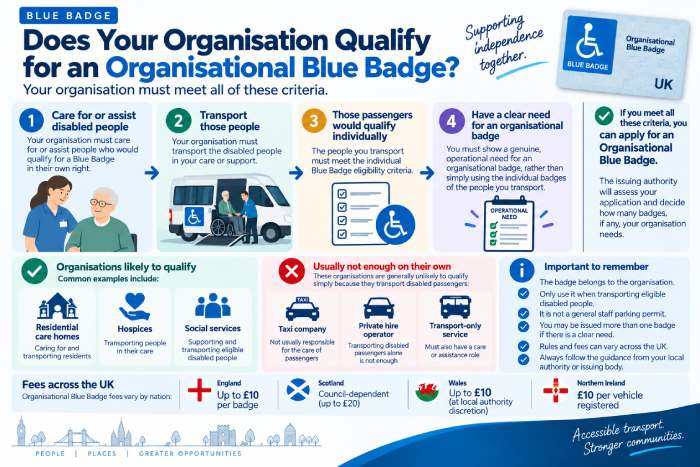
These are examples rather than an automatic eligibility list.
The council or issuing authority still assesses the organisation’s actual circumstances.
Does every care home automatically qualify?
No.
Being a care home does not automatically produce an Organisational Blue Badge.
The authority can consider:
- how many people in your care would qualify individually;
- how frequently you transport them;
- which vehicles are used;
- the types of journeys you make;
- whether residents already have individual Blue Badges;
- and why individual badges would not adequately meet your transport needs.
The organisation needs to demonstrate that the badge is genuine and necessary.
Can a hospice get an Organisational Blue Badge?
Potentially, yes.
Hospices are specifically mentioned in official England and Wales guidance as an example of organisations that may qualify where they both care for and transport people who meet individual Blue Badge eligibility criteria.
Can a council social-services department get one?
Yes, potentially.
Local-authority social-services departments are another example given in official guidance.
The relevant department must still demonstrate that it transports eligible disabled people and has a clear operational need for organisational badges.
Can a taxi company get an Organisational Blue Badge?
Usually not simply because it transports disabled passengers.
England’s Department for Transport guidance says taxi and private-hire operators are unlikely to qualify because they are not normally responsible for the care of the disabled people they transport.
A taxi driver carrying an individual Blue Badge holder can instead use that passenger’s personal Blue Badge for the qualifying journey, subject to the normal scheme rules.
Can a community transport organisation get one?
Transporting disabled people alone does not necessarily establish eligibility.
In Great Britain, official guidance generally focuses on organisations that both:
- care for or assist eligible disabled people;
- and transport them.
Some councils may examine the exact nature of a community transport operator’s activities differently, so the organisation should explain any genuine care or assistance role rather than relying only on the fact that it provides accessible transport.
Organisational Blue Badge vs an individual’s Blue Badge
| Individual Blue Badge | Organisational Blue Badge |
|---|---|
| Issued to one named disabled person | Issued to an eligible organisation |
| Based on that person’s eligibility | Based on organisational care and transport needs |
| Can travel with the person in different vehicles | Used for qualifying organisational transport |
| Has the individual’s identifying information | Can display the organisation’s logo or identification |
| Cannot be shared with another eligible person | Can cover journeys involving different eligible people in the organisation’s care |
If you are simply helping one particular disabled person apply for their own badge, you do not need an organisational application.
See how to apply for a Blue Badge for someone else.
When should individual Blue Badges be used instead?
The issuing authority can refuse an organisational application if it considers the passengers’ individual badges to be sufficient.
For example, individual badges may make more sense where:
- you transport only one or two people;
- those people already hold personal Blue Badges;
- the same individuals normally travel in the vehicle;
- or there is no operational need for a separate organisational badge.
Official England guidance specifically requires councils to decide whether the organisation has a clear need for its own badge rather than using the individual badges of the people being transported.
Can an organisation have more than one Blue Badge?
Yes, potentially.
An organisation may be issued more than one badge where its operational needs justify it.
For example, an organisation might:
- operate several vehicles;
- transport different groups simultaneously;
- have several locations;
- or regularly make overlapping journeys involving eligible passengers.
However, there is no universal UK rule saying every vehicle automatically receives one badge.
The authority assesses how many badges are genuinely necessary.
Welsh Government guidance expressly confirms that a single organisation can hold more than one organisational badge depending on:
- the number of vehicles;
- and the number of eligible people in its care.
Is an Organisational Blue Badge tied to one vehicle?
The administrative arrangements can vary by nation and issuing authority.
Applications commonly ask for vehicle information such as:
- vehicle registration numbers;
- vehicle types;
- adaptations;
- V5C registration documents;
- lease agreements;
- or Disabled Passenger Vehicle taxation details.
Do not assume, however, that every council uses the same one-badge-per-vehicle rule.
Some councils permit a badge to be associated administratively with several vehicles, while others issue or assess badges based more closely on individual vehicles and simultaneous use.
Follow the authority handling your organisation’s application.
What information do I need to apply?
Requirements vary by authority, but you should prepare information about:
- the organisation;
- the main contact;
- the organisation’s address;
- the nature of the care or assistance provided;
- the number of disabled people in your care;
- how many would qualify individually for a Blue Badge;
- how many vehicles you use;
- vehicle registration numbers;
- vehicle types and adaptations;
- how frequently qualifying passengers are transported;
- the types of journeys made;
- how many organisational badges you need;
- and why individual passengers’ badges are not sufficient.
Do I need an organisation logo?
You may be asked for one.
Organisational Blue Badges can use an organisation’s logo or identifying mark rather than an individual’s photograph.
For example, Welsh Blue Badge Digital Service guidance requires:
- an organisation logo;
- or a reason for not supplying one.
Northern Ireland also allows a support organisation’s logo to be printed on the badge, although nidirect says providing the logo is optional.
Individual councils elsewhere can also request a clear copy of the organisation’s official logo.
Do I need vehicle registration documents?
Often, yes, but exact requirements are local.
An authority may ask for:
- V5C vehicle registration documents;
- lease agreements;
- vehicle registration numbers;
- insurance information;
- details of vehicle adaptations;
- or evidence relating to Disabled Passenger Vehicle taxation class.
This helps the authority establish that the vehicles are genuinely connected to the organisation and used for qualifying transport.
What is the Disabled Passenger Vehicle tax class?
Some organisational application forms ask whether vehicles are licensed within the Disabled Passenger Vehicle (DPV) taxation class.
Evidence of this can help demonstrate that the vehicle is genuinely used in connection with transporting disabled passengers.
However, do not assume that holding DPV taxation status is the only way an organisation can ever demonstrate its Blue Badge eligibility.
Follow the evidence requirements of your own issuing authority.
Do I need medical evidence for every passenger?
Not necessarily.
An organisational application is not normally the same as submitting dozens of individual Blue Badge applications.
The authority needs to be satisfied that the organisation:
- cares for people who would qualify individually;
- transports those people;
- and genuinely needs organisational badges.
The council may ask for information about:
- the number of qualifying people;
- the type of disabilities or care provided;
- how eligibility has been established;
- or existing individual Blue Badges.
Do not submit sensitive medical records for multiple service users unless the authority specifically asks for appropriate evidence.
How to apply for an Organisational Blue Badge in England
In England, an eligible organisation can normally start through the GOV.UK Blue Badge application service:
GOV.UK — Apply for or reapply for a Blue Badge
Select the option to apply for an organisation.
The local council makes the final decision.
England eligibility test
The council must be satisfied that your organisation:
- cares for disabled people who would meet individual Blue Badge eligibility criteria;
- transports those people;
- and has a clear need for organisational badges rather than relying on individual badges.
The Department for Transport says applications should be examined to make sure they are genuine and necessary.
What might an English council ask for?
Depending on the council, this can include:
- organisation name and address;
- main contact details;
- charity number, where applicable;
- organisation logo;
- nature of the care provided;
- number of eligible disabled people in the organisation’s care;
- vehicle details;
- V5C or lease agreements;
- vehicle adaptations;
- frequency and type of journeys;
- and the number of badges required.
How much does an organisational badge cost in England?
An English council can charge up to £10 for each badge issued.
The exact payment process depends on the council.
How to apply for an Organisational Blue Badge in Scotland
mygov.scot confirms that you can apply or reapply for:
- yourself;
- someone you look after;
- or your organisation.
Most applicants can begin through GOV.UK, or you can ask the Scottish local council for a paper form.
Official information:
mygov.scot — How to apply or reapply
Scotland eligibility
Scottish organisational application guidance uses the same fundamental test:
- the organisation cares for disabled people who would qualify individually;
- it transports those people;
- and it has a clear need for an organisational badge.
Scottish forms can request information about:
- the organisation;
- main contact;
- organisation logo;
- nature of care;
- number of disabled people;
- vehicles;
- vehicle registration numbers;
- adaptations;
- and how frequently passengers are transported.
Scotland fee
Scottish local councils can set the issue or reissue fee within the statutory maximum of £20.
Most Scottish councils charge £20 for Blue Badges generally, but check the exact organisational-badge charge with your council.
How to apply for an Organisational Blue Badge in Wales
Welsh organisational badges are issued by the relevant local authority.
The core eligibility test is:
- care for people who would qualify for an individual badge;
- transport those people;
- and demonstrate a clear need for an organisational badge.
Welsh Government’s Blue Badge Digital Service guidance lists mandatory organisational information including:
- organisation name;
- organisation contact’s forename and surname;
- full address and postcode;
- organisation logo or reason for not supplying one;
- number of badges required;
- confirmation that the organisation cares for eligible people;
- and confirmation that the care includes transportation.
A local authority can request additional evidence about vehicles and organisational need.
How much does an organisational badge cost in Wales?
Unlike an individual Welsh Blue Badge, which is free, a Welsh local authority can charge up to £10 for an organisational badge.
The charge is discretionary.
Official guidance:
GOV.WALES — Organisational Blue Badge rights and responsibilities
How to apply for an Organisational Blue Badge in Northern Ireland
Northern Ireland uses a separate system and calls eligible organisations support organisations.
nidirect confirms that individuals and support organisations can apply:
- online;
- or by post.
Use:
nidirect — Apply for or renew a Blue Badge online
Northern Ireland organisation information
For a support-organisation application, nidirect asks for:
- the organisation’s name;
- address;
- contact details;
- approximate number of disabled people in the organisation;
- the type of each vehicle being registered;
- the registration number of each vehicle;
- and, optionally, an organisation logo.
How much does it cost in Northern Ireland?
Northern Ireland support organisations are charged £10 for each vehicle they register.
This is an important difference from simply describing the cost as £10 “per organisation”.
Organisational Blue Badge costs across the UK
| Nation | Organisational fee |
|---|---|
| England | Up to £10 per badge issued |
| Scotland | Council-dependent, up to £20 |
| Wales | Up to £10 at local-authority discretion |
| Northern Ireland | £10 for each vehicle registered |
See how much a Blue Badge costs across the UK.
How long does an Organisational Blue Badge application take?
There is no single UK-wide organisational application processing time.
Local authorities assess whether:
- the organisation is genuine;
- it meets the care-and-transport test;
- the passengers would qualify individually;
- the vehicles are appropriate;
- and the number of badges requested is justified.
This means organisational applications can have different local processing times.
For example, current English council guidance ranges from relatively short local assessment periods to several weeks or more.
Check the authority receiving your application rather than assuming the standard individual 12-week estimate applies exactly.
Can an organisation renew its Blue Badge?
Organisational badges do not automatically continue indefinitely.
The organisation must reapply when required and demonstrate its current need.
This is particularly important because circumstances may change:
- the organisation may transport fewer disabled people;
- its vehicle fleet may change;
- passengers may now use individual badges;
- or the organisation may no longer provide the same care service.
Some councils explicitly describe organisational renewal as a fresh assessment of current need.
See how Blue Badge reapplications work.
How long does an Organisational Blue Badge last?
Blue Badges generally last for up to 3 years, although the issuing authority determines the badge’s actual validity period.
Check the expiry date printed on each organisational badge and reapply before it expires.
How do you use an Organisational Blue Badge?
The badge can only be used when transporting people in the organisation’s care who would themselves qualify for a Blue Badge.
This can include parking connected with:
- dropping eligible disabled passengers off;
- picking them up;
- or parking during a journey where those people are being transported.
The normal Blue Badge parking rules still apply.
See where you can park with a Blue Badge.
Can staff use the organisational badge when the passengers are not there?
No.
An employee must not use an Organisational Blue Badge for their own benefit.
Examples of misuse include displaying the badge:
- while commuting to work;
- while attending a staff meeting;
- while shopping for the organisation;
- while collecting supplies;
- while doing administrative errands;
- or because an organisational vehicle happens to be parked in a disabled bay.
The badge is connected to the transport of eligible disabled people, not simply to ownership of the vehicle.
Can staff use it while collecting an eligible passenger?
Yes, where the parking is genuinely connected with picking up or dropping off an eligible disabled person.
Welsh Government guidance, for example, says an organisational badge should only be displayed when employees using organisational vehicles are dropping off or picking up eligible disabled people from the place where the vehicle is parked.
The badge should not remain displayed afterwards for unrelated staff activities.
Can employees take the Blue Badge home?
The organisation is responsible for controlling and safeguarding its badges.
It should have a clear internal policy covering:
- who can access each badge;
- where badges are stored;
- how journeys are authorised;
- which vehicle uses each badge;
- how misuse is reported;
- and what happens if a badge is lost or stolen.
Allowing badges to circulate informally among employees creates a significant misuse risk.
Should the organisation keep a Blue Badge log?
This is a sensible administrative practice even where your authority does not explicitly require a specific format.
A log can record:
- badge number;
- vehicle registration;
- staff member;
- date;
- journey purpose;
- and confirmation that eligible disabled passengers were being transported.
This makes it easier to demonstrate proper control of the badge and investigate any suspected misuse.
Can you copy an Organisational Blue Badge?
No.
You cannot photocopy a badge to create additional permits for other vehicles.
You also cannot:
- alter the badge;
- change its details;
- reproduce it;
- or create a digital substitute.
If the organisation needs additional badges because vehicles are operating simultaneously, apply for the number of genuine physical badges required and allow the issuing authority to assess that need.
Does an Organisational Blue Badge have a photograph?
Normally it can display the organisation’s stamp or logo instead of an individual’s photograph.
Wales explicitly states that the organisational badge has the organisation’s stamp or logo on the reverse.
Northern Ireland also allows the organisation’s logo to be printed on the badge.
When the badge is displayed, the identifying reverse side should remain hidden in accordance with the applicable display rules.
Can an Organisational Blue Badge be used in any UK nation?
Blue Badges can generally be used elsewhere in the UK, but parking concessions differ between England, Scotland, Wales and Northern Ireland.
For example:
- yellow-line time limits differ;
- parking-clock rules differ;
- pay-and-display concessions differ;
- and local restrictions can apply.
The driver should check the rules of the nation and location being visited.
What about Scottish Low Emission Zones?
Holding an organisational Blue Badge does not mean every organisational vehicle can simply enter a Scottish Low Emission Zone without following the exemption process.
Scotland’s current LEZ Blue Badge exemption system provides a specific organisational process.
Organisations can register their organisational Blue Badges and use one-day exemptions.
One vehicle exemption can be registered per organisational Blue Badge on a particular day.
See the official Scottish LEZ guidance before travelling.
What happens if an organisational badge is misused?
Misuse can have serious consequences.
Depending on the nation and circumstances, these can include:
- parking penalties;
- withdrawal of the badge;
- prosecution;
- and fines.
England and Wales guidance warns that Blue Badge misuse can result in fines of up to £1,000.
The organisation should therefore make sure every employee who may use the badge understands the scheme rules.
When must an Organisational Blue Badge be returned?
Return instructions depend on the nation and issuing authority, but the badge should normally be returned when:
- it expires;
- the organisation ceases to exist;
- the organisation no longer cares for eligible disabled people;
- the badge is no longer needed;
- the authority requests its return;
- or it has been cancelled.
Welsh Government specifically lists these circumstances for organisational badges.
What if an Organisational Blue Badge is lost, stolen or damaged?
Contact the authority that issued it.
Do not photocopy another organisational badge or use a reproduction temporarily.
Replacement rules and fees depend on the nation.
Northern Ireland, for example, requires support organisations to use the postal replacement process rather than the individual online replacement service.
See what to do with a lost, stolen or damaged Blue Badge.
Organisational Blue Badge application checklist
- ☑ Does the organisation genuinely care for or assist disabled people?
- ☑ Does it transport those people?
- ☑ Would the passengers qualify for individual Blue Badges?
- ☑ Is there a clear need for an organisational badge?
- ☑ Why are individual passengers’ badges not sufficient?
- ☑ How many eligible people are in the organisation’s care?
- ☑ How frequently are they transported?
- ☑ What types of journeys are made?
- ☑ How many vehicles are involved?
- ☑ Do you have the vehicle registration numbers?
- ☑ Do you have V5C or lease evidence if requested?
- ☑ Can you describe any vehicle adaptations?
- ☑ Do you have the organisation logo?
- ☑ How many physical badges are genuinely needed?
- ☑ Have you checked your authority’s current fee?
- ☑ Have staff been told that the badge cannot be used for personal or organisational errands without eligible passengers?
Related Blue Badge guides
- How to apply for a Blue Badge online
- Can I apply for a Blue Badge for someone else?
- How much does a Blue Badge cost?
- Organising accessible group travel with Blue Badge parking
- Can you share a Blue Badge?
- Where can you park with a Blue Badge?
- How to display a Blue Badge correctly
Official Organisational Blue Badge guidance
- GOV.UK — Apply for a Blue Badge as an organisation
- GOV.UK — Organisational Blue Badge eligibility
- GOV.UK — England organisational eligibility guidance
- mygov.scot — Apply for your organisation
- GOV.WALES — Organisational rights and responsibilities
- GOV.WALES — Organisational eligibility and application requirements
- nidirect — Support organisation applications
- nidirect — Apply online as a support organisation
The bottom line
An Organisational Blue Badge is intended for organisations that both care for and transport disabled people who would qualify for individual Blue Badges.
The organisation must also demonstrate that it has a genuine need for organisational badges instead of relying on the personal badges of the people it transports.
Before applying, be ready to explain:
- who you care for;
- how many people would qualify;
- how frequently you transport them;
- what vehicles you use;
- what journeys you make;
- and how many badges you genuinely require.
After approval, staff must only use the badge when transporting eligible disabled people. It must never become a general parking permit for employees, organisational errands or vehicles simply because they belong to a care provider.
Frequently asked questions
Who qualifies for an Organisational Blue Badge?
An organisation may qualify if it both cares for or assists disabled people who would qualify for individual Blue Badges and transports those people. The issuing authority must also be satisfied that the organisation genuinely needs its own badge rather than relying on individual passengers’ badges.
Can a care home get an Organisational Blue Badge?
Potentially. Residential care homes are specifically identified in official guidance as organisations that may qualify, but they must still demonstrate that they care for and transport eligible disabled people and genuinely need organisational badges.
Can a hospice get an Organisational Blue Badge?
Yes, potentially. Hospices are another example given in official guidance where the organisation transports people in its care who would qualify for individual Blue Badges.
Can a taxi company apply for an Organisational Blue Badge?
Taxi and private-hire businesses are generally unlikely to qualify simply because they transport disabled passengers, as they are not normally responsible for those passengers’ care. They can use an individual’s Blue Badge when transporting that badge holder in accordance with the scheme rules.
Can an organisation have more than one Blue Badge?
Yes, where there is a genuine operational need. The authority can consider the number of vehicles, simultaneous journeys and number of eligible people transported before deciding how many badges are justified.
What documents do I need?
Requirements vary, but councils can ask for organisation and contact details, information about the care provided, number of eligible disabled people, vehicle registrations, V5C or lease documents, vehicle adaptations, organisation logo, journey information and the number of badges required.
Do I need a logo?
You may be asked for an organisation logo. Wales requires a logo or a reason for not providing one through its Blue Badge Digital Service fields, while Northern Ireland allows an organisation logo to be printed on the badge but says this is optional.
How much does an Organisational Blue Badge cost?
In England councils can charge up to £10 per badge. Scottish fees are council-dependent within a maximum of £20. Welsh authorities can charge up to £10 at their discretion. Northern Ireland support organisations pay £10 for each vehicle they register.
Can employees use the badge for work errands?
No. An organisational badge should only be used in connection with transporting eligible disabled people. It must not be used for staff convenience, shopping, collecting supplies or other organisational business when eligible passengers are not involved.
Can staff use it to pick up or drop off a disabled passenger?
Yes, where the parking is genuinely connected with picking up or dropping off an eligible disabled person and the normal Blue Badge parking rules permit it.
Can an organisation photocopy a badge for several vehicles?
No. Blue Badges must not be copied or altered. If several vehicles need badges at the same time, the organisation should apply for the appropriate number and allow the issuing authority to determine what is justified.
How long does an Organisational Blue Badge application take?
There is no single UK-wide organisational processing time. Councils and issuing authorities have their own assessment times because they need to check the organisation’s eligibility, vehicles and operational need.
Does an Organisational Blue Badge renew automatically?
No. The organisation should reapply before expiry and may need to demonstrate that its current care, transport and vehicle arrangements still justify the badge.
Is an Organisational Blue Badge the same as applying for someone else?
No. Applying for someone else produces an individual badge for one named disabled person. An organisational badge belongs to a qualifying organisation and is used when transporting eligible disabled people in its care.