

To organise accessible group travel with Blue Badge parking, first match each Blue Badge holder to the vehicle actually transporting them, then check accessible bays, drop-off points, parking charges and vehicle-registration rules at the destination.
A Blue Badge is not a group parking permit. An individual badge belongs to the disabled person it was issued to and can only be used for a journey involving that person.
If several cars, a minibus or a coach are travelling together, good planning matters because:
- one individual Blue Badge cannot cover several vehicles at the same time;
- accessible bays may be limited;
- private car parks can have their own payment and registration rules;
- parking concessions differ across England, Scotland, Wales and Northern Ireland;
- and larger vehicles may need separate drop-off or parking arrangements.
How do you organise Blue Badge parking for a group trip?
A simple planning process is:
- List each passenger’s accessibility needs.
- Identify who has an individual Blue Badge.
- Decide which passenger will travel in each vehicle.
- Match each Blue Badge to the vehicle transporting that holder.
- Check accessible parking and drop-off options at the destination.
- Check payment, ANPR and number-plate registration rules.
- Contact the venue if several accessible spaces or a large-vehicle drop-off are needed.
- Prepare a backup plan in case accessible spaces are full.
The most important question is:
Which vehicle is actually transporting each Blue Badge holder?
Step 1: match Blue Badge holders to vehicles
An individual Blue Badge belongs to the person, not permanently to a particular vehicle.
A badge holder can therefore travel in:
- their own car;
- a family member’s vehicle;
- a friend’s car;
- a carer’s vehicle;
- a taxi;
- a minibus;
- or another suitable vehicle.
The badge can be displayed when the holder is travelling as the driver or passenger, or where someone genuinely needs to park while picking them up or dropping them off.
England and Wales expressly state this principle in their official Blue Badge guidance. :contentReference[oaicite:1]{index=1}
| Vehicle | Badge holder travelling? | Blue Badge parking? | Main requirement |
|---|---|---|---|
| Car 1 | Yes | Potentially | Wheelchair transfer space |
| Car 2 | Yes | Potentially | Short walking distance |
| Car 3 | No | No individual badge concession | Use ordinary parking |
Can one Blue Badge be used for several vehicles?
No, not at the same time.
An individual Blue Badge follows its holder.
You must not:
- photocopy the badge for several vehicles;
- photograph it and use printed copies;
- place the badge in a vehicle that is unrelated to the holder’s journey;
- or use the holder’s entitlement to obtain concessions for other vehicles in the group.
Official England guidance expressly prohibits copying or altering a Blue Badge and states that the badge is for the holder’s use and benefit only. :contentReference[oaicite:2]{index=2}
See carpooling and Blue Badge usage.
What if several Blue Badge holders travel in different cars?
Each Blue Badge holder can use their own badge in the vehicle transporting them.
For example:
- Holder A travels in Car 1 with Badge A;
- Holder B travels in Car 2 with Badge B;
- Holder C travels in Car 3 with Badge C.
Each vehicle can then use whatever Blue Badge concession is available at that location.
However, having three valid badges does not guarantee that three accessible bays will be available.
Parking entitlement and parking-space availability are separate issues.
What if several Blue Badge holders travel in one vehicle?
That is allowed, but it does not multiply the vehicle’s parking rights.
Having two or more badge holders in one car does not:
- double a time limit;
- allow the vehicle to occupy two bays;
- override a restriction;
- or create additional parking concessions.
A valid badge belonging to a holder whose journey the vehicle is serving should be displayed in accordance with the rules at that location.
Can Blue Badges be used to reserve spaces for other vehicles?
No.
You cannot use Blue Badges to:
- hold accessible bays for cars arriving later;
- reserve multiple bays;
- place a badge in an empty space;
- or distribute badges among vehicles that are not transporting the relevant holders.
If your group needs several accessible bays together, contact the venue or parking operator and ask whether spaces can be reserved.
Can accessible parking spaces be reserved for a group?
Sometimes, but that is a venue arrangement rather than a Blue Badge right.
Venues that may operate pre-booked accessible parking include:
- stadiums;
- arenas;
- conference centres;
- visitor attractions;
- hotels;
- universities;
- hospitals;
- event sites;
- and other private venues.
Ask whether accessible bays need to be booked and whether each vehicle must provide:
- its registration number;
- Blue Badge details;
- an event ticket or booking reference;
- or accessibility information.
What should you ask the venue before travelling?
For a group with several disabled passengers, ask:
- How many accessible bays are available?
- Can they be reserved?
- How close are they to the accessible entrance?
- Do any bays have side or rear wheelchair-transfer space?
- Is there an accessible drop-off point?
- Can a minibus or coach use it?
- Do Blue Badge holders have to pay?
- Does each vehicle need to register its number plate?
- Is ANPR used?
- Is there a maximum stay?
- Do Blue Badge details need to be registered?
- Where should additional group vehicles park?
Check the accessible route, not just the parking space
The nearest parking bay is not necessarily the most accessible one.
Check the route from the vehicle to the destination for:
- steps;
- steep slopes;
- uneven surfaces;
- dropped kerbs;
- heavy doors;
- long walking distances;
- narrow entrances;
- poor lighting;
- and sufficient space for wheelchairs or mobility aids.
For a group with different disabilities, one parking arrangement may not suit everyone.
Plan drop-off, parking and collection separately
For larger groups, think of arrival as three separate stages:
- Drop passengers off.
- Move the vehicle to its parking location.
- Return to an agreed collection point afterwards.
This approach can be particularly useful where:
- accessible bays are limited;
- the group is using a minibus;
- a coach cannot enter the main car park;
- passengers need extra transfer time;
- or parking is some distance from the entrance.
Can a Blue Badge be used when dropping someone off?
Yes, where the badge holder is genuinely being picked up or dropped off and the normal parking rules allow the vehicle to park there.
Both England and Wales specifically recognise pick-up and drop-off use. :contentReference[oaicite:3]{index=3}
However, the badge does not allow you to stop or park anywhere you want.
You still need to check restrictions such as:
- loading bans;
- bus-stop clearways;
- taxi ranks;
- loading bays;
- clearways;
- red-route restrictions;
- pedestrian crossings;
- school keep-clear areas;
- and temporary restrictions.
See can a Blue Badge park in a loading bay?
What about group travel in a minibus?
A minibus does not automatically receive Blue Badge parking rights.
If an individual Blue Badge holder is genuinely travelling in the minibus, their individual badge can potentially be used for their journey, subject to the parking rules that apply to that vehicle and location.
Before travelling, check:
- whether the accessible bay can accommodate the minibus;
- height or length restrictions;
- whether there is a dedicated minibus area;
- whether a drop-off point is more appropriate;
- and whether the operator imposes separate vehicle restrictions.
What about travelling by coach?
A Blue Badge does not turn an ordinary accessible parking bay into a coach-parking space.
For coach trips, contact the destination in advance and ask about:
- accessible coach set-down areas;
- boarding and unloading arrangements;
- coach parking;
- waiting restrictions;
- maximum vehicle dimensions;
- accessible entrances;
- and collection arrangements.
Do not assume the coach can remain at the drop-off point while the group visits the venue.
When is an Organisational Blue Badge useful?
An Organisational Blue Badge may be appropriate where an organisation:
- cares for or assists disabled people who would qualify for Blue Badges individually;
- transports those people;
- and has a clear need for an organisational badge instead of relying on passengers’ individual badges.
Examples can include:
- residential care homes;
- hospices;
- and social-services departments.
Taxi, private-hire and community-transport operators are unlikely to qualify merely because they transport disabled passengers, because they are not normally responsible for their care. :contentReference[oaicite:4]{index=4}
For the complete eligibility, documents, vehicle and fee rules, see how to apply for an Organisational Blue Badge.
Can an Organisational Blue Badge be used for staff parking?
No.
An organisational badge can only be used when eligible disabled people are genuinely being transported.
England’s official guidance says it should only be displayed when employees are dropping off or picking up eligible disabled people from the place where the vehicle is parked. :contentReference[oaicite:5]{index=5}
Northern Ireland applies the same core restriction to support organisations. :contentReference[oaicite:6]{index=6}
It cannot be used simply for:
- staff commuting;
- meetings;
- shopping;
- collecting supplies;
- administrative errands;
- or convenient parking when no eligible passenger is involved.
Does an Organisational Blue Badge provide extra parking rights?
No.
In England and Northern Ireland, organisational badges receive the same parking concessions as individual Blue Badges. :contentReference[oaicite:7]{index=7}
An organisational badge does not automatically provide:
- reserved parking;
- unlimited parking;
- free private parking;
- special coach parking;
- or permission to ignore restrictions.
What if the group is travelling in Scotland?
Blue Badge parking rules are not identical across the UK.
Scotland, for example, does not use the same general three-hour yellow-line rule and parking-clock requirement as England and Wales.
Scottish guidance also lists places where the badge does not normally allow parking, including:
- loading bays unless signs specifically permit badge holders;
- kerb-marked loading restrictions;
- spaces reserved for residents or taxis;
- clearways;
- bus stops;
- and red lines.
Always check the rules for the nation being visited rather than assuming the rules from home apply. :contentReference[oaicite:8]{index=8}
What about Scottish Low Emission Zones?
This is particularly relevant for organised trips to Aberdeen, Dundee, Edinburgh or Glasgow.
A Blue Badge does not mean a non-compliant vehicle should simply enter a Scottish Low Emission Zone without using the exemption system.
The current Scottish system allows valid Blue Badge holders to register one-day exemptions for non-compliant vehicles.
Organisations holding valid Organisational Blue Badges can also register vehicles through the Blue Badge LEZ exemption system.
One-day exemptions can be registered up to 7 days before travel or by midnight on the day of travel. :contentReference[oaicite:9]{index=9}
What if the destination uses a private car park?
Do not assume the national on-street Blue Badge concessions apply.
Official guidance in England, Wales and Northern Ireland makes clear that off-street car parks can have separate rules. :contentReference[oaicite:10]{index=10}
The operator may require each vehicle to:
- pay a tariff;
- display the badge;
- register its number plate;
- use an ANPR terminal;
- validate parking at reception;
- obtain a permit;
- or comply with a maximum stay.
If several group vehicles arrive, do not assume registering one vehicle automatically covers the others.
See using a Blue Badge in private car parks.
Do Blue Badge holders get free parking on a group trip?
Not necessarily.
Travelling as a group does not alter the ordinary parking-charge rules.
Whether a vehicle parks free depends on:
- the UK nation;
- whether parking is on-street or off-street;
- the type of space;
- the council;
- the venue;
- and the private operator where applicable.
See do Blue Badge holders get free parking?
What about group visits to hospitals?
Hospital parking rules require extra care because hospital car parks are generally off-street facilities.
England
NHS England parking guidance requires free parking for valid Blue Badge holders attending an NHS hospital as a patient or visitor for the duration of their attendance or visit. :contentReference[oaicite:11]{index=11}
However, individual hospitals can still require a local validation process, such as:
- registering the vehicle;
- entering the number plate into a terminal;
- presenting the Blue Badge;
- or validating parking at reception.
If several vehicles are involved, check the process for each vehicle.
See is hospital parking free for Blue Badge holders?
How should multiple vehicles display their badges?
Every vehicle relying on an individual Blue Badge concession needs a valid badge connected with a holder whose journey that vehicle is genuinely serving.
Follow the display rules for the nation and location.
For example, England and Wales require a parking clock where the specific concession is time-limited, including qualifying yellow-line parking. :contentReference[oaicite:12]{index=12}
Never:
- photocopy badges;
- move one badge between several parked vehicles;
- cover important details;
- display an expired badge;
- or assume multiple badge holders multiply one vehicle’s concessions.
See how to display your Blue Badge correctly.
What if some disabled passengers do not have Blue Badges?
Separate two concepts:
- parking entitlement;
- accessibility requirements.
A passenger can need:
- step-free access;
- a wheelchair-accessible vehicle;
- extra boarding time;
- a closer drop-off point;
- assistance;
- seating;
- or an accessible toilet;
without necessarily holding a Blue Badge.
Talk to the venue about accessibility rather than treating accessible parking as the only solution.
What if there are not enough accessible bays?
Have a backup plan before arrival.
Possible solutions include:
- using an accessible drop-off point;
- prioritising accessible bays for vehicles needing wheelchair-transfer space;
- moving other vehicles to standard spaces after passengers have been dropped off;
- using another nearby car park;
- splitting arrival times;
- or arranging a meeting point near the accessible entrance.
Do not solve a shortage of accessible bays by:
- using somebody else’s badge;
- blocking access hatching;
- parking in a loading bay without permission;
- blocking an emergency route;
- or occupying a bay simply to reserve it.
Who should keep the Blue Badges during the trip?
An individual badge should remain under the control of the holder or the person legitimately assisting them.
A group organiser should not collect everyone’s badges and redistribute them according to whichever vehicles need convenient parking.
Where an organisation has organisational badges, it should have an internal process covering:
- who can use each badge;
- which journey it is being used for;
- which vehicle has it;
- when it is returned;
- and where badges are stored securely.
What Blue Badge misuse should group organisers avoid?
Common problems include:
- placing a holder’s badge in a vehicle they are not travelling in;
- copying badges for several vehicles;
- using badges to reserve spaces;
- continuing to use the badge after the holder’s journey has ended;
- using an organisational badge without eligible passengers;
- using an organisational badge as a staff permit;
- or displaying an expired, cancelled or altered badge.
In England, misuse is a criminal offence and can lead to a fine of up to £1,000 and confiscation of the badge. :contentReference[oaicite:13]{index=13}
See can you share a Blue Badge with a family member?
Accessible group travel planning checklist
Passengers
- ☑ Who has a Blue Badge?
- ☑ Who needs accessible parking?
- ☑ Who uses a wheelchair or mobility aid?
- ☑ Who needs extra transfer time?
- ☑ Who would benefit from an accessible drop-off?
Vehicles
- ☑ Which holder is travelling in each vehicle?
- ☑ Does each vehicle have enough transfer space?
- ☑ Is a wheelchair-accessible vehicle required?
- ☑ Is a minibus or coach involved?
- ☑ Does an organisation need an organisational badge?
Parking
- ☑ How many accessible bays are available?
- ☑ Can any be reserved?
- ☑ Is the car park public or private?
- ☑ Is parking free?
- ☑ Is there a maximum stay?
- ☑ Does ANPR apply?
- ☑ Must each vehicle be registered separately?
Arrival and departure
- ☑ Where is the accessible entrance?
- ☑ Where is the accessible drop-off point?
- ☑ Can a minibus or coach stop there?
- ☑ Is there enough room to unload mobility equipment?
- ☑ Where will the vehicle park after drop-off?
- ☑ Where will the group meet for collection?
Backup plan
- ☑ What happens if the accessible bays are full?
- ☑ Is there another car park?
- ☑ Can passengers be dropped off before drivers park?
- ☑ Does everyone have the organiser’s contact number?
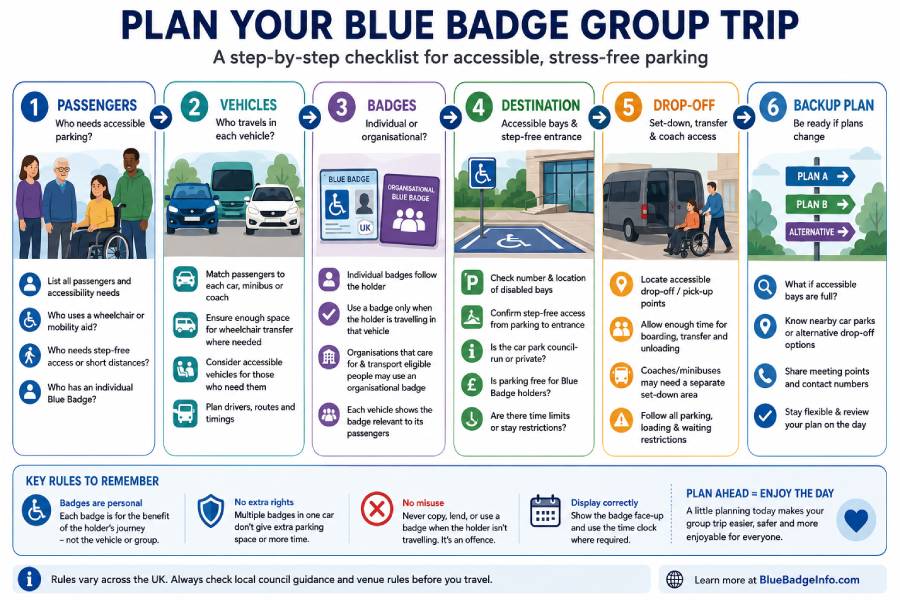
Example: three cars and two Blue Badge holders
Suppose six people are travelling to a visitor attraction:
- two passengers hold Blue Badges;
- one passenger uses a wheelchair;
- and the group is travelling in three cars.
Car 1
The wheelchair user travels with their Blue Badge in the wheelchair-accessible vehicle.
Car 2
The second Blue Badge holder travels with their badge in the second car.
Car 3
The remaining passengers use ordinary parking because no Blue Badge holder is travelling in that car.
Before travelling, the organiser confirms that:
- two accessible bays are normally available;
- one has sufficient wheelchair-transfer space;
- the car park uses ANPR;
- and both accessible vehicles need to register separately.
If only one accessible bay is available, the wheelchair-accessible vehicle could use it while the second badge holder is dropped close to the entrance and their driver moves to another lawful parking space, where this arrangement is permitted.
Example: a care-home minibus trip
A care home regularly transports residents who would individually qualify for Blue Badges.
Instead of depending on residents always bringing their personal badges, the care home could consider whether it qualifies for an Organisational Blue Badge.
If one is issued:
- the badge belongs to the organisation;
- it can only be used while eligible disabled people are being transported;
- it cannot be used for staff convenience;
- and it provides the normal Blue Badge concessions rather than special group-parking privileges.
Official information for accessible group travel
- GOV.UK — Blue Badge rights and responsibilities in England
- GOV.UK — Organisational Blue Badge guidance in England
- mygov.scot — Using a Blue Badge in Scotland
- GOV.WALES — Blue Badge rights and responsibilities
- nidirect — Blue Badge rights and responsibilities in Northern Ireland
- GOV.UK — NHS hospital parking guidance in England
The bottom line
Good accessible group travel starts by matching each passenger to the vehicle actually transporting them and then planning parking, drop-off and accessibility before the journey.
For individual Blue Badges:
- the badge follows the holder;
- one badge cannot cover several vehicles at once;
- each vehicle relying on a badge needs to be genuinely serving that holder’s journey;
- and several badge holders in one vehicle do not multiply its parking rights.
For care organisations, an Organisational Blue Badge may be useful where the organisation both cares for and transports eligible disabled people, but it does not provide additional parking privileges.
For larger trips, contact the venue in advance, check accessible bays and drop-off arrangements, confirm ANPR or payment requirements for every vehicle and always have a backup plan if the most suitable spaces are unavailable.
Frequently asked questions
How do I plan Blue Badge parking for a group trip?
Match each Blue Badge holder to the vehicle transporting them, then check accessible bays, drop-off points, parking charges, ANPR requirements and vehicle-registration rules. Contact the venue before travelling if several accessible spaces, a minibus or a coach is involved.
Can one Blue Badge be used for several group vehicles?
No. An individual Blue Badge follows its holder and cannot be copied or used to provide parking concessions to several vehicles at the same time.
Can several Blue Badge holders travel in the same car?
Yes. However, having several badge holders in one vehicle does not multiply its parking rights, extend time limits or provide entitlement to additional spaces.
Can Blue Badges reserve accessible parking spaces?
No. Blue Badges do not reserve spaces. A venue may separately allow accessible parking to be pre-booked, so contact the operator if several spaces are needed.
Can Blue Badges be used for drop-off and pick-up?
They can be used where the parking is genuinely connected with picking up or dropping off the badge holder and parking is permitted at that location. A Blue Badge does not override stopping or parking prohibitions.
Can a minibus use a Blue Badge?
An individual badge may be used in connection with a badge holder genuinely travelling in the minibus, subject to the parking rules and vehicle restrictions at the location. Organisations that regularly care for and transport eligible people may instead need an Organisational Blue Badge.
What is an Organisational Blue Badge?
It is a badge for an eligible organisation that both cares for or assists disabled people who would qualify individually and transports them. The authority must also be satisfied that an organisational badge is genuinely needed.
Can a community transport operator get an Organisational Blue Badge?
Not simply because it transports disabled passengers. England’s official guidance says community transport, taxi and private-hire operators are unlikely to qualify because they are not normally involved in both the care and transport of eligible disabled people.
Can staff use an Organisational Blue Badge when no disabled passengers are travelling?
No. It must not be used as a general staff parking permit or for organisational errands when eligible disabled passengers are not involved.
Do Organisational Blue Badges get better parking rights?
No. They provide the normal Blue Badge parking concessions rather than additional group-parking, minibus or reserved-space rights.
Do Blue Badge holders get free parking on a group trip?
Not everywhere. Parking charges depend on the UK nation, parking location and operator. Private and off-street car parks can set their own conditions.
Are Blue Badge holders entitled to free NHS hospital parking in England?
Valid Blue Badge holders attending an NHS hospital in England as patients or visitors are included in the national groups entitled to free parking, but the hospital can require a local registration or validation process.
What if all accessible bays are full?
Use your backup plan. This might mean accessible drop-off followed by ordinary parking, another nearby car park or prioritising a suitable bay for the vehicle that needs wheelchair-transfer space.
Do all group vehicles need to register for ANPR separately?
If the parking operator requires vehicle registration, each vehicle normally needs to follow the operator’s requirements individually. Do not assume registering one car covers the whole group.