


A Blue Badge costs up to £10 in England, most Scottish councils charge £20 for a new badge, individual Blue Badges are free in Wales, and Northern Ireland charges £10. The amount you pay can differ if you are reapplying for an existing badge, requesting a replacement or applying on behalf of an organisation.
There is no annual Blue Badge subscription. A standard badge usually lasts for up to three years, although some badges are issued for a shorter period. Once your badge expires, you must reapply if you still need one.
This guide explains the official Blue Badge fees across the UK, how payment works, what happens if an application is refused, and how much renewals, replacements and organisational badges cost. If you have not applied yet, start with our step-by-step guide to applying for a Blue Badge online.
Blue Badge costs across the UK
The cost of obtaining a Blue Badge depends on the nation responsible for issuing it. England, Scotland and Wales operate through local authorities, while Northern Ireland has a central Blue Badge Unit.
| Nation | New individual Blue Badge | Who handles payment? |
|---|---|---|
| England | Up to £10 | Local council |
| Scotland | Most councils charge £20 | Local council |
| Wales | Free | No issue fee for individuals |
| Northern Ireland | £10 | Department for Infrastructure Blue Badge Unit |
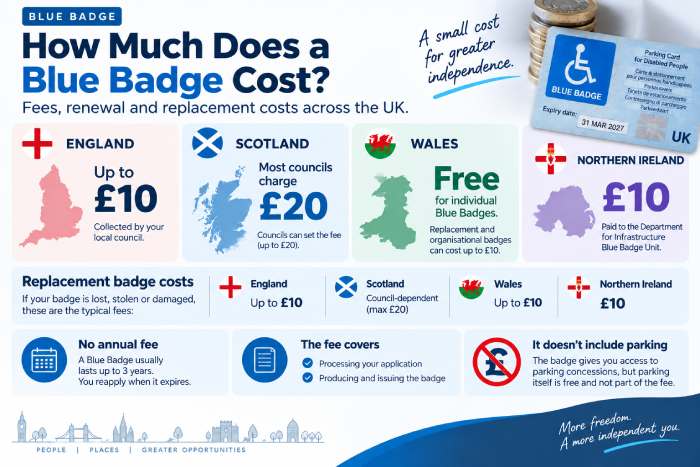
Blue Badge charges differ between the four UK nations. Renewal and replacement fees may also depend on the authority issuing the badge.
The main charges are:
- England: councils can charge up to £10 for issuing a badge.
- Scotland: most councils charge £20 for a new badge, but some reissue charges differ.
- Wales: the ordinary issue of an individual badge is free.
- Northern Ireland: the standard individual badge fee is £10.
These amounts concern the official badge itself. They do not include optional services sold by third-party websites, private medical reports or parking charges imposed by particular car parks.
How much does a Blue Badge cost in England?
A Blue Badge costs up to £10 in England. The Department for Transport allows local authorities to charge a fee when issuing a badge, but the statutory maximum is £10.
This is described as a badge issue fee, rather than a separate fee simply for having your disability assessed.
The issuing council determines whether you satisfy the eligibility criteria and explains how any applicable fee must be paid.
Payment arrangements differ between English councils. Depending on the authority, you may be asked to:
- pay after your application has been approved;
- provide payment during the application process, subject to the council’s refund arrangements;
- follow separate payment instructions sent by the Blue Badge team.
This is why the official GOV.UK service states that how you pay depends on your local council.
You can start your application through GOV.UK — Apply for or renew a Blue Badge.
Is a Blue Badge £10 everywhere in England?
Not necessarily. The £10 amount is the maximum that an English council may charge, not a compulsory national fee that every council must impose.
Local authorities have discretion over whether to charge and how much to charge within that limit.
Although many councils charge the full £10, the amount payable is the fee set by the council responsible for issuing your badge.
You should therefore check your issuing council’s instructions rather than assuming the charge is identical throughout England.
Do I have to pay if my Blue Badge application is refused in England?
Unsuccessful applicants should not ultimately pay the statutory badge issue fee.
Department for Transport guidance states that only successful applicants should be asked to pay the issue fee.
If your council has taken payment before completing its decision and subsequently refuses your application, the relevant refund arrangements should ensure that you do not bear the issue fee.
Contact your council if you have paid and need clarification about a refund.
For the official rule, consult the Department for Transport Blue Badge guidance for England.
How much does a Blue Badge cost in Scotland?
Most Scottish local councils charge £20 for a new Blue Badge.
Scottish legislation permits local authorities to charge up to £20 for issuing or reissuing a badge.
However, the distinction between a new application and a reapplication is important.
The Scottish Parliament’s research briefing on disabled parking, published in December 2024, reported that all Scottish local authorities charged £20 for a new Blue Badge at that time, but renewal charges differed between authorities.
In fact, approximately half of Scottish councils had a renewal charge below £20 when that research was prepared.
This means you should not automatically assume that every Scottish Blue Badge transaction costs £20.
The actual amount may depend on whether you are:
- applying for a new badge;
- reapplying when an existing badge expires;
- requesting a replacement after loss, theft or damage;
- applying through another eligible category.
The Scottish Government’s public guidance continues to state that most councils charge £20.
Official information: mygov.scot — Apply or reapply for a Blue Badge.
Is it cheaper to renew a Blue Badge in Scotland?
It can be. Scottish councils set renewal charges within the statutory maximum, so the fee may be lower than the cost of obtaining a new badge.
Some councils use the same charge for new applications and renewals. Others may apply a reduced renewal fee.
You should check the current amount with your council before paying.
Remember that a Blue Badge does not renew automatically. You must make another application and continue to satisfy the applicable eligibility criteria.
Scottish Government guidance recommends reapplying at least 12 weeks before your current badge expires.
See how to renew a Blue Badge and when to submit your renewal application.
Do I get a refund if my Scottish application is unsuccessful?
Yes, the badge issue charge should be returned if your application is unsuccessful.
Citizens Advice Scotland explains that councils can ask applicants to pay when applying, but the fee is normally refunded if the application does not succeed.
If you paid your council and were refused a badge, check the council’s refund instructions or contact its Blue Badge team.
For additional guidance, see Citizens Advice Scotland — Applying for a Blue Badge.
How much does a Blue Badge cost in Wales?
An individual Blue Badge is free in Wales.
Welsh local authorities are not permitted to charge individual applicants for the ordinary issue of their badge.
The Welsh Government provides funding towards administration of the Blue Badge scheme through the Revenue Settlement Grant.
As a result, eligible individuals do not pay a badge issue fee for:
- their first individual Blue Badge;
- an ordinary individual reapplication when a badge expires;
- a new individual badge issued under the applicable eligibility rules.
However, not every transaction involving a Welsh Blue Badge is free.
Welsh Government guidance permits councils to charge up to £10 for replacement badges and organisational badges.
These charges are discretionary and can vary by local authority.
Is a replacement Blue Badge free in Wales?
Not necessarily.
Welsh councils can charge up to £10 when replacing a lost, stolen or damaged badge.
The fee is discretionary, which means a council may charge less than £10 or choose not to charge.
Welsh Government guidance also recognises that councils may waive a replacement fee when a badge has been stolen and the holder supplies appropriate police evidence, such as an incident number.
There is no automatic guarantee that every stolen badge will be replaced free of charge.
Check the specific policy followed by your issuing authority.
Official information: Welsh Government — Blue Badge Scheme guidance for local authorities.
How much does a Blue Badge cost in Northern Ireland?
A Blue Badge costs £10 in Northern Ireland.
The scheme is administered by the Department for Infrastructure Blue Badge Unit rather than by individual local councils.
Applicants can use the official nidirect online service or a postal application.
How do you pay for a Blue Badge in Northern Ireland?
If you apply online, you must pay the £10 fee using a credit or debit card accepted by the nidirect service.
If you submit a postal application, payment can be made by cheque or postal order payable to the Department for Infrastructure.
Do not send cash through the post. This warning appears in the official Northern Ireland guidance.
Official services:
- nidirect — Apply for or renew a Blue Badge online
- nidirect — Blue Badge application and payment guidance
Do I get my £10 back if my application is refused?
Yes. Nidirect explicitly states that unsuccessful applicants will have their Blue Badge fee refunded.
If your application is rejected, the Blue Badge Unit should also explain why you were found ineligible.
You can request reassessment if you believe relevant information was not considered, or reapply if your circumstances change and you later satisfy the criteria.
Questions about the refund should be directed to the Blue Badge Unit.
How much does it cost to renew a Blue Badge?
A Blue Badge normally lasts for up to three years, but it does not renew automatically.
You need to reapply for another badge before the existing one expires.
If your reapplication is successful, the applicable issue fee depends on the nation and, where relevant, the local authority.
| Nation | Renewal / reapplication cost |
|---|---|
| England | Up to £10 |
| Scotland | Up to £20; renewal charges vary by council |
| Wales | Free for individuals |
| Northern Ireland | £10 |
It is important to understand that renewal is not the same as simply extending an existing badge.
Your authority may need to verify that you still meet the eligibility requirements.
Depending on your circumstances, you may need to submit:
- a new photograph;
- updated contact details;
- your existing Blue Badge information;
- evidence of qualifying benefits;
- additional information about your mobility or health condition.
In some circumstances, particularly where the authority already has evidence of permanent eligibility, the reapplication process may be simpler.
For a complete explanation of the procedure, see how to renew your Blue Badge.
Do you have to pay for a Blue Badge every year?
No. There is no annual Blue Badge subscription.
The normal fee is associated with issuing a badge, not with each year that it remains valid.
For example, if an English council charges £10 for a badge valid for three years, the holder does not normally pay another £10 during each of those three years.
When the badge expires, the person must reapply and may have to pay the relevant fee again if another badge is issued.
In Wales, ordinary individual badges remain free.
Does every Blue Badge last exactly three years?
No.
A Blue Badge normally lasts for up to three years, but an individual badge may be issued for a shorter period.
This can depend on:
- the duration of a qualifying benefit award;
- time-limited eligibility;
- the category under which the badge was awarded;
- specific national rules or temporary eligibility arrangements.
For example, Wales has a temporary Blue Badge route for certain applicants who meet its temporary eligibility criteria.
Always check the expiry date printed on your badge rather than assuming it will remain valid for exactly three years.
How much does a replacement Blue Badge cost?
Replacement fees are not always identical to the charges for a new badge.
If your badge is lost, stolen, damaged or no longer legible, you may need to pay the applicable replacement fee.
| Nation | Replacement fee |
|---|---|
| England | Up to £10 |
| Scotland | Council-dependent; maximum £20 |
| Wales | Up to £10 at council discretion |
| Northern Ireland | £10 |
A replacement badge normally has the same expiry date as the badge it replaces.
If a badge is reported lost or stolen, the issuing authority can cancel it to prevent misuse. You must not continue using a cancelled badge if it is later found.
For the correct procedure, see what to do if your Blue Badge is lost, stolen or damaged.
How much does a replacement cost in England?
English councils can charge up to £10 when replacing a badge that has been:
- lost;
- stolen;
- damaged;
- destroyed;
- or made illegible.
The amount and payment method are determined by the local council.
You can access the official GOV.UK replacement service where appropriate.
How much does a replacement cost in Scotland?
Scottish councils have discretion to charge for reissuing a badge within the maximum fee of £20.
Some councils charge less for a replacement than they charge for a new badge.
Check the current fee and procedure with the authority that issued your badge.
How much does a replacement cost in Wales?
Although an ordinary individual badge is free in Wales, local authorities can charge up to £10 for a replacement.
Welsh Government guidance says councils may choose not to charge when a badge was stolen and the holder provides appropriate police evidence.
This is discretionary, so the final amount depends on the local authority.
How much does a replacement cost in Northern Ireland?
A replacement Blue Badge costs £10 in Northern Ireland.
Nidirect offers a separate online replacement service for individual applicants.
If your badge has been damaged or faded, the existing badge must be returned to the Blue Badge Unit before a replacement is issued.
According to nidirect, a replacement should normally arrive within around two weeks of the Unit receiving the necessary application information and the existing badge where applicable.
Use the official Northern Ireland replacement service.
For further information about delivery times, see how long a replacement Blue Badge takes.
Does a replacement Blue Badge last another three years?
No. A replacement normally retains the original badge’s expiry date.
Requesting and paying for a replacement does not give you a fresh three-year entitlement.
For example:
- Original badge expiry date: August 2027.
- Replacement requested: January 2027.
- Replacement expiry date: August 2027.
In this example, the replacement only remains valid until August 2027.
It does not remain valid until January 2030 simply because it was issued as a replacement in January 2027.
Check your current expiry date before requesting a replacement, especially if the badge is close to expiry.
What if my lost Blue Badge is about to expire?
If you live in England, Scotland or Wales and the badge will expire within the next three months, the GOV.UK guidance directs you towards reapplying for a new badge rather than requesting a replacement.
For a badge with more than three months remaining, use the replacement service where appropriate.
This can help you avoid paying to replace a badge that will only remain valid for a short period.
Northern Ireland uses separate nidirect processes for replacing a badge and applying for another one, so follow the instructions specific to your circumstances.
If the badge has already expired, see what to do when your Blue Badge has expired.
How much does an organisational Blue Badge cost?
Organisational Blue Badges are intended for eligible organisations that care for or assist disabled people and transport them.
They are not general parking permits that any business can purchase.
The rules and fees depend on the relevant nation.
England
English councils can charge up to £10 for issuing an organisational Blue Badge.
The authority must also be satisfied that the organisation meets the relevant eligibility requirements.
Scotland
Scottish authorities can charge within the statutory maximum of £20 for issuing or reissuing organisational badges.
The exact fee depends on the issuing council.
Wales
Welsh authorities can charge up to £10 for an organisational Blue Badge.
This is an important exception to the statement that Blue Badges are free in Wales.
The ordinary free issue rule applies to individual badges, not necessarily organisational badges or replacements.
Northern Ireland
Support organisations in Northern Ireland are charged £10 for each vehicle they register.
For example, registering three qualifying vehicles would mean a total fee of £30 under the published £10-per-vehicle charging arrangement.
For replacements, nidirect states that support organisations are charged £10 for each badge that needs replacing.
Read how to apply for an organisational Blue Badge for the eligibility requirements and application details.
Are Blue Badge applications free?
There is an important difference between applying for a badge and paying the official fee when a badge is issued.
In England, the Department for Transport describes the charge as a badge issue fee and says only successful applicants should pay it.
In Scotland, a council may collect payment with the application, but the fee is normally returned if the application is unsuccessful.
In Wales, ordinary individual Blue Badges are free.
In Northern Ireland, the £10 fee is paid during the application process, but nidirect states that it is refunded if the applicant is unsuccessful.
You do not need to pay an unofficial website simply to access the government application service.
See how to apply for a Blue Badge online for the official application links and requirements.
Are there extra charges for medical evidence?
Possibly, but these are separate from the official Blue Badge issue fee.
For example, a private healthcare professional may charge for preparing a medical report or letter that you request independently.
However, you do not automatically need to buy a private GP letter to apply for a Blue Badge.
Some applications can be assessed through qualifying benefit information or evidence the applicant already has.
Other cases require more detailed supporting information showing how a disability or condition affects mobility or journeys.
Before paying for additional medical evidence:
- check the eligibility route under which you are applying;
- read the council’s document requirements;
- review any relevant medical reports you already possess;
- ask whether extra evidence is necessary;
- avoid paying for documents that will not help establish the relevant criteria.
For further guidance, see what medical evidence you need for a Blue Badge and the essential application documents checklist.
Do I need to pay someone to complete my application?
No. You can apply through the official government services without paying an intermediary.
For England, Scotland and Wales, use:
GOV.UK — Apply for or renew a Blue Badge
For Northern Ireland, use:
nidirect — Apply for or renew a Blue Badge
If you need help using the application service, ask your council or the Blue Badge Unit about available assistance.
Some councils can provide support with completing an application or offer a paper application process where appropriate.
A commercial website may offer an administrative service, but it is not the government authority responsible for issuing your badge.
Can a third-party website charge more than £10?
A private company may charge for its own service, but that does not increase the official Blue Badge issue fee.
For example, an English applicant might encounter a commercial website asking for significantly more than £10 to help complete a Blue Badge application.
That additional amount is not the statutory English badge fee.
Using an intermediary:
- does not guarantee that you satisfy the eligibility criteria;
- does not guarantee approval;
- does not give you an official right to priority processing;
- may require you to share sensitive information with another organisation;
- can cost substantially more than using the official service directly.
Always check the website address before entering personal, medical or payment details.
Use GOV.UK, mygov.scot, GOV.WALES, nidirect or your issuing council’s official website.
Can I pay extra to get my Blue Badge faster?
There is no standard official Blue Badge priority service that allows ordinary applicants to buy faster approval.
The issuing authority must assess eligibility under the rules that apply in your nation.
Some applicants with a terminal or life-limiting illness may qualify for faster consideration under specific administrative procedures.
For example, Scottish Government guidance explains that councils can look at applications from people with a terminal illness and relevant supporting forms more quickly.
Similarly, Department for Transport guidance encourages English councils to consider fast-track arrangements for applicants with terminal illness and serious mobility difficulties.
These arrangements are based on qualifying circumstances, not on paying an additional charge.
Be cautious of a website claiming that a large payment will guarantee faster government approval.
Is there a Blue Badge fee waiver for people on a low income?
There is no automatic UK-wide fee exemption simply because an applicant has a low income.
The normal fee rules depend on the nation and the issuing authority.
Remember:
- individual Blue Badges are free in Wales;
- English councils can charge less than the £10 maximum;
- Scottish councils have discretion within the £20 maximum;
- Northern Ireland’s published standard individual badge fee is £10.
If you cannot afford a council fee, contact the issuing authority and ask whether it offers any discretionary local arrangement or assistance.
Do not assume that receiving Universal Credit, Pension Credit or another means-tested benefit automatically removes the Blue Badge fee.
Do PIP recipients get a free Blue Badge?
Not simply because they receive Personal Independence Payment (PIP).
A qualifying PIP award may establish automatic Blue Badge eligibility under particular conditions, but eligibility and the badge issue fee are separate matters.
For example:
- England: a qualifying PIP recipient can still be charged up to £10.
- Scotland: an eligible applicant can still have to pay the council’s applicable fee.
- Wales: individual Blue Badges are free, regardless of whether eligibility comes through PIP or another route.
- Northern Ireland: an eligible PIP recipient normally pays the £10 badge fee.
Also remember that not every PIP award creates automatic Blue Badge eligibility.
The relevant mobility descriptors, points and national rules matter.
Read can I get a Blue Badge on PIP? for the full eligibility explanation.
Is a Blue Badge free for pensioners?
Age alone does not make a Blue Badge free.
The standard badge fee depends primarily on where it is issued, rather than whether the applicant is retired.
For example, a pensioner in England can be charged up to £10, while an eligible individual in Wales receives a badge free of charge.
The same general charging rules apply whether the applicant is:
- a pensioner;
- working;
- unemployed;
- receiving PIP;
- receiving another qualifying disability benefit.
Eligibility and charges are separate questions.
Does the Blue Badge fee include free parking?
No. Paying for a Blue Badge does not make every parking space free.
The Blue Badge provides parking concessions under the rules applicable in each nation.
However, those concessions depend on the type of parking location and the restrictions in force.
For example:
- many qualifying on-street parking situations offer free or extended parking;
- restrictions concerning yellow lines, loading bans and time limits can still apply;
- some off-street council car parks have their own charging rules;
- private car parks can impose separate terms and payment requirements;
- hospital and retail car parks may operate under different arrangements.
The statutory Blue Badge scheme does not automatically override every restriction imposed by a private operator.
For a full explanation, read do you get free parking with a Blue Badge?.
Does the Blue Badge fee include the London Congestion Charge?
No. The Blue Badge fee and the London Congestion Charge are separate.
Transport for London operates a Blue Badge discount arrangement for eligible badge holders.
However, possession of a Blue Badge does not automatically register your vehicle for that discount.
You must follow TfL’s registration process and comply with its eligibility conditions.
The Congestion Charge discount should not be confused with the amount you pay to obtain or renew the Blue Badge itself.
Official information: Transport for London — Discounts and exemptions.
Does the Blue Badge fee include ULEZ?
No. A Blue Badge does not automatically exempt a vehicle from London’s Ultra Low Emission Zone (ULEZ).
ULEZ operates according to vehicle emissions standards and specific exemption or grace-period rules.
Transport for London states that Blue Badge holders generally need to pay the ULEZ charge if their vehicle does not meet the emissions standards, unless another applicable exemption or grace period covers the vehicle.
For example, eligible vehicles in the disabled or disabled passenger vehicle tax class can benefit from a grace period until 24 October 2027, subject to the applicable rules.
This entitlement is connected to the vehicle and the specific ULEZ conditions, not simply to possession of a Blue Badge.
Official information: TfL — ULEZ discounts and exemptions.
Does having a Blue Badge reduce vehicle tax?
A Blue Badge does not automatically give you free or reduced vehicle tax.
Vehicle Excise Duty concessions operate under a separate system.
Some disabled people may qualify for:
- a vehicle tax exemption;
- a 50% vehicle tax reduction;
- other arrangements linked to an eligible vehicle or benefit.
Qualification depends on the relevant rules and supporting benefit or vehicle information.
A person may hold a Blue Badge without qualifying for vehicle tax exemption, or qualify for a vehicle-related concession under separate criteria.
See GOV.UK — Get free vehicle tax if you are a driver with a disability.
What does the Blue Badge fee actually pay for?
The official charge is associated with issuing or reissuing the Blue Badge under the relevant national scheme.
It should not be confused with:
- a yearly membership subscription;
- a fee charged every time you park;
- a permit giving unlimited parking everywhere;
- payment for a guaranteed application approval;
- payment for faster assessment;
- a blanket exemption from congestion or emissions charges;
- automatic vehicle tax relief.
The badge establishes access to relevant parking concessions while it remains valid and is used correctly.
The exact parking conditions continue to depend on the location and applicable rules.
Blue Badge fee checklist
Before applying, renewing or replacing your badge, check the following:
- ☑ England: the badge issue fee is up to £10.
- ☑ Scotland: most councils charge £20 for a new badge.
- ☑ Wales: individual Blue Badges are free.
- ☑ Northern Ireland: the individual fee is £10.
- ☑ There is no annual Blue Badge subscription.
- ☑ A standard badge normally lasts for up to three years.
- ☑ You must reapply before your badge expires.
- ☑ Scottish renewal and replacement charges can vary by council.
- ☑ Welsh councils can charge up to £10 for replacement badges.
- ☑ Welsh councils can charge up to £10 for organisational badges.
- ☑ Northern Ireland replacements cost £10.
- ☑ Northern Ireland support organisations pay £10 per registered vehicle.
- ☑ A replacement normally keeps the original expiry date.
- ☑ The badge fee does not guarantee free parking everywhere.
- ☑ A Blue Badge does not automatically provide a ULEZ exemption.
- ☑ There is no standard paid priority-approval service.
- ☑ Use official government application services to avoid unnecessary intermediary fees.
Related Blue Badge guides
For more detailed information about applications, renewals and replacements, use the following guides.
Applications and eligibility
- How to apply for a Blue Badge online
- Can I get a Blue Badge on PIP?
- Documents needed for a Blue Badge application
- What medical evidence do I need for a Blue Badge?
Renewals and replacements
- How to renew a Blue Badge
- When to renew your Blue Badge
- Lost, stolen or damaged Blue Badge: what to do
- How long does a replacement Blue Badge take?
- What to do if your Blue Badge has expired
Organisations and parking concessions
Official Blue Badge fee guidance
The following government and public-authority sources explain the relevant charges and procedures.
- GOV.UK — Apply for or renew a Blue Badge
- Department for Transport — Badge issue and replacement fees in England
- mygov.scot — Scottish Blue Badge applications and fees
- Transport Scotland — Blue Badge scheme
- Scottish Parliament — Disabled Parking and the Blue Badge Scheme
- Welsh Government — Individual, replacement and organisational badge fees
- nidirect — Northern Ireland application fees and refunds
- nidirect — Replacement Blue Badge charges
The bottom line
The cost of a Blue Badge depends on which part of the UK issues it. England charges up to £10, most Scottish councils charge £20 for a new badge, individual badges are free in Wales, and Northern Ireland charges £10.
You do not pay an annual subscription. A standard badge normally lasts up to three years, after which you must reapply if you still need one.
Replacement and organisational fees may differ from standard individual charges. Scottish councils can vary renewal fees, Welsh councils can charge for replacements and organisational badges, and Northern Ireland operates a separate central payment system.
Finally, paying for a Blue Badge does not guarantee free parking everywhere or automatically provide Congestion Charge, ULEZ or vehicle-tax concessions.
If you are ready to apply, use our Blue Badge online application guide to access the correct official service.
Frequently asked questions
How much does a Blue Badge cost?
A Blue Badge costs up to £10 in England, most Scottish councils charge £20 for a new badge, individual badges are free in Wales, and Northern Ireland charges £10.
Is a Blue Badge free in Wales?
Yes. Individual Blue Badges are free in Wales. However, Welsh councils can charge up to £10 for replacement badges and organisational badges.
Is a Blue Badge £20 in Scotland?
Most Scottish councils charge £20 for a new Blue Badge. The statutory maximum is £20, but renewal and replacement fees can be lower depending on the council.
Is a Blue Badge £10 in England?
£10 is the maximum Blue Badge issue fee in England. Councils can charge less or choose not to charge, although many charge the full amount.
How much does a Blue Badge cost in Northern Ireland?
An individual Blue Badge costs £10 in Northern Ireland. The fee is refunded if the application is unsuccessful.
Do you have to pay for a Blue Badge every year?
No. There is no annual Blue Badge subscription. A standard badge normally lasts for up to three years, after which you must reapply if you still need one.
How much does it cost to renew a Blue Badge?
A successful reapplication can cost up to £10 in England, up to £20 in Scotland depending on the council, nothing for individuals in Wales, and £10 in Northern Ireland.
How much does a replacement Blue Badge cost?
England can charge up to £10, Scottish councils can charge up to £20, Welsh councils can charge up to £10 at their discretion, and Northern Ireland charges £10.
Do I pay for a replacement if my Blue Badge was stolen?
Replacement charges depend on the issuing authority. In Wales, a council may waive the fee where the badge was stolen and appropriate police evidence is supplied. Other authorities follow their own replacement fee rules.
Do PIP recipients get a free Blue Badge?
Not simply because they receive PIP. Certain PIP awards can establish automatic eligibility, but the normal national badge fee still applies. Individual badges are free in Wales regardless of PIP.
Do pensioners get a Blue Badge for free?
Not simply because of age. Blue Badge fees depend mainly on where the badge is issued, rather than whether the applicant is a pensioner.
Do I have to pay if my Blue Badge application is refused?
In England, only successful applicants should ultimately pay the statutory issue fee. Scottish application fees are normally returned if an application is unsuccessful. Northern Ireland refunds its £10 fee after refusal, while individual applications in Wales are free.
How much does an organisational Blue Badge cost?
English councils can charge up to £10, Scottish councils up to £20, and Welsh councils up to £10. Northern Ireland charges support organisations £10 for each vehicle they register.
Does paying for a Blue Badge mean parking is free?
No. A Blue Badge provides parking concessions, but does not make every parking space or car park free. Charges and restrictions depend on the nation, location and parking operator.
Can I pay extra to get my Blue Badge faster?
There is no standard official priority service allowing ordinary applicants to pay for faster approval. Some people with terminal or life-limiting illnesses may receive faster consideration under specific procedures, but this is not a paid upgrade.