


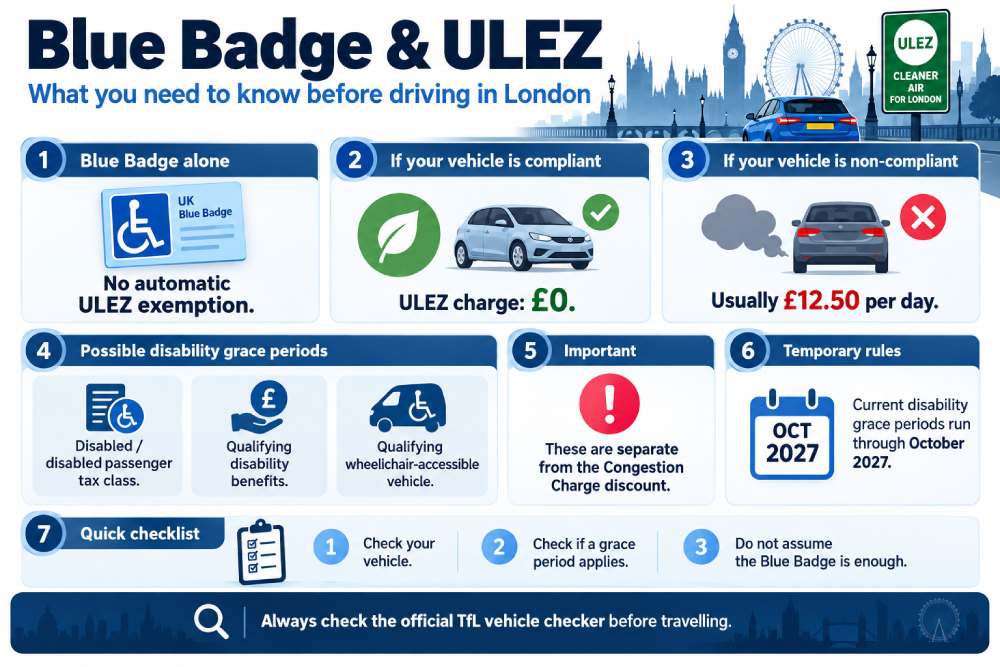
A Blue Badge by itself does not exempt you from London’s Ultra Low Emission Zone (ULEZ). If your vehicle does not meet the ULEZ emissions standards, the normal charge is £12.50 per day unless the vehicle or disabled person qualifies for a separate TfL exemption or temporary grace period.
This distinction is important because:
Blue Badge eligibility and ULEZ eligibility are not the same thing.
However, it is also incorrect to say that every Blue Badge holder with a non-compliant vehicle must always pay £12.50.
TfL currently operates specific disability-related grace periods for:
- vehicles in the disabled or disabled passenger vehicle tax class;
- qualifying wheelchair-accessible vehicles; and
- people receiving certain disability benefits or meeting specified disability criteria.
These temporary arrangements currently run until October 2027.
Do Blue Badge holders pay ULEZ?
Usually yes if the vehicle is non-compliant — but not in every case.
The basic ULEZ rule is:
- ULEZ-compliant vehicle: £0;
- non-compliant vehicle: normally £12.50 per day;
- Blue Badge alone: no automatic exemption;
- qualifying disability grace period: temporary 100% relief may apply.
TfL expressly states that Blue Badge holders need to pay the ULEZ charge unless their vehicle:
- meets the ULEZ emissions standards; or
- qualifies for one of the applicable disability-related grace periods.
Therefore, the question is not simply:
“Do I have a Blue Badge?”
You also need to ask:
“Does my vehicle comply, or do I qualify for a separate ULEZ grace period?”
Blue Badge and ULEZ rules at a glance
| Situation | ULEZ position |
|---|---|
| Blue Badge + compliant vehicle | £0 — vehicle meets ULEZ standards |
| Blue Badge + non-compliant vehicle | Normally £12.50 per day |
| Blue Badge alone | No automatic ULEZ exemption |
| Disabled / disabled passenger tax class | Temporary grace period through 24 October 2027 |
| Qualifying disability benefit | Can apply for a temporary grace period for one vehicle |
| Qualifying wheelchair-accessible vehicle | Can apply for temporary ULEZ relief |
| Congestion Charge Blue Badge discount | Does not automatically apply to ULEZ |
| Non-compliant car, motorcycle, van or qualifying minibus without exemption | £12.50 per day |
Why doesn’t a Blue Badge automatically exempt you from ULEZ?
Because the two schemes have different purposes and eligibility rules.
The Blue Badge scheme primarily provides:
parking concessions for disabled people.
ULEZ, by contrast, is based primarily on:
vehicle emissions.
That means a Blue Badge can be used in:
- a compliant petrol car;
- a compliant diesel car;
- an electric vehicle;
- or an older non-compliant vehicle.
The badge itself does not tell TfL how much pollution the vehicle produces.
TfL therefore does not use possession of a Blue Badge alone as the general test for ULEZ exemption.
Instead, it provides separate temporary arrangements for certain disabled people and vehicles.
What disability ULEZ exemptions and grace periods are available?
TfL currently lists three main temporary routes relevant to disabled people.
1. Disabled and disabled passenger vehicle tax class
Vehicles registered with the DVLA in the:
- disabled tax class; or
- disabled passenger vehicle tax class
currently benefit from a temporary ULEZ grace period.
This means they do not have to pay the ULEZ charge through:
24 October 2027
provided the vehicle remains in the qualifying tax class.
For a UK-registered vehicle in one of these tax classes:
you do not normally need to register separately with TfL.
TfL can identify the tax class from the vehicle record.
If the vehicle is registered outside the UK, separate TfL registration is required.
For more on disability vehicle tax, see do Blue Badge holders pay road tax?.
What if I receive Attendance Allowance?
TfL currently provides an additional route for some disabled people over State Pension age who receive:
Attendance Allowance
but whose vehicle is not registered in the disabled or disabled passenger vehicle tax class.
You can apply for the grace period for:
- your own vehicle; or
- a vehicle belonging to your nominated driver.
TfL currently asks for evidence including:
- your most recent Attendance Allowance award letter;
- the relevant pages of the vehicle’s V5C;
- and photo identification.
If the vehicle belongs to a nominated driver, additional signed evidence confirming that relationship and use of the vehicle is required.
2. Disabled Benefits grace period
TfL also operates a separate temporary grace period for people receiving certain disability benefits.
Current qualifying benefits include:
- standard or enhanced-rate mobility PIP;
- higher-rate mobility DLA;
- higher-rate mobility Child Disability Payment;
- War Pensioners’ Mobility Supplement;
- Armed Forces Independence Payment;
- and standard or enhanced-rate Adult Disability Payment (ADP).
Importantly:
standard-rate PIP mobility can qualify for this ULEZ grace period.
That is different from vehicle-tax exemption, where standard-rate PIP normally gives only a 50% vehicle-tax reduction.
This is another reason not to treat:
- Blue Badge;
- vehicle tax;
- and ULEZ
as if they used the same eligibility criteria.
Can someone on standard-rate PIP get a ULEZ exemption?
Temporarily, yes — if the TfL Disabled Benefits grace-period conditions are met and the application is approved.
TfL currently includes both:
- standard-rate mobility PIP; and
- enhanced-rate mobility PIP
within the Disabled Benefits grace-period criteria.
The vehicle must:
- not meet the normal ULEZ emissions standards;
- be registered in the qualifying person’s name or their nominated driver’s name;
- and meet TfL’s other registration requirements.
Only:
one vehicle
can be registered under this grace period for each eligible disabled person.
Can ADP qualify for the ULEZ disability grace period?
Yes.
TfL currently accepts:
- standard-rate mobility Adult Disability Payment; and
- enhanced-rate mobility Adult Disability Payment.
Again, this is separate from the rules governing:
- Blue Badge entitlement;
- and vehicle-tax relief.
Are there disability routes that do not depend on receiving PIP?
Yes.
The Disabled Benefits grace period can also cover certain people who meet specified medical or disability criteria.
TfL currently lists routes including:
- a parent or guardian of a child under 3 who must always travel with bulky medical equipment;
- a parent or guardian of a child under 3 who must remain close to a vehicle for emergency medical treatment;
- a person with a terminal illness who cannot walk or finds walking very difficult;
- and a person registered blind or severely sight impaired.
Therefore:
not receiving PIP does not automatically mean there is no disability-related ULEZ route available.
You need to check the specific TfL criteria.
Can a nominated driver’s vehicle qualify?
Yes, in certain disability grace-period applications.
For the Disabled Benefits grace period, the vehicle can be registered:
- in the disabled person’s name; or
- in the nominated driver’s name.
If it belongs to the nominated driver, TfL requires evidence confirming that:
the vehicle is used solely for the disabled person’s personal needs.
The relevant declaration must be signed by both:
- the disabled applicant; and
- the nominated driver.
Only one vehicle can be registered under this grace period.
How long does the Disabled Benefits grace period last?
Successful applicants currently receive temporary relief from the ULEZ charge until:
25 October 2027.
In practical terms, the current transitional protection runs through:
24 October 2027.
After the grace period ends, the vehicle will need to:
- meet the ULEZ emissions standard;
- qualify under whatever rules apply at that time;
- or pay the normal ULEZ charge.
Because this is explicitly a:
temporary grace period
it should not be described as a permanent ULEZ exemption.
3. Wheelchair Accessible Vehicle grace period
There is also a separate grace period for qualifying:
wheelchair-accessible cars and vans.
The vehicle must be non-compliant with the standard ULEZ emissions rules and have been converted by mobility specialists for disabled access.
TfL currently lists qualifying permanent adaptations such as:
- a permanently fitted foldable ramp;
- a powered wheelchair lift;
- an electric or hydraulic hoist;
- a swivel driver or passenger seat;
- or a permanently fitted accelerator ring on the steering wheel.
The vehicle must satisfy the registration and evidence requirements.
Only:
one wheelchair-accessible vehicle
can be registered for this grace period per applicant.
Does any wheelchair-accessible vehicle automatically qualify?
No.
TfL requires the vehicle to meet its specific definition and supporting-evidence requirements.
For example, applicants need to provide evidence relating to:
- the vehicle registration;
- the applicant’s identity;
- and the permanent disability adaptations.
Do not assume that simply carrying a wheelchair makes a vehicle a qualifying WAV.
What about wheelchair-accessible private hire vehicles?
There is also a separate rule for designated:
wheelchair-accessible private hire vehicles (PHVs)
licensed by TfL.
Qualifying vehicles receive temporary ULEZ protection until:
24 October 2027
when they are carrying out a private-hire booking for a TfL-licensed operator.
Outside a qualifying booking, the vehicle can still need to pay ULEZ unless:
- it meets the ULEZ emissions standards; or
- another applicable exemption or tax-class grace period applies.
How do I apply for the Disabled Benefits grace period?
Applications are made through:
a TfL Road User Charging account in the applicant’s name.
The vehicle must be registered:
- to you; or
- to your nominated driver.
TfL currently requires documents including:
- images of the vehicle’s V5C log book;
- photo identification;
- and evidence showing that you meet the relevant disability-benefit or medical criteria.
For a benefit-based application, TfL currently asks for:
a benefit award letter no more than 12 months old.
Other evidence applies for:
- children requiring bulky medical equipment;
- terminal illness;
- and severe sight impairment.
Use the current TfL application page before submitting your documents because these requirements can change.
What are the ULEZ emission standards?
The main minimum standards for the light vehicles most Blue Badge holders are likely to use are:
| Vehicle | Minimum ULEZ standard |
|---|---|
| Petrol cars | Euro 4 |
| Diesel cars | Euro 6 |
| Petrol vans | Euro 4 |
| Diesel vans | Euro 6 |
| Motorcycles, mopeds, motorised tricycles and quadricycles | Euro 3 |
As a rough guide:
- Euro 4 petrol cars were widely available from around 2006;
- Euro 6 diesel cars from around September 2015;
- and Euro 3 motorcycles from around 2007.
However:
do not decide compliance solely from the vehicle’s age.
Some vehicles met later standards earlier than required, while unusual vehicle records can produce different results.
Use the official TfL checker.
How do I check whether my vehicle is ULEZ compliant?
Enter the vehicle registration number into TfL’s official:
The checker tells you whether the vehicle meets the ULEZ emissions standard.
Be aware that:
ULEZ is only one London road-charging scheme.
A vehicle can be ULEZ compliant and still potentially be liable for:
- Congestion Charge;
- Blackwall or Silvertown tunnels charge;
- or another applicable road-user charge.
How much is the ULEZ charge?
For affected:
- cars;
- motorcycles;
- vans;
- and minibuses within the ULEZ vehicle limits,
the current daily charge for a non-compliant vehicle is:
£12.50.
The charge is payable for each charging day on which the non-compliant vehicle is driven within the ULEZ, unless an exemption or grace period applies.
Does ULEZ operate every day?
Almost.
ULEZ operates:
24 hours a day, every day of the year except Christmas Day.
The charging day runs from:
midnight to midnight.
Bank holidays are included.
This differs significantly from the Congestion Charge, which operates only during specified daytime hours.
Where does ULEZ operate?
ULEZ covers:
all London boroughs and the City of London.
It expanded London-wide on:
29 August 2023.
Do not confuse the ULEZ area with the much smaller:
central London Congestion Charge zone.
Is the £100 heavy-vehicle charge part of ULEZ?
No — do not treat the London Low Emission Zone as the same scheme as ULEZ.
This is a common source of confusion.
ULEZ primarily applies to:
- cars;
- motorcycles;
- vans;
- and certain minibuses and specialist light vehicles.
Heavier vehicles such as:
- HGVs;
- heavy lorries;
- buses;
- coaches;
- and some larger specialist vehicles
are dealt with under London’s separate:
Low Emission Zone (LEZ).
LEZ has:
- different emissions standards;
- different charges;
- and different penalties.
Do not quote a generic £100 charge as if it were today’s ULEZ rate for heavy vehicles.
ULEZ vs LEZ: what is the difference?
| ULEZ | LEZ | |
|---|---|---|
| Main vehicles | Cars, motorcycles, vans, lighter specialist vehicles and qualifying minibuses | Heavier vans, lorries, buses, coaches, minibuses and other specialist vehicles depending on weight/type |
| Main purpose | Vehicle emissions | Heavy-vehicle emissions |
| Standard light-vehicle daily charge | £12.50 | Separate LEZ charging structure |
| Blue Badge alone exempt? | No | No general Blue Badge exemption |
Is ULEZ the same as the Congestion Charge?
No.
They are separate schemes with:
- different purposes;
- different boundaries;
- different charging times;
- and different exemptions.
This distinction is particularly important for Blue Badge holders.
Congestion Charge
A Blue Badge holder can apply for a:
100% TfL discount.
Registration is required.
ULEZ
There is:
no universal Blue Badge discount.
Instead, eligibility depends on:
- vehicle compliance;
- vehicle tax class;
- specific disability benefits;
- wheelchair accessibility;
- or another qualifying exemption.
See do Blue Badge holders pay the Congestion Charge?.
Can I have a Congestion Charge discount but still pay ULEZ?
Yes.
This can happen very easily.
For example, imagine a Blue Badge holder has:
- successfully registered for TfL’s 100% Congestion Charge discount;
- but travels in an older diesel vehicle that does not meet Euro 6;
- and does not qualify for any ULEZ grace period.
For that journey:
- Congestion Charge: £0;
- ULEZ: £12.50.
The Blue Badge Congestion Charge discount does not transfer to ULEZ.
Can I have free road tax but still need to check ULEZ?
Yes — although the disabled tax class currently has an important temporary grace period.
Vehicle tax and ULEZ are separate systems.
A qualifying vehicle recorded by DVLA in the:
- disabled tax class; or
- disabled passenger vehicle tax class
currently benefits from the ULEZ grace period through 24 October 2027.
But that is:
a temporary ULEZ rule tied to the tax class.
It should not be interpreted as a permanent rule that free road tax always means free ULEZ.
See do Blue Badge holders pay road tax?.
Do I need to register a disabled-tax-class vehicle with TfL?
For a qualifying:
UK-registered
vehicle already recorded by DVLA in the disabled or disabled passenger vehicle tax class:
TfL says you do not need to register separately for the current grace period.
The grace period applies as long as:
- the vehicle remains in the qualifying tax class;
- and the temporary grace period is still in force.
Vehicles registered outside the UK need a different registration process.
What happens after October 2027?
The current disability grace periods are:
temporary.
The disabled and disabled passenger tax-class grace period currently runs through:
24 October 2027.
The Disabled Benefits and WAV arrangements likewise provide temporary protection until the October 2027 transition point.
Unless TfL changes the rules before then, a vehicle that still does not meet the ULEZ emissions standard after the applicable grace period ends will need to:
- meet another exemption;
- be replaced or modified so that it complies;
- or pay the ULEZ charge when driven in the zone.
Check TfL again before the grace period expires because future policy may change.
What if I am travelling to hospital?
Some NHS patients can claim reimbursement of certain London driving charges.
TfL says that if you are:
clinically assessed as too ill to travel to an appointment on public transport
you may be eligible to claim back eligible road-user charges through your treating hospital.
This is:
not an automatic Blue Badge exemption.
The hospital determines whether the reimbursement criteria are met.
When do I need to pay the ULEZ charge?
TfL currently allows ULEZ payments for:
- up to three previous days;
- today;
- the following day;
- or a selected future date range.
You can also use:
TfL Auto Pay
to automatically pay relevant charges when the registered vehicle is detected.
If you regularly travel in London, Auto Pay can reduce the risk of forgetting an applicable daily charge.
What happens if I forget to pay ULEZ?
If a vehicle:
- does not meet the ULEZ standard;
- does not qualify for an exemption or grace period;
- and the ULEZ charge is not paid,
TfL can issue a:
Penalty Charge Notice (PCN).
The current ULEZ PCN is:
£180
and is reduced to:
£90
if paid within 14 days.
The penalty can increase further if it remains unpaid.
What should a Blue Badge holder check before driving into London?
Use this checklist:
- ☑ Check whether the vehicle meets the ULEZ emissions standard.
- ☑ Do not assume your Blue Badge creates a ULEZ exemption.
- ☑ Check whether the vehicle is in the disabled or disabled passenger tax class.
- ☑ Check whether you qualify for the Disabled Benefits grace period.
- ☑ Check whether a wheelchair-accessible vehicle grace period applies.
- ☑ Make sure any required TfL application has been approved.
- ☑ Remember that only one vehicle can be registered under certain disability grace periods.
- ☑ Check Congestion Charge separately.
- ☑ Check Blackwall and Silvertown tunnel charging separately if relevant.
- ☑ Check LEZ separately if driving a vehicle covered by that scheme.
Official guidance
- Transport for London — Ultra Low Emission Zone
- Transport for London — ULEZ discounts and exemptions
- Transport for London — Check your vehicle for ULEZ
- Transport for London — Pay to drive in London
- Transport for London — Congestion Charge discounts and exemptions
The bottom line
A Blue Badge by itself does not exempt you from ULEZ.
The basic rule is:
- compliant vehicle: £0 ULEZ;
- non-compliant vehicle: normally £12.50 per day;
- Blue Badge alone: no automatic ULEZ exemption.
However, several important disability-related temporary grace periods currently exist.
These include:
- disabled and disabled passenger vehicle tax class vehicles;
- qualifying disability-benefit recipients;
- qualifying wheelchair-accessible vehicles;
- and certain additional medical or disability circumstances.
The main disability grace periods currently run through:
October 2027.
This means the most accurate answer is not simply:
“Blue Badge holders always pay ULEZ.”
Instead:
Blue Badge holders do not receive an exemption simply because they hold the badge, but they may qualify for a separate disability-related ULEZ grace period.
Before travelling, use TfL’s vehicle checker and check whether any disability exemption applies.
And remember:
ULEZ, Congestion Charge, vehicle tax and the London LEZ are separate schemes with separate rules.
For related guidance, see Blue Badge and the Congestion Charge, Blue Badge and road tax, and current Blue Badge rules and regulations.
Frequently asked questions
Do Blue Badge holders pay ULEZ?
A Blue Badge by itself does not provide a ULEZ exemption. If the vehicle does not meet the ULEZ emissions standards, the £12.50 daily charge normally applies unless the vehicle or disabled person qualifies for a separate TfL exemption or temporary disability grace period.
How much is ULEZ for a Blue Badge holder?
If a Blue Badge holder travels in a non-compliant car, motorcycle, van or other vehicle subject to the standard ULEZ charge and no exemption applies, the current daily charge is £12.50.
Does a disabled tax class vehicle pay ULEZ?
Vehicles registered with the DVLA in the disabled or disabled passenger vehicle tax class currently benefit from a temporary ULEZ grace period through 24 October 2027, provided the vehicle remains in the qualifying tax class.
Do I need to register my disabled-tax-class vehicle with TfL?
If the qualifying vehicle is registered in the UK and DVLA records it in the disabled or disabled passenger vehicle tax class, TfL says separate registration is not normally required for the current grace period.
Can standard-rate PIP mobility qualify for ULEZ relief?
Yes. TfL’s Disabled Benefits grace period currently includes people receiving either the standard or enhanced mobility component of PIP, subject to the vehicle and application requirements.
Can ADP qualify for the ULEZ grace period?
Yes. Both standard and enhanced mobility Adult Disability Payment are currently included in TfL’s Disabled Benefits grace-period criteria.
Can a wheelchair-accessible vehicle be exempt from ULEZ?
A qualifying wheelchair-accessible car or van that does not meet ULEZ standards can currently be registered for a temporary grace period if it meets TfL’s adaptation and documentation requirements.
Is ULEZ the same as the Congestion Charge?
No. They are separate schemes. Blue Badge holders can apply for a 100% Congestion Charge discount, but that discount does not automatically apply to ULEZ.
What emissions standards does my car need to meet?
The main ULEZ minimum standards are Euro 4 for petrol cars and Euro 6 for diesel cars. Motorcycles generally need to meet Euro 3. Use TfL’s registration checker rather than relying only on the age of the vehicle.
Does ULEZ operate on bank holidays?
Yes. ULEZ operates 24 hours a day every day of the year, including bank holidays, except Christmas Day.
What is the penalty for not paying ULEZ?
The current ULEZ Penalty Charge Notice is £180, reduced to £90 if paid within 14 days.
What happens after October 2027?
The current disability-related ULEZ arrangements are temporary. Unless TfL changes the rules, a non-compliant vehicle will need to meet the emissions standard, qualify for another exemption or pay the applicable ULEZ charge after its grace period ends.