

A Blue Badge does not automatically give you free road tax. Vehicle tax relief is based on the disability benefit you receive, not on whether you hold a Blue Badge.
Some disabled people qualify for a 100% vehicle tax exemption, while others can claim a 50% reduction.
The key distinction is:
- Blue Badge: mainly provides parking concessions;
- vehicle tax relief: depends on specific qualifying disability benefits and mobility components.
So it is possible to:
- have a Blue Badge but still pay full vehicle tax;
- have a Blue Badge and qualify for a 50% reduction;
- or qualify for a full vehicle tax exemption.
Do Blue Badge holders pay road tax?
Some do and some do not.
Having a valid Blue Badge does not itself change how much vehicle tax you pay.
Instead, the DVLA looks at whether you receive one of the disability benefits that qualify for:
- a 100% vehicle tax exemption; or
- a 50% vehicle tax reduction.
The official term is vehicle tax, although it is commonly called:
- road tax;
- car tax;
- or Vehicle Excise Duty (VED).
Vehicle tax relief at a glance
| Benefit | Mobility rate | Vehicle tax relief |
|---|---|---|
| Disability Living Allowance (DLA) | Higher-rate mobility | 100% exemption |
| Personal Independence Payment (PIP) | Enhanced-rate mobility | 100% exemption |
| Personal Independence Payment (PIP) | Standard-rate mobility | 50% reduction |
| Adult Disability Payment (ADP) | Enhanced-rate mobility | 100% exemption |
| Adult Disability Payment (ADP) | Standard-rate mobility | 50% reduction |
| Child Disability Payment | Higher-rate mobility | 100% exemption |
| Scottish Adult Disability Living Allowance | Qualifying award | 100% exemption |
| War Pensioners’ Mobility Supplement | Qualifying award | 100% exemption |
| Armed Forces Independence Payment | Qualifying award | 100% exemption |
| DLA | Lower-rate mobility | No 50% reduction |
| Blue Badge only | Not applicable | No automatic vehicle tax relief |
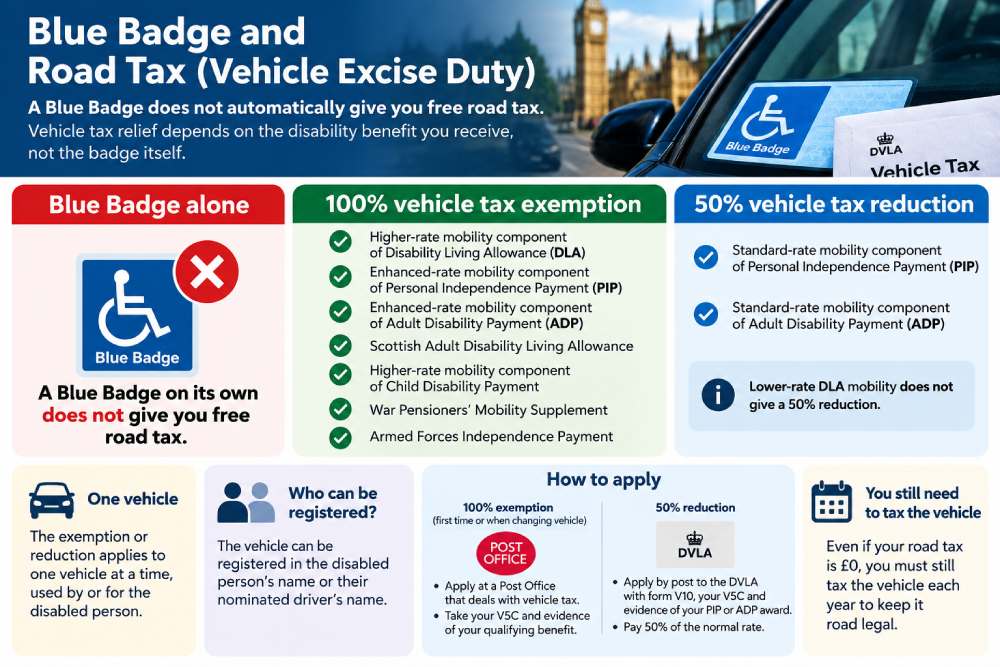
Who qualifies for 100% free vehicle tax?
You can apply for a complete vehicle tax exemption if you receive one of the qualifying benefits listed by GOV.UK.
These currently include:
- the higher-rate mobility component of Disability Living Allowance (DLA);
- the enhanced-rate mobility component of Personal Independence Payment (PIP);
- the enhanced-rate mobility component of Adult Disability Payment (ADP);
- Scottish Adult Disability Living Allowance;
- the higher-rate mobility component of Child Disability Payment;
- War Pensioners’ Mobility Supplement; or
- Armed Forces Independence Payment.
If you qualify:
vehicle tax for the eligible vehicle is £0.
However, you still need to tax the vehicle.
Exempt does not mean that you can simply leave the vehicle untaxed.
Who qualifies for the 50% vehicle tax reduction?
A 50% vehicle tax reduction is available if you receive:
- the standard-rate mobility component of PIP; or
- the standard-rate mobility component of ADP.
This is different from the full exemption.
You still pay vehicle tax, but only:
50% of the normal vehicle tax rate.
Does lower-rate DLA mobility give a 50% road tax reduction?
No.
This is an important distinction.
GOV.UK specifically states that you cannot claim the 50% vehicle tax reduction simply because you receive:
the lower-rate mobility component of DLA.
The 50% reduction currently applies to the:
- standard-rate mobility component of PIP; and
- standard-rate mobility component of ADP.
Does having 8 PIP mobility points automatically give free road tax?
No.
This is another area where Blue Badge and vehicle-tax rules should not be mixed together.
In England, receiving:
8 or more Moving Around points
can create automatic Blue Badge entitlement.
But vehicle tax exemption uses a different test.
For a full vehicle tax exemption through PIP, you need:
the enhanced-rate mobility component of PIP.
If you receive the standard-rate mobility component instead, you may qualify for the:
50% vehicle tax reduction.
For the separate Blue Badge rules, see can you get a Blue Badge on PIP?.
Can you have a Blue Badge but still pay full road tax?
Yes.
This can easily happen because Blue Badge eligibility is broader than vehicle-tax exemption.
For example, someone might receive a Blue Badge because:
- they have severe walking difficulties;
- they experience very considerable psychological distress during journeys;
- they qualify through sight-loss criteria;
- they meet another assessed eligibility route;
- or they meet a Blue Badge benefit criterion that does not correspond to vehicle-tax relief.
If they do not receive a qualifying vehicle-tax benefit:
they can still have to pay the normal vehicle tax.
How many vehicles can be exempt from road tax?
The disability vehicle-tax exemption applies to:
one vehicle at a time.
If you have more than one vehicle, you must choose which vehicle will receive the exemption.
You cannot use the same disability entitlement to make several vehicles tax-free simultaneously.
The same one-vehicle principle applies to the:
50% reduction.
Whose name must the vehicle be registered in?
The qualifying vehicle can be registered in:
- the disabled person’s name; or
- their nominated driver’s name.
This means the disabled person does not necessarily have to be:
- the driver;
- or the registered keeper.
A nominated driver can qualify where the vehicle is genuinely used for the disabled person’s needs.
Can a family member use the tax-exempt vehicle?
Yes, but there is an important restriction.
A vehicle receiving the disability tax exemption must be used for:
the disabled person’s personal needs.
A nominated driver cannot simply use the exempt vehicle for their own unrelated personal journeys.
Acceptable use can include journeys carried out for the disabled person’s needs, such as:
- taking the disabled person somewhere;
- collecting medication;
- shopping for them;
- or carrying out another journey genuinely for their benefit.
The tax exemption is not intended to provide a tax-free vehicle for someone else’s independent personal use.
Does the disabled person have to be in the car?
Not for every journey.
The key rule is that the vehicle must be used:
for the disabled person’s personal needs.
For example, a nominated driver may sometimes use the vehicle to:
- collect a prescription;
- buy groceries for the disabled person;
- or carry out another journey on their behalf.
But the nominated driver cannot treat the exempt vehicle as their own tax-free car for unrelated personal use.
How do I claim the 100% disabled vehicle tax exemption?
You claim the exemption when you tax the vehicle.
For a vehicle being claimed under the disability exemption for the first time:
you must apply at a Post Office branch that deals with vehicle tax.
You also need to do this:
each time you change the vehicle receiving the exemption.
Depending on your circumstances, you may need documents including:
- the vehicle’s V5C registration certificate;
- your vehicle-tax reminder if you have one;
- evidence that you qualify for the disability exemption;
- evidence of a valid MOT where required;
- and other supporting documents relevant to the vehicle or benefit.
If you live in Northern Ireland, additional insurance and MOT documentation can also be required.
Use the official guidance before visiting the Post Office:
GOV.UK — Get free vehicle tax if you’re a driver with a disability.
Do I need to change the vehicle’s tax class?
Often, yes for the full exemption.
A vehicle receiving the full disability tax exemption may need to be placed in the:
disabled tax class.
This is particularly relevant when:
- you are taxing the vehicle under the disability exemption for the first time;
- the vehicle was previously taxed normally;
- or a vehicle previously used by a disabled person needs to move out of the disabled class.
The initial change to or from the disabled tax class is handled through the vehicle-tax process.
See:
GOV.UK — Change your vehicle’s tax class.
How do I claim the 50% vehicle tax reduction?
The 50% reduction uses a different process from the full exemption.
The application is made:
by post to the DVLA.
You generally need to send:
- a completed V10 vehicle tax application form;
- your V5C log book;
- evidence of your qualifying PIP or ADP mobility award;
- evidence of a valid MOT if required;
- any required goods-vehicle testing certificate;
- and payment for 50% of the normal vehicle-tax rate.
For PIP, GOV.UK asks for a DWP letter or statement showing:
- your PIP rate; and
- the dates for which you receive it.
For ADP, you need a Social Security Scotland decision letter showing:
- the mobility-component rate; and
- the dates of the award.
Importantly:
do not send your PIP assessment or other medical information.
The application is sent to:
DVLA
Swansea
SA99 1BF
What if the vehicle is not registered in my name?
The vehicle can also be registered to your:
nominated driver.
For a 50% reduction application where the registered keeper is someone else, DVLA may require a signed letter from the keeper explaining:
- how they know you; and
- how the vehicle will be used for your needs.
For example:
- taking you to appointments;
- collecting prescriptions;
- or shopping for you.
What happens if I’ve already paid road tax?
If your vehicle becomes eligible for the full disability exemption:
DVLA automatically refunds any full remaining months of vehicle tax.
The refund is sent to the address DVLA holds on its records.
You do not receive a refund for partial months already used.
Do I still have to tax the car if the tax is £0?
Yes.
This is a very important point.
Even if the vehicle qualifies for a:
100% vehicle tax exemption
you still need to make sure it is properly taxed with DVLA.
The amount due may be:
£0
but the vehicle still needs a valid tax record unless it is legally off the road and covered by a SORN.
How do I renew free vehicle tax?
Once the vehicle is correctly registered under the disability exemption, GOV.UK says you can renew the vehicle-tax exemption:
- online; or
- by phone.
You should renew the vehicle tax when it becomes due even though:
there is no tax charge to pay.
If you change to another vehicle, the first disability-exemption claim for that vehicle needs to be dealt with through the appropriate Post Office process again.
What happens if I change car?
The disability vehicle-tax concession does not simply follow you automatically to the new car.
If you want the new vehicle to receive the full exemption:
you need to claim the exemption for that vehicle.
GOV.UK says a first claim must be made at a Post Office that handles vehicle tax:
every time you change the exempt vehicle.
Remember:
- only one vehicle can use your exemption at a time;
- the previous vehicle’s tax position may need to change;
- and the new vehicle must satisfy the relevant registration and use conditions.
What if I stop receiving the qualifying benefit?
Your vehicle-tax entitlement depends on the qualifying disability benefit.
If your circumstances change and you are no longer entitled to the exemption or reduction:
you should not continue using a disability vehicle-tax concession for which you are no longer eligible.
The vehicle may need to be moved out of the disabled tax class and taxed at the appropriate normal rate.
Check your award notice and DVLA requirements whenever your benefit entitlement changes.
Is a Blue Badge the same as the disabled tax class?
No.
They are completely separate concepts.
| Blue Badge | Disabled vehicle tax class | |
|---|---|---|
| Main purpose | Parking concessions | Vehicle-tax exemption |
| Based on | Blue Badge eligibility rules | Qualifying disability benefit |
| Linked to | The disabled person | A specific qualifying vehicle |
| Automatically gives the other? | No | No |
| Can affect London Congestion Charge? | Can apply for TfL 100% Blue Badge discount | Qualifying disabled-tax-class vehicles can have a separate Congestion Charge exemption |
| ULEZ | No automatic exemption | Separate temporary rules may apply |
Does free road tax mean you do not pay the London Congestion Charge?
Not simply because your vehicle tax is £0.
London’s road-charging schemes use separate rules.
However, a vehicle recorded in the qualifying:
disabled taxation class
can have a separate exemption from the London Congestion Charge.
This should not be confused with TfL’s:
Blue Badge 100% discount.
The Blue Badge discount is person-based and requires TfL registration.
The disabled-tax-class exemption is based on the qualifying vehicle.
See do Blue Badge holders pay the London Congestion Charge?.
Does free road tax exempt you from ULEZ?
Not permanently.
ULEZ is a separate emissions scheme.
A Blue Badge itself does not give a general ULEZ exemption.
TfL currently provides a temporary grace period for some vehicles registered with the DVLA in:
- the disabled tax class; and
- the disabled passenger vehicle tax class.
That is a separate ULEZ rule and should not be treated as a permanent consequence of receiving free vehicle tax.
See do Blue Badge holders pay ULEZ?.
Does Motability automatically mean free road tax?
Motability eligibility overlaps substantially with the mobility benefits that qualify for full vehicle-tax exemption.
However, the important legal basis is still:
your qualifying disability benefit and the vehicle-tax rules.
Do not use the Blue Badge itself as proof that your vehicle should be tax-free.
Blue Badge vs road tax: common mistakes
1. Assuming every Blue Badge holder gets free road tax
They do not.
Blue Badge eligibility and vehicle-tax eligibility are separate.
2. Assuming standard-rate PIP mobility means completely free tax
It does not.
Standard-rate PIP mobility normally gives a:
50% reduction.
Enhanced-rate PIP mobility can qualify for:
100% exemption.
3. Assuming lower-rate DLA mobility gives the 50% reduction
It does not.
GOV.UK specifically excludes lower-rate DLA mobility from the 50% vehicle-tax reduction.
4. Forgetting to tax a £0 vehicle
An exempt vehicle still needs to be correctly taxed.
£0 payable does not mean no DVLA tax process is required.
5. Letting a nominated driver use the vehicle entirely for themselves
The qualifying vehicle must be used for:
the disabled person’s personal needs.
The exemption is not a general tax break for another driver’s unrelated journeys.
6. Assuming the exemption automatically moves to a new vehicle
It does not.
The exemption applies to:
one specific vehicle at a time.
You need to claim it again when changing the exempt vehicle.
Official guidance
- GOV.UK — Vehicle tax exemption and reduction for disabled people
- GOV.UK — Get free vehicle tax if you’re a driver with a disability
- GOV.UK — Change your vehicle’s tax class
- GOV.UK — Tax your vehicle
- DVLA — How to apply for free disabled vehicle tax
The bottom line
A Blue Badge does not automatically give you free road tax.
Vehicle-tax relief depends on the disability benefit you receive.
The main rules are:
- Higher-rate DLA mobility: 100% vehicle-tax exemption.
- Enhanced-rate PIP mobility: 100% exemption.
- Enhanced-rate ADP mobility: 100% exemption.
- Higher-rate Child Disability Payment mobility: 100% exemption.
- Scottish Adult Disability Living Allowance: qualifying recipients can receive the full exemption.
- War Pensioners’ Mobility Supplement: 100% exemption.
- Armed Forces Independence Payment: 100% exemption.
- Standard-rate PIP mobility: 50% reduction.
- Standard-rate ADP mobility: 50% reduction.
- Lower-rate DLA mobility: no 50% vehicle-tax reduction.
The concession applies to:
one vehicle at a time.
The vehicle can be registered to the disabled person or a nominated driver, but it must be used for the disabled person’s needs.
For a first full-exemption claim on a vehicle, you normally need to use a Post Office branch that deals with vehicle tax.
For the 50% PIP or ADP reduction, the application is made to DVLA by post.
And even when your tax bill is:
£0
you must still make sure the vehicle is correctly taxed.
For related charges, see Blue Badge and the London Congestion Charge and Blue Badge and ULEZ rules, or the current Blue Badge rules and regulations.
Frequently asked questions
Do all Blue Badge holders get free road tax?
No. Holding a Blue Badge does not automatically give you a vehicle-tax exemption. Free vehicle tax depends on receiving a qualifying disability benefit, such as enhanced-rate PIP mobility, higher-rate DLA mobility or enhanced-rate ADP mobility.
Does enhanced-rate PIP give free road tax?
The enhanced-rate mobility component of PIP can qualify you for a 100% vehicle-tax exemption on one qualifying vehicle.
Does standard-rate PIP give free road tax?
No. Standard-rate PIP mobility can qualify you for a 50% reduction in vehicle tax rather than a full exemption.
Does ADP qualify for road tax exemption?
Yes. Enhanced-rate mobility Adult Disability Payment can qualify for full vehicle-tax exemption, while standard-rate mobility ADP can qualify for the 50% reduction.
Does lower-rate DLA mobility give a 50% reduction?
No. GOV.UK specifically states that lower-rate DLA mobility does not qualify for the 50% vehicle-tax reduction.
Can I exempt more than one car from road tax?
No. The disability vehicle-tax exemption or reduction applies to one vehicle at a time.
Can the vehicle be registered in someone else’s name?
It can be registered in the disabled person’s name or their nominated driver’s name. The vehicle must be used for the disabled person’s personal needs rather than the nominated driver’s unrelated personal use.
Does the disabled person have to be in the car every time?
Not necessarily. A nominated driver can make journeys for the disabled person’s needs, such as collecting prescriptions or shopping for them. The vehicle cannot simply be used for the nominated driver’s own unrelated personal purposes.
How do I claim free disabled vehicle tax for the first time?
For a vehicle being claimed under the disability exemption for the first time, GOV.UK says you need to apply at a Post Office branch that deals with vehicle tax. You must also do this each time you change the vehicle receiving the exemption.
How do I claim the 50% PIP or ADP vehicle-tax reduction?
The 50% reduction is claimed by post to DVLA. You normally need form V10, the V5C, evidence of your PIP or ADP mobility award, any required MOT evidence and payment for half the normal vehicle-tax rate.
Do I still need to tax the car if it is exempt?
Yes. A vehicle-tax exemption means the amount payable is £0; it does not mean the vehicle can remain untaxed. You still need to renew its vehicle tax when required.
Will DVLA refund road tax I have already paid?
When a vehicle becomes exempt, DVLA automatically refunds any full remaining months of vehicle tax to the address held on its records.