


You should not rely on your UK Blue Badge alone when parking in New Zealand. Overseas disability parking permits are not recognised consistently in every region, so the safest approach for a UK visitor is to arrange a New Zealand visitor Mobility Parking Permit before travelling.
New Zealand has a nationwide Mobility Parking Permit scheme, and CCS Disability Action provides a specific application process for overseas visitors who already hold a disability parking permit such as a UK Blue Badge.
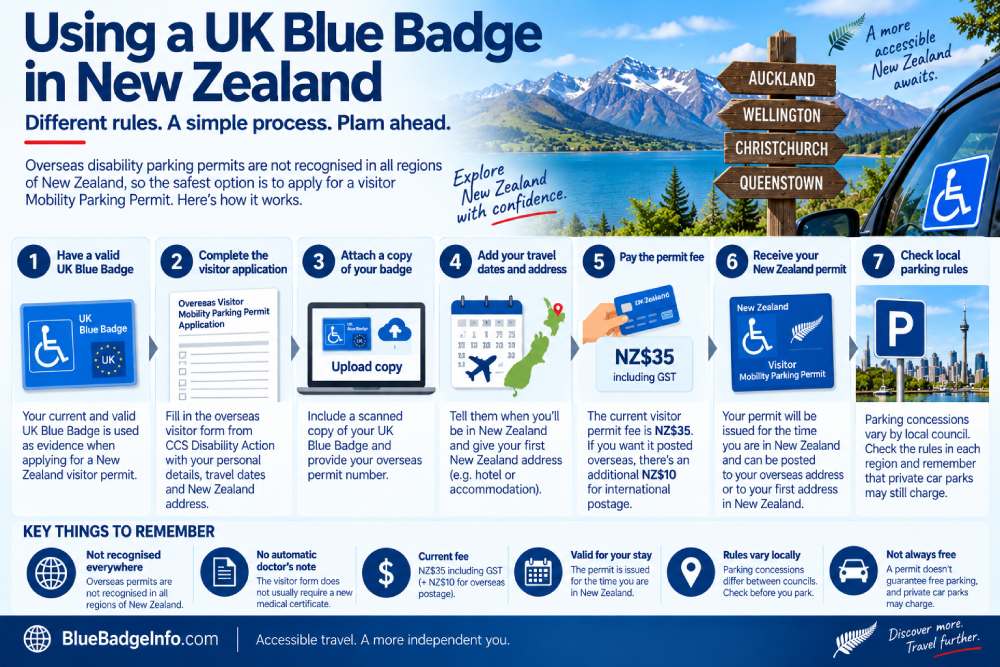
The current overseas visitor application asks you to provide a scanned copy of your UK Blue Badge, your travel dates and a New Zealand address. It does not automatically require you to obtain a new doctor’s certificate simply because you are visiting.
Can I use my UK Blue Badge in New Zealand?
Do not assume it will be accepted everywhere.
There is no UK-New Zealand nationwide agreement guaranteeing recognition of a UK Blue Badge.
Official New Zealand tourism guidance says that overseas mobility parking permits are not recognised in all regions.
That means your UK badge may potentially be accepted in some circumstances, but relying on it alone can create problems when:
- using designated mobility parking spaces;
- claiming additional parking time;
- using council parking concessions;
- or dealing with parking enforcement.
For a short-term visitor, the more reliable option is to obtain the dedicated New Zealand Mobility Parking Permit for overseas visitors.
For the wider international position, see which countries recognise the UK Blue Badge.
What is the New Zealand visitor Mobility Parking Permit?
New Zealand operates a Mobility Parking Permit scheme for people with qualifying mobility impairments.
A Mobility Parking Permit can allow the holder to:
- use designated mobility parking spaces;
- park closer to services and facilities;
- receive additional parking time in some council-controlled spaces;
- and receive other local concessions where they are offered.
For international travellers, CCS Disability Action provides a specific overseas visitor application.
The visitor permit is issued to the person, not permanently to one vehicle.
Do I have to exchange my UK Blue Badge?
No.
You do not surrender your UK Blue Badge simply because you are visiting New Zealand.
Instead, your existing Blue Badge serves as evidence when applying for the New Zealand overseas visitor permit.
The current application form specifically asks for:
“Overseas Permit Number”
and instructs applicants to include a scanned copy of their:
“Mobility Parking Permit / UK Blue Badge.”
This makes the UK Blue Badge directly relevant to the visitor application even though you should not rely on the UK permit alone nationwide.
How to apply for a New Zealand visitor Mobility Parking Permit
The current CCS Disability Action overseas visitor form asks for relatively straightforward information.
You need to provide:
- your name;
- date of birth;
- the nature of your impairment;
- your overseas permit number;
- a scanned copy of your UK Blue Badge;
- your first address in New Zealand;
- your dates in New Zealand;
- New Zealand contact details;
- and payment details.
You also sign a declaration confirming that the information supplied is correct and that you will follow the rules of the Mobility Parking Permit scheme.
Do I need medical certification?
Not automatically under the current overseas visitor application.
This is an important correction to the old version of this article.
The current overseas visitor form asks for:
- the nature of your impairment;
- your overseas permit number;
- and a copy of your existing UK Blue Badge.
It does not include the standard healthcare-practitioner certification section used for ordinary New Zealand resident applications.
However, CCS Disability Action states that it may contact you if the information provided is insufficient to assess the application.
So do not obtain a doctor’s letter automatically unless CCS requests further evidence.
How much does the New Zealand visitor permit cost?
The current overseas visitor application form lists the fee as:
NZ$35
including GST.
If you want the permit posted to you outside New Zealand, the current form asks for an additional:
NZ$10
for overseas postage.
Check the latest CCS Disability Action application before paying, as fees can change.
How long is the visitor Mobility Parking Permit valid?
The current overseas visitor form states that:
the permit will be issued for the time you are in New Zealand.
You therefore provide your:
- arrival date;
- departure date;
- and New Zealand address
as part of the application.
This makes the visitor permit different from a normal long-term New Zealand Mobility Parking Permit.
Can I apply before travelling to New Zealand?
Yes, and doing so is the sensible approach.
Official Tourism New Zealand guidance recommends arranging a visitor Mobility Parking Permit before your trip.
The CCS application also allows for:
- the permit to be posted overseas;
- or the permit to be sent to your first address in New Zealand.
If you are collecting a rental car immediately after arriving, arranging the permit in advance can make the first days of your trip much easier.
Where is the permit sent?
The application asks for your first address when in New Zealand.
CCS states that the permit will be sent to this address unless another arrangement is requested.
This could potentially be:
- a hotel;
- holiday accommodation;
- a friend or relative’s address;
- or another suitable delivery address.
If you prefer to receive the permit before leaving the UK, the current application provides an overseas-postage option.
Is the New Zealand Mobility Parking Permit recognised nationwide?
Yes.
New Zealand Mobility Parking Permits issued through recognised providers are accepted nationwide.
However, this does not mean every council gives exactly the same parking concessions.
The permit may be nationally recognised while:
- parking charges;
- additional time;
- maximum stays;
- and other concessions
vary between local authorities.
Do parking concessions vary around New Zealand?
Yes.
CCS Disability Action specifically tells permit holders to contact the relevant local council to find out what concessions apply.
Concessions can vary from region to region.
They may include:
- extra time in ordinary parking spaces;
- special mobility bays;
- different meter concessions;
- or other locally determined benefits.
Do not assume the rules you used in Auckland will automatically apply in Wellington, Christchurch or another city.
Can I park in mobility parking spaces?
Yes, with a valid recognised Mobility Parking Permit.
Mobility parking spaces are specifically designed for people with mobility impairments.
They are generally:
- wider than ordinary parking spaces;
- closer to entrances and facilities;
- and marked with the wheelchair accessibility symbol.
New Zealand road rules require a valid mobility permit to be displayed when using these spaces.
Parking without one can result in a fine or the vehicle being towed.
How should I display the New Zealand permit?
The visitor Mobility Parking Permit is designed to be displayed clearly inside the vehicle.
CCS says it can:
- hang from the vehicle’s rear-view mirror using its built-in hook;
- or be placed on the dashboard.
Whichever method you use, the permit details must be clearly visible from outside the vehicle.
Do not hide part of the permit behind:
- sun shades;
- other permits;
- documents;
- or vehicle equipment.
Can I use the permit in a rental car?
Yes.
New Zealand Mobility Parking Permits are issued to a person, not a vehicle.
This makes the visitor permit particularly suitable for tourists using:
- rental cars;
- accessible rental vehicles;
- family members’ cars;
- or another vehicle transporting the permit holder.
If you change rental vehicles during your trip, the physical permit remains associated with you rather than the original car.
Can someone else use my permit?
No.
CCS states that the permit:
- is issued personally to the permit holder;
- has its own unique number and barcode;
- cannot be copied or duplicated;
- and cannot be used by another person for their own parking.
The permit must be used for the needs of the person to whom it was issued.
Can the permit be displayed while I stay in the car?
Not when using a designated mobility space simply for the convenience of the driver.
The CCS visitor guidance states that if the permit holder remains in the vehicle, they should use a standard parking space rather than a designated mobility parking space, and the permit should not be displayed.
The permit is intended to help when the holder needs to get into or out of the vehicle.
Is mobility parking free in New Zealand?
Not automatically.
The official visitor-permit guidance expressly says that the permit does not allow you to:
- park illegally;
- or park for free where parking charges are indicated.
Some councils provide free parking or additional time in certain spaces, while others require payment.
Always check:
- the sign;
- parking meter;
- parking app;
- and local council rules.
What are the mobility parking rules in Auckland?
Auckland provides a useful example of how local concessions work.
For recognised Mobility Parking Permit holders, Auckland Transport currently provides concessions including:
- free parking in dedicated mobility spaces, subject to the time restrictions shown;
- double the posted time in certain ordinary time-restricted on-street spaces;
- and an extra hour of free parking on top of the time paid in qualifying paid on-street parking areas.
Off-street car park buildings can have different concessions.
That means you should check the specific car park rather than assuming one Auckland rule applies everywhere.
What about Auckland’s mobility e-permit?
Auckland Transport also operates an optional mobility e-permit system.
This links a valid physical Mobility Parking Permit to a vehicle registration number so camera-based parking enforcement can recognise the concession more reliably.
You still need to display the physical permit.
If you will spend significant time parking on Auckland streets, it may be worth checking whether the e-permit is appropriate for your visitor permit and rental vehicle.
Are the rules the same in Christchurch?
No.
Christchurch provides a good example of why you must check local rules.
Current Christchurch City Council concessions include:
- in qualifying P60 metered areas, paying for parking can provide an additional 60 minutes, up to a maximum of 120 minutes;
- there is no equivalent concession in P120 metered areas;
- P30 and P60 ordinary time-restricted spaces can allow double the stated time;
- and concessions do not apply to time-restricted areas of less than 30 minutes.
These rules are quite different from Auckland’s.
This illustrates the central New Zealand rule:
the permit is national, but many parking concessions are local.
What about private car parks?
Do not assume council Mobility Parking Permit concessions apply.
CCS specifically says that council parking concessions do not automatically apply in privately managed car parks.
This includes facilities such as:
- hotels;
- shopping centres;
- airports;
- tourist attractions;
- supermarkets;
- hospitals;
- and commercial parking buildings.
A private operator may:
- provide mobility spaces;
- charge normal parking fees;
- require registration;
- set its own maximum stay;
- or apply another concession.
Always read the signs.
Does the permit allow me to park anywhere?
No.
A Mobility Parking Permit does not override normal road-safety and parking restrictions.
Do not use it to park illegally or obstruct:
- traffic;
- footpaths;
- driveways;
- bus stops;
- loading areas;
- emergency access;
- or other prohibited areas.
Follow the signs and road markings at the location.
Can I use my UK Blue Badge instead of getting the visitor permit?
You should not rely on it nationwide.
Official Tourism New Zealand guidance says overseas mobility parking permits are not recognised in all regions.
There may be individual councils or parking authorities willing to recognise an overseas permit.
For example, some New Zealand local councils expressly accept a current equivalent disability permit issued by an overseas authority.
However, this creates unnecessary uncertainty when travelling between regions.
For a multi-region holiday, the dedicated New Zealand visitor permit is the more reliable option.
What if I am only visiting one city?
If you intend to stay in one area and want to rely on your UK Blue Badge alone, contact the relevant local council before travelling.
Ask:
- whether a UK Blue Badge is recognised;
- whether mobility bays can be used;
- what parking concessions apply;
- and how the foreign permit must be displayed.
Get written confirmation where possible.
For a trip involving several regions, obtaining the visitor Mobility Parking Permit avoids having to depend on separate local recognition decisions.
Do I need to carry my UK Blue Badge after receiving the New Zealand permit?
It is sensible to keep your original UK Blue Badge with your travel documents because it is the overseas permit used to support your visitor application.
However, when using New Zealand mobility parking concessions, display the valid New Zealand Mobility Parking Permit according to the local rules.
Do not display multiple permits in a way that obscures important information.
What should I prepare before travelling?
Use this checklist:
- ☑ Make sure your UK Blue Badge is valid.
- ☑ Complete the overseas visitor application.
- ☑ Include a clear scanned copy of your UK Blue Badge.
- ☑ Provide your New Zealand travel dates.
- ☑ Provide your first New Zealand address.
- ☑ Pay the current visitor permit fee.
- ☑ Arrange overseas or New Zealand delivery.
- ☑ Check the parking concessions for each council area.
- ☑ Check private car parks separately.
- ☑ Display the visitor permit clearly when parked.
- ☑ Only use the permit for the permit holder’s journey.
Travelling from Australia to New Zealand?
Do not assume Australia’s overseas-permit recognition rules continue in New Zealand.
Several Australian states directly recognise overseas disability parking permits, while New Zealand’s official visitor guidance recommends arranging its own visitor Mobility Parking Permit because overseas permits are not recognised consistently throughout the country.
See Can I use my UK Blue Badge in Australia?
Other destinations outside Europe
- Using a UK Blue Badge in Australia
- Using a UK Blue Badge in Canada
- Using a UK Blue Badge in the United States
For international trip planning, see how to plan an international road trip with your Blue Badge.
Official guidance
- CCS Disability Action — New Zealand Mobility Parking Permit application for overseas visitors
- Tourism New Zealand — Inclusive and accessible travel
- Disability Support Services New Zealand — Transport and vehicles
- NZ Transport Agency — Mobility parking and parking signs
- Auckland Transport — Mobility parking permits and concessions
The bottom line
You should not rely on your UK Blue Badge alone throughout New Zealand.
Overseas permits are not recognised consistently across every region, so official New Zealand tourism guidance recommends arranging a visitor Mobility Parking Permit before travelling.
The process is simpler than your old article suggested:
- you already have evidence of eligibility through your UK Blue Badge;
- the current visitor form asks for a scanned copy of that badge;
- it does not automatically require a new doctor’s certificate;
- the permit is issued for the period of your stay;
- and it can be used nationwide.
Parking concessions still vary by local council, so always check the rules in each town or city you visit.
For the wider international picture, see which countries recognise the UK Blue Badge.
Frequently asked questions
Can I use my UK Blue Badge in New Zealand?
You should not rely on it nationwide. Overseas mobility parking permits are not recognised consistently in every region, so visitors are advised to arrange a New Zealand visitor Mobility Parking Permit.
How do I get a New Zealand visitor Mobility Parking Permit?
Complete the CCS Disability Action overseas visitor application and provide your personal details, travel dates, New Zealand address, overseas permit number and a scanned copy of your UK Blue Badge.
Do I need a doctor’s letter to apply?
Not automatically under the current overseas visitor form. It asks for the nature of your impairment and a copy of your existing overseas Mobility Parking Permit or UK Blue Badge. CCS may contact you if more information is needed.
How much does a New Zealand visitor Mobility Parking Permit cost?
The current CCS overseas visitor form lists a fee of NZ$35 including GST, plus an additional NZ$10 if the permit is posted overseas. Check the latest form before applying because fees can change.
How long is the visitor permit valid?
The current application states that the permit is issued for the time you are in New Zealand, based on the travel dates you provide.
Can I apply before travelling?
Yes. Official Tourism New Zealand guidance recommends arranging the visitor permit before your trip. The CCS application allows delivery overseas or to your first New Zealand address.
Can I use the permit throughout New Zealand?
New Zealand Mobility Parking Permits are recognised nationwide. However, the actual parking concessions, charges and additional time available can vary between local councils.
Is mobility parking free in New Zealand?
Not automatically. The visitor permit does not allow free parking where charges apply. Some councils offer free or extended parking concessions, but the rules vary locally.
Can I use the permit in a rental car?
Yes. The Mobility Parking Permit is issued to the person rather than permanently to a vehicle, so it can be used in a rental car when the permit holder is travelling.
Can someone else use my visitor permit?
No. The permit is personal to the holder and cannot be copied, duplicated or used by another person for their own parking.
How should I display the permit?
CCS says the permit can hang from the rear-view mirror or be displayed on the dashboard, provided the details are clearly visible from outside the vehicle.
Do New Zealand parking concessions vary by city?
Yes. For example, Auckland provides free dedicated mobility spaces and additional time in some ordinary spaces, while Christchurch uses different concessions for metered and time-restricted parking. Always check the relevant local council.
Can I simply use my UK Blue Badge if a local council accepts overseas permits?
Possibly in that specific area, but overseas permits are not recognised consistently nationwide. A New Zealand visitor Mobility Parking Permit is the more reliable option for a multi-region trip.