


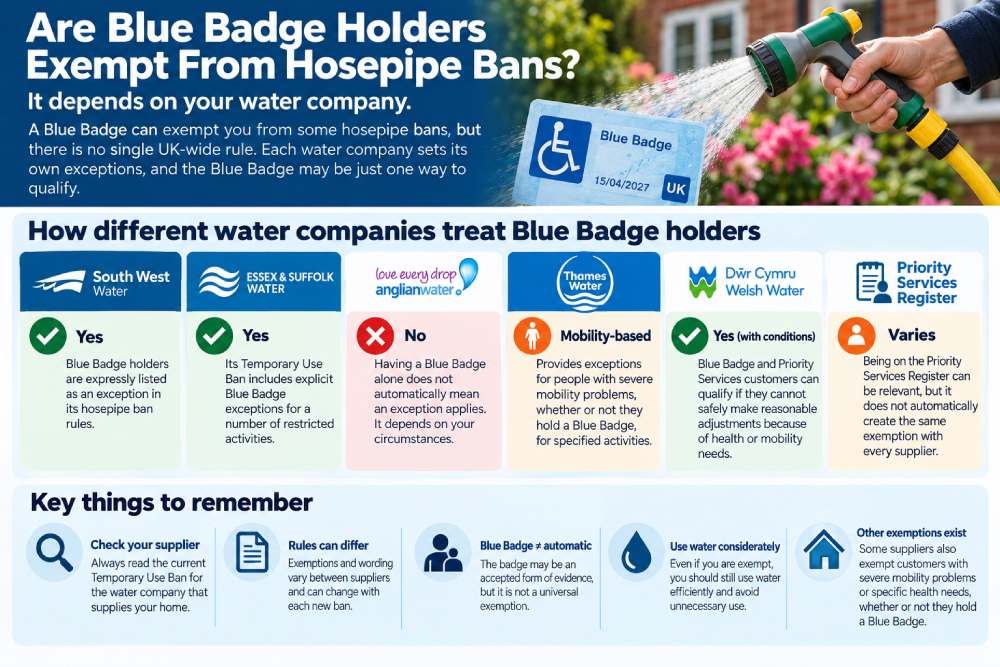
A Blue Badge can exempt you from some hosepipe bans, but there is no single rule saying every Blue Badge holder is automatically exempt everywhere. The exact exception depends on the water supplier, the Temporary Use Ban currently in force and sometimes whether your disability makes alternatives such as a watering can or bucket unsafe or impractical.
For example:
- South West Water currently lists Blue Badge holders among its hosepipe-ban exceptions;
- Essex & Suffolk Water expressly allows Blue Badge holders to continue certain restricted uses;
- Anglian Water says having a Blue Badge alone does not automatically create an exception;
- and Thames Water currently frames an important exception around severe mobility problems, whether or not the person holds a Blue Badge.
So the safest rule is:
check the current Temporary Use Ban published by the company that actually supplies your water.
Are Blue Badge holders exempt from hosepipe bans?
Sometimes — but not automatically nationwide.
A hosepipe ban is formally known as a:
Temporary Use Ban (TUB).
In England and Wales, water companies can introduce these restrictions when they are experiencing, or expect to experience, a serious shortage of water.
A Temporary Use Ban can restrict activities such as:
- watering a garden with a hosepipe;
- washing a private vehicle with a hosepipe;
- watering domestic plants;
- filling a swimming or paddling pool;
- filling a domestic pond;
- cleaning paths or patios;
- cleaning walls or windows;
- and cleaning other outdoor surfaces.
However, the legislation also allows exceptions to be included.
That is why:
two water companies can have similar hosepipe bans but different disability exceptions.
Blue Badge hosepipe-ban rules at a glance
| Situation | Does the Blue Badge automatically exempt you? |
|---|---|
| South West Water | Its published exceptions expressly include Blue Badge holders. |
| Essex & Suffolk Water | Its current Temporary Use Ban includes explicit Blue Badge exceptions for a number of restricted activities. |
| Anglian Water | No. Anglian Water expressly says having a Blue Badge alone does not automatically mean an exception applies. |
| Thames Water | Its current legal notice provides exceptions for people with severe mobility problems, whether or not they hold a Blue Badge, for specified activities. |
| Dŵr Cymru Welsh Water | Its published framework includes Blue Badge and Priority Services customers who cannot safely make reasonable adjustments because of health or mobility needs. |
| Priority Services Register | Being registered can be relevant, but PSR membership does not create the same automatic hosepipe exception with every supplier. |
| No exemption applies | You must follow the restrictions in the Temporary Use Ban. |
Why can disabled people be exempt from a hosepipe ban?
The most important point is that these exemptions are:
not really a benefit of the Blue Badge parking scheme itself.
Water suppliers generally focus instead on the practical effect of:
- a disability;
- a health condition;
- severe mobility difficulties;
- or another additional support need.
For some people, complying with a hosepipe restriction by switching to a:
- watering can;
- bucket;
- or another manually carried container
may not be safe or reasonably practical.
Current supplier rules repeatedly use concepts such as:
being unable to make reasonable adjustments because of a disability or health condition.
The Blue Badge can therefore be used by some suppliers as a convenient way of identifying customers who may have significant mobility needs.
But:
the Blue Badge itself is not the legal reason every exemption exists.
Does the Water Industry Act automatically exempt Blue Badge holders?
No.
The Water Industry Act 1991 gives water undertakers in England and Wales the power to impose Temporary Use Bans.
The legislation also allows a prohibition to:
- apply only in specified circumstances;
- apply to particular classes of users;
- and contain absolute or conditional exceptions.
Some exceptions arise directly from legislation or health-and-safety requirements.
Others are:
discretionary exceptions adopted by the water supplier.
A Blue Badge exemption can therefore appear in one company’s Temporary Use Ban while another company’s notice uses different disability criteria.
Does South West Water exempt Blue Badge holders?
Yes, under its currently published hosepipe-ban exception rules.
South West Water states that its hosepipe restrictions do not apply if:
- you are a Blue Badge holder;
- you are on its Priority Services Register and cannot make reasonable adjustments because of a disability or health condition;
- the water use is necessary to protect human health and safety;
- or another listed exception applies.
South West Water also asks customers who can avoid using a hosepipe to continue helping reduce demand where possible.
See:
South West Water — Hosepipe ban exceptions.
Does Essex & Suffolk Water exempt Blue Badge holders?
Yes, its current Temporary Use Ban contains explicit Blue Badge exceptions for a number of activities.
For example, its published restrictions currently allow a Blue Badge holder to use a hosepipe for specified activities that can otherwise be prohibited.
The supplier also provides exceptions for some people who:
have reduced mobility and cannot reasonably use an alternative such as a watering can.
This is useful because it demonstrates that:
you do not necessarily need a Blue Badge to have a disability-related exception.
See:
Essex & Suffolk Water — Temporary Use Ban.
Does Anglian Water automatically exempt Blue Badge holders?
No.
Anglian Water makes this particularly clear.
Its current FAQ asks:
“I have a Blue Badge. Am I exempt?”
and explains that:
having a Blue Badge does not automatically mean an exception applies.
However, an exception may apply if a person is physically unable to safely use:
- a watering can;
- or a bucket
because of:
- a health condition;
- a disability;
- or another additional support need.
Anglian Water also encourages eligible customers to join its:
Priority Services Register.
Where the relevant exception applies, its current guidance says the customer does not need to separately apply or notify the company before relying on it.
See:
Anglian Water — Hosepipe restriction FAQs.
What does Thames Water say?
Thames Water provides another useful example of why you should not treat the Blue Badge itself as the universal test.
Its current Temporary Use Ban legal notice provides an exception for:
people with severe mobility problems, whether they hold a current Blue Badge or not.
For qualifying people, the exception covers specified uses including using a hosepipe to:
- water a domestic garden;
- clean a private motor vehicle;
- water domestic or other non-commercial plants;
- water an allotment in qualifying circumstances;
- fill or maintain a domestic pond;
- clean domestic walls or windows;
- clean paths or patios;
- and clean other artificial outdoor surfaces.
Thames Water also provides separate exceptions for some customers on its:
Priority Services Register.
The important point is:
the qualifying mobility problem matters more than simply possessing the badge.
See:
Thames Water — Temporary Use Ban legal notice.
What about Welsh Water?
Dŵr Cymru Welsh Water’s published hosepipe-ban exception framework also demonstrates the conditional nature of these rules.
It provides exceptions for qualifying:
- Blue Badge holders;
- and customers on its Priority Services Register
who are:
physically unable or cannot make reasonable adjustments because of health reasons to safely comply with the restriction.
Qualifying customers can continue the permitted use without having to obtain an individual letter of permission.
However, restrictions themselves are temporary.
Dŵr Cymru confirmed that the Temporary Use Ban affecting parts of west Wales in summer 2026 was lifted on:
4 September 2026.
So a published exemption does not mean a hosepipe ban is necessarily in force today.
See:
Dŵr Cymru Welsh Water — Hosepipe-ban exemptions.
Does being on the Priority Services Register automatically exempt you?
Not necessarily.
This is another point where the original question can become misleading.
A water company’s Priority Services Register is generally a free service for customers who may need extra support because of circumstances such as:
- disability;
- health needs;
- age;
- communication needs;
- or other vulnerabilities.
But:
being on a PSR does not automatically create exactly the same hosepipe-ban rights with every supplier.
For example, a company may require:
- PSR membership;
- and an inability to make reasonable adjustments because of a disability;
- or a particular medical or mobility circumstance.
Always read the exception attached to the actual Temporary Use Ban.
Do I need to register my Blue Badge with the water company?
It depends on the supplier.
Do not assume there is a national Blue Badge database used by water companies.
Some suppliers state that customers meeting their published exception:
do not need to apply for individual permission.
Others may ask customers to:
- join the Priority Services Register;
- contact the supplier;
- provide information;
- or follow another process.
Check the current supplier guidance rather than relying on an old hosepipe-ban article.
Do I need to show my Blue Badge?
Not necessarily.
The evidence required depends on the supplier’s exception.
If the rule expressly covers Blue Badge holders, it is sensible to:
keep your valid Blue Badge available.
However, another supplier may base its exception on:
- mobility problems;
- a health condition;
- PSR status;
- or another qualifying circumstance
rather than treating the physical Blue Badge as the sole proof.
Can someone without a Blue Badge still be exempt?
Yes.
Several current supplier rules make this clear.
For example, exceptions can apply to people who:
- have severe mobility problems;
- cannot safely carry a watering can or bucket;
- have a qualifying health condition;
- are registered for Priority Services and satisfy additional criteria;
- or need water for health-and-safety purposes.
Thames Water expressly refers to people with severe mobility problems:
whether or not they hold a Blue Badge.
So a Blue Badge can be one route to an exception, but it is not necessarily the only route.
What can a hosepipe ban actually restrict?
A Temporary Use Ban in England and Wales can cover activities including:
- watering a garden using a hosepipe;
- cleaning a private motor vehicle;
- watering plants on domestic or non-commercial premises;
- cleaning a private leisure boat;
- filling or maintaining a domestic swimming or paddling pool;
- domestic recreational use;
- filling or maintaining a domestic pond;
- filling or maintaining an ornamental fountain;
- cleaning domestic walls or windows;
- cleaning paths or patios;
- and cleaning other artificial outdoor surfaces.
The exact prohibition and exceptions should be set out in:
the supplier’s current legal notice.
Does an exemption mean I can use unlimited water?
No.
An exception means the specified restriction does not apply to you in the circumstances described.
It does not mean:
- there is no drought;
- water supplies are unlimited;
- every possible hosepipe use is permitted;
- or all other restrictions disappear.
Water companies still ask exempt customers to:
use water efficiently wherever they reasonably can.
For example, someone who needs a hosepipe because carrying a watering can is unsafe may still be able to:
- avoid unnecessary watering;
- use collected rainwater;
- water at cooler times of day;
- repair leaking equipment;
- or use a more efficient watering method.
Can I use water from a water butt during a hosepipe ban?
Generally, restrictions concern water supplied by the water company rather than collected rainwater.
Current supplier guidance commonly allows a hosepipe connected to:
- a water butt;
- rainwater storage;
- or another recycled-water source
rather than the mains supply.
Check the specific Temporary Use Ban, particularly if your system can also connect to mains water.
Can a Blue Badge holder wash their car with a hosepipe?
Only if the applicable Temporary Use Ban provides an exception that covers that use.
Do not assume a general disability exception automatically covers every prohibited activity.
For example, some current supplier notices expressly permit qualifying disabled customers to:
clean a private motor vehicle using a hosepipe.
Others may frame the exception differently.
Check:
- the supplier;
- the specific prohibited activity;
- and the wording of the disability exception.
Can a Blue Badge holder water the garden with a hosepipe?
Again:
it depends on the actual supplier exception.
Many disability-related exceptions specifically address garden watering because the usual alternative:
- filling;
- lifting;
- carrying;
- and repeatedly emptying a watering can
may not be safe or reasonable for some people with severe mobility difficulties.
But possession of the Blue Badge should not be treated as a universal national permission slip.
Can you be fined for breaking a hosepipe ban?
Yes.
Temporary Use Bans are legally enforceable.
A person who breaches the restrictions can face:
a fine of up to £1,000.
Water suppliers generally focus first on:
- education;
- explaining the restrictions;
- and encouraging compliance.
But repeated or serious breaches can lead to enforcement.
If you believe you qualify for an exception:
check the supplier’s published rules before using the hosepipe.
How do I know which water company sets my hosepipe rules?
Check:
- your latest water bill;
- your water supplier’s website;
- or the current restriction notice for your postcode.
Do not rely only on:
the county or town you live in.
Water-supply boundaries do not always follow local-authority boundaries.
Different properties in the same broader region can be supplied by different companies.
What about Scotland and Northern Ireland?
The Temporary Use Ban framework described above is particularly relevant to:
England and Wales.
If you live in Scotland or Northern Ireland, check the current restrictions published by:
Do not assume that an exemption published by an English or Welsh water company applies elsewhere in the UK.
For example, NI Water confirmed in July 2026 that it was not at that time considering a hosepipe ban, despite very high summer water demand.
Restrictions can change quickly during prolonged dry weather.
How to check whether you are exempt
If a Temporary Use Ban is announced in your area:
- Identify your actual water supplier.
- Open its current Temporary Use Ban or hosepipe-ban page.
- Read the legal notice and exceptions.
- Look specifically for Blue Badge, disability, severe mobility or Priority Services wording.
- Check whether the exception applies to the activity you want to carry out.
- Check whether registration or notification is required.
- Keep any relevant evidence available.
- Use water carefully even when an exception applies.
Examples of why you must check your own supplier
| Supplier | Published disability approach |
|---|---|
| South West Water | Expressly lists Blue Badge holders as an exception. |
| Essex & Suffolk Water | Explicit Blue Badge exceptions appear for specified restricted activities; reduced-mobility exceptions also exist. |
| Anglian Water | Blue Badge alone does not automatically qualify; disability or health-related inability to safely use alternatives is relevant. |
| Thames Water | Uses a severe-mobility test for specified activities whether or not the customer has a Blue Badge. |
| Dŵr Cymru Welsh Water | Blue Badge/PSR customers can qualify where they cannot safely make reasonable adjustments because of health or mobility needs. |
These policies can change whenever a new Temporary Use Ban is issued.
Always use the latest supplier notice rather than treating this comparison as permanent permission.
Official guidance
- Ofwat — Hosepipe bans and non-essential use bans
- GOV.UK — How drought is managed in England
- Anglian Water — Hosepipe restriction FAQs
- Essex & Suffolk Water — Temporary Use Ban
- Thames Water — Temporary Use Ban legal notice
- South West Water — Hosepipe-ban exceptions
- Dŵr Cymru Welsh Water — Hosepipe-ban exceptions
The bottom line
Blue Badge holders can be exempt from a hosepipe ban, but the Blue Badge is not a universal UK-wide exemption.
The actual rule depends on:
- your water supplier;
- the Temporary Use Ban currently in force;
- the activity you want to carry out;
- your disability or mobility needs;
- and sometimes whether you are registered for Priority Services.
Current supplier rules show just how different the approaches can be:
- South West Water: Blue Badge holders are expressly listed as an exception.
- Essex & Suffolk Water: explicit Blue Badge exceptions apply to specified activities.
- Anglian Water: having a Blue Badge alone does not automatically exempt you.
- Thames Water: severe mobility problems can qualify whether or not you have a Blue Badge.
- Dŵr Cymru Welsh Water: disability and ability to make reasonable adjustments form part of its published exception criteria.
So do not rely on the simple statement:
“I have a Blue Badge, so the hosepipe ban does not apply to me.”
Instead:
check your supplier’s current legal notice and confirm that both you and the activity you want to carry out are covered by the exception.
For the wider scheme, see current Blue Badge rules and regulations.
Frequently asked questions
Are Blue Badge holders exempt from hosepipe bans?
Sometimes. Some water suppliers expressly exempt Blue Badge holders, while others base their exception on disability, severe mobility problems or inability to safely use alternatives such as a watering can or bucket. Check your supplier’s current Temporary Use Ban.
Is there a nationwide Blue Badge hosepipe-ban exemption?
No. In England and Wales, water companies can introduce Temporary Use Bans with their own applicable exceptions. The wording can therefore differ between suppliers and between separate bans.
Does Anglian Water automatically exempt Blue Badge holders?
No. Anglian Water currently states that having a Blue Badge alone does not automatically mean an exception applies. An exception may apply where a health condition, disability or additional support need means the customer cannot safely use a watering can or bucket.
Does Thames Water exempt Blue Badge holders?
Thames Water’s current legal notice provides an exception for people with severe mobility problems for specified hosepipe uses, whether or not they hold a Blue Badge.
Does South West Water exempt Blue Badge holders?
South West Water currently lists Blue Badge holders among its published hosepipe-ban exceptions.
Can someone without a Blue Badge still be exempt?
Yes. Some suppliers provide disability or mobility exceptions that do not require a Blue Badge. Thames Water, for example, currently refers to severe mobility problems whether or not the person holds a badge.
Does being on the Priority Services Register automatically exempt me?
Not necessarily. Priority Services status can be relevant, but some suppliers also require a disability or health condition that makes it unsafe or impractical to comply using alternatives. Check the specific exception.
Do I need to register my Blue Badge with my water company?
It depends on the supplier. Some companies state that qualifying customers do not need to apply or notify them, while others may use Priority Services registration or another process.
Can a Blue Badge holder wash a car with a hosepipe during a ban?
Only if the applicable Temporary Use Ban contains an exception covering both the customer and vehicle washing. Do not assume every disability exception applies to every restricted hosepipe use.
Can a Blue Badge holder water a garden with a hosepipe?
Potentially. Several suppliers provide disability-related exceptions for garden watering where using a watering can is not safe or reasonable, but the exact criteria vary.
Can I be fined for breaking a hosepipe ban?
Yes. Temporary Use Bans are legally enforceable and breaches can result in a fine of up to £1,000.
Does a hosepipe ban apply to water from a water butt?
Restrictions generally concern water supplied through the mains. Many supplier rules allow hosepipes connected only to rainwater, recycled-water storage or a water butt, but check the current notice.