
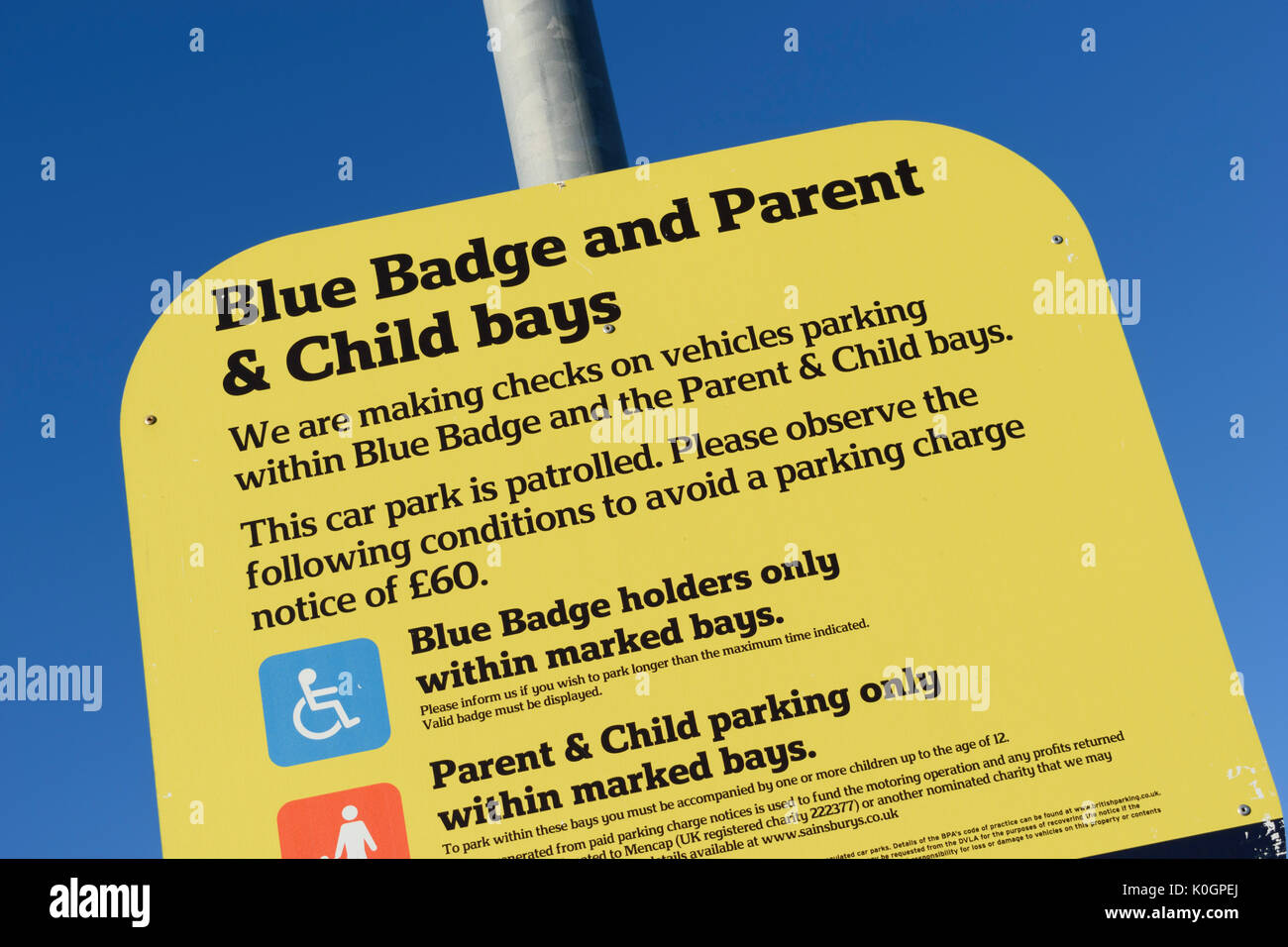

A Blue Badge does not automatically give you the right to park in a parent-and-child space. Whether you can use one depends on the rules of the specific car park, the signs displayed and any policy set by the landowner or parking operator.
This is especially important in:
- supermarket car parks;
- retail parks;
- shopping centres;
- private car parks;
- and other off-street parking facilities.
If the accessible bays are full, some car parks may allow a Blue Badge holder to use another wider bay such as a parent-and-child space.
Others may not.
Never assume that displaying your Blue Badge automatically overrides the parent-and-child restriction.
Can Blue Badge holders park in parent and child spaces?
There is no general Blue Badge rule giving badge holders an automatic right to use parent-and-child bays.
Parent-and-child bays are different from statutory on-street disabled parking bays.
They are normally provided as part of an:
off-street car park’s own parking arrangements.
The rules can therefore be set by:
- the supermarket;
- shopping centre;
- retail park;
- local authority operating the car park;
- landowner;
- or private parking operator.
That means the correct question is not simply:
“Do I have a Blue Badge?”
It is:
“What do the rules for this particular parent-and-child bay say?”
Blue Badge and parent-and-child bays at a glance
| Situation | What to do |
|---|---|
| Accessible bay available | Use the accessible bay where appropriate. |
| All accessible bays full | Do not automatically move into a parent-and-child bay. Check the signs or ask the operator. |
| Sign says parent and child only | Assume the restriction applies unless the operator confirms a Blue Badge exception. |
| Operator explicitly permits Blue Badge holders | You can use the bay subject to any conditions stated by the operator. |
| No clear information | Ask customer services, the parking attendant or the car park operator before leaving the vehicle. |
| Blue Badge displayed | This does not by itself cancel the parent-and-child parking conditions. |
| Private parking charge issued | Check the signs and evidence, then appeal promptly if you believe the charge was wrongly issued. |
Why doesn’t a Blue Badge automatically cover parent-and-child bays?
Because the statutory Blue Badge parking concessions mainly concern specific forms of parking.
For example, depending on the UK nation and local rules, they can provide concessions relating to:
- disabled parking bays;
- on-street pay-and-display parking;
- parking meters;
- yellow lines;
- and certain other controlled on-street spaces.
Parent-and-child bays are a different type of parking facility.
They are designed to provide additional space for people getting children:
- into or out of child seats;
- into pushchairs;
- or safely between the vehicle and the premises.
They are not automatically part of the statutory Blue Badge concessions.
For the broader rules, see where you can park with a Blue Badge.
Are parent-and-child spaces always private?
No.
They are very common in privately operated supermarket and retail car parks, but local authorities can also provide parent-and-child bays in council-run off-street car parks.
That is another reason not to rely on one universal rule.
For example, North Devon Council expressly states that at its Barnstaple Central car park:
parent-and-child bays can also be used by Disabled Badge holders.
That is a local parking rule for that particular car park.
It does not mean the same rule applies:
- at another council’s car park;
- at another supermarket;
- at another retail park;
- or even necessarily at another location operated by the same organisation.
Always check the actual parking conditions where you are parking.
Can the rules differ between branches of the same supermarket?
Yes.
Private parking arrangements can differ even between locations operated under the same retail brand.
A supermarket may:
- own one car park itself;
- lease another;
- share another with a retail park;
- or use different parking-management companies at different stores.
The resulting rules can differ in relation to:
- maximum stay;
- number-plate registration;
- customer validation;
- accessible parking;
- and parent-and-child spaces.
Therefore:
do not rely on what happened at another branch.
Read the signs each time you park.
What if all the disabled bays are full?
This is the situation most likely to cause uncertainty.
If every accessible bay is occupied, do not assume that your Blue Badge automatically gives you permission to use:
a parent-and-child bay.
Instead:
- Check the signs. Look for any wording explaining who may use the parent-and-child spaces.
- Look for alternative accessible parking. Another section of the car park may have additional disabled bays.
- Ask customer services. If you are at a supermarket or shopping centre, staff may be able to confirm the site’s policy.
- Ask the parking operator if necessary. Contact details are often shown on the parking signs.
- Keep evidence. If permission is given or the accessible bays are all occupied, retaining evidence may help if a charge is later issued.
Does displaying a Blue Badge protect you from a parking charge?
No.
Displaying a Blue Badge can show that you are a badge holder, but it does not automatically override:
- the parent-and-child restriction;
- a maximum stay;
- a requirement to register your number plate;
- a customer-only rule;
- or another condition of the car park.
This is particularly important in private car parks.
See using your Blue Badge in private car parks.
Does the Equality Act give Blue Badge holders the right to use parent-and-child bays?
Not automatically.
In England, Scotland and Wales, service providers are subject to duties under the:
Equality Act 2010.
This includes a duty to make reasonable adjustments where disabled people would otherwise be placed at a substantial disadvantage when using a service.
A reasonable adjustment can sometimes involve:
- changing a policy;
- changing how a service is provided;
- removing or reducing an access barrier;
- or providing an alternative way for the disabled person to access the service.
However:
the Equality Act does not contain a general rule saying that every Blue Badge holder may use every parent-and-child parking bay.
Whether allowing use of a particular space would amount to an appropriate reasonable adjustment depends on the circumstances.
The operator should consider disabled access properly rather than simply assuming that displaying a Blue Badge answers every parking question.
What about Northern Ireland?
Northern Ireland has separate disability-discrimination legislation rather than relying on the Equality Act 2010 in the same way as Great Britain.
Service providers still have duties relating to:
reasonable adjustments and access for disabled customers.
But again:
that does not create a universal rule allowing every Blue Badge holder to use parent-and-child bays.
Check the site-specific parking conditions.
Are accessible parking bays legally different from parent-and-child bays?
They serve different purposes.
Accessible parking provision forms part of making facilities usable by disabled people.
Parent-and-child bays are normally provided to give families additional room for:
- child seats;
- pushchairs;
- doors opening more widely;
- and safe access with children.
A parent-and-child bay should therefore not simply be treated as:
an overflow disabled bay.
Likewise, an accessible bay should not be treated simply as an alternative parent-and-child space by a person who does not meet the relevant parking conditions.
Do parent-and-child spaces have a universal age limit?
No.
Do not assume that every parent-and-child bay has the same age rule.
The permitted child’s age can depend on:
- the retailer;
- the shopping centre;
- the parking operator;
- or the wording on the signs.
Some car parks may refer to:
- young children;
- children using child seats;
- a particular age;
- or another defined condition.
Read the actual restriction rather than relying on a general age such as:
“under 12”.
There is no single UK-wide parent-and-child parking age rule.
Can you get a Parking Charge Notice?
Yes.
In a privately managed car park, a parking operator can issue a:
Parking Charge Notice
if it believes you have breached the parking terms displayed on the signs.
For example, that might happen if a sign says the bay is:
reserved exclusively for customers accompanied by a child
and the operator’s policy provides no Blue Badge exception.
A private Parking Charge Notice should not be confused with a council:
Penalty Charge Notice.
They can both commonly be abbreviated as:
PCN
but they arise under different enforcement systems.
Is there a new government Private Parking Code of Practice?
The situation needs to be described carefully.
The government published a Private Parking Code of Practice in:
February 2022.
That code was subsequently:
withdrawn in June 2022.
The government launched a new consultation in 2025 as part of preparing a replacement statutory code.
Meanwhile, the two main private-parking trade associations introduced a:
single industry Code of Practice
which came into effect for new members from 31 October 2024.
Existing members have been moving through a transition period, with full implementation under that industry code scheduled by the end of:
December 2026.
Therefore:
do not rely on articles claiming that the withdrawn 2022 Government Code is currently the binding government parking code.
What has the CMA said about private parking?
In July 2026, the Competition and Markets Authority announced action concerning private parking practices and appeals.
One of its key messages to drivers was:
not all car parks work the same.
The CMA specifically warns that even car parks associated with:
the same supermarket chain can have different rules at different locations.
It also recommends:
- checking the signs every time you park;
- keeping evidence if something goes wrong;
- and acting quickly if you receive a parking charge you want to challenge.
That advice is especially relevant to parent-and-child bays.
What should I photograph if the disabled bays are full?
If you believe you have a good reason to use another bay and want to preserve evidence, photograph:
- the occupied accessible bays;
- the parent-and-child bay sign;
- the main car park terms and conditions;
- your parked vehicle;
- your displayed Blue Badge where relevant;
- and any written permission or information provided by staff.
Do this before leaving the car park if possible.
The evidence does not automatically make the parking permitted, but it can help explain what happened if there is a dispute later.
What if a member of staff says I can use the bay?
If customer services or another authorised member of staff confirms that you can use the parent-and-child bay because the accessible spaces are full:
ask whether you need to do anything else.
For example:
- register your number plate;
- speak to the parking attendant;
- enter your registration at a terminal;
- or obtain written confirmation.
This is particularly important where the car park uses:
ANPR cameras.
A verbal conversation with store staff may not automatically update the parking operator’s system.
What if I receive a private Parking Charge Notice?
Do not ignore it.
First check:
- which parking company issued it;
- the alleged breach;
- the signs displayed at the car park;
- the date and time;
- and any evidence you collected.
If you believe the charge was wrongly issued:
appeal promptly to the parking operator.
The CMA currently advises motorists who want to challenge a private parking charge to act quickly, including within 14 days where relevant, so they do not unnecessarily lose access to the early-payment discount while pursuing an appeal.
Useful evidence can include:
- photographs;
- receipts;
- parking confirmations;
- proof of a malfunctioning machine;
- or evidence of permission given by the premises.
Should I use a parent-and-child space if a normal bay is available?
If you can safely and practically use another space:
that will usually avoid the uncertainty altogether.
But for some disabled people, an ordinary bay may not provide enough space to:
- fully open a door;
- transfer to a wheelchair;
- use mobility equipment;
- or enter and leave the vehicle safely.
In those circumstances, speak to the service provider about:
what accessible alternative it can provide.
This is more appropriate than assuming a parent-and-child bay automatically becomes available because you hold a Blue Badge.
How to avoid a parking charge
Before parking in a parent-and-child bay as a Blue Badge holder:
- Use an accessible bay if a suitable one is available.
- Read the parent-and-child bay sign.
- Read the main car park terms.
- Do not assume your Blue Badge overrides those terms.
- Ask the operator or customer services if the accessible bays are full.
- Check whether your number plate needs to be registered.
- Keep evidence if permission is given or there is an accessibility problem.
Official guidance and useful sources
- GOV.UK — Blue Badge rights and responsibilities in England
- GOV.UK — Equality Act guidance for service providers
- GOV.UK — Private Parking Code of Practice consultation
- Competition and Markets Authority — Private parking guidance and enforcement action
- North Devon Council — Example of a local parent-and-child bay policy
- Equality Commission for Northern Ireland — Accessible services guidance
The bottom line
A Blue Badge does not automatically give you permission to park in a parent-and-child bay.
The rules depend on:
- who owns the car park;
- who manages it;
- the wording on the signs;
- and any specific accessibility policy or local parking rules.
Do not rely on the idea that:
“Blue Badge holders can use parent-and-child spaces whenever the disabled bays are full.”
Some operators may allow this.
Others may not.
And even locations operated by the same retail chain can have different parking arrangements.
If accessible bays are full:
check the signs, ask the operator and keep evidence of any permission or accessibility problem.
The Blue Badge itself is not a universal parent-and-child parking permit.
For more guidance, see using a Blue Badge in private car parks, where you can park with a Blue Badge and current Blue Badge rules and regulations.
Frequently asked questions
Can Blue Badge holders park in parent and child spaces?
Not automatically. A Blue Badge does not create a general right to use parent-and-child bays. Check the signs and the rules of the specific car park before parking.
Can I use a parent-and-child bay if all disabled spaces are full?
Only if the car park’s rules permit it or the operator authorises it. The fact that the accessible bays are full does not automatically turn a parent-and-child bay into a Blue Badge space.
Do supermarkets allow Blue Badge holders in parent-and-child bays?
There is no single supermarket rule covering all locations. Parking arrangements can vary between chains and even between branches of the same chain, so check the signs or ask customer services.
Does displaying my Blue Badge make it legal to use a parent-and-child bay?
No. Displaying the badge does not automatically override the conditions attached to a parent-and-child bay.
Does the Equality Act let me use a parent-and-child space?
The Equality Act requires service providers in Great Britain to make reasonable adjustments for disabled people where necessary, but it does not create an automatic national right for Blue Badge holders to use every parent-and-child parking bay.
Can I receive a Parking Charge Notice?
Yes. In a privately managed car park, an operator can issue a Parking Charge Notice if it believes you breached the displayed parking terms.
What should I do if the disabled bays are full?
Check whether there are more accessible bays elsewhere, read the parking signs and ask customer services or the parking operator whether you may use another wider space. Do not assume permission.
Do all parent-and-child bays have the same age limit?
No. Age limits and eligibility conditions vary between operators. Check the wording displayed at that particular car park.
Are parent-and-child bays always on private land?
No. Although they are common in supermarket and retail car parks, councils can also provide parent-and-child bays in off-street public car parks. Their local parking rules then apply.
Can I appeal a private parking charge?
Yes. If you believe a private parking charge was wrongly issued, you can appeal to the operator. Keep photographs, receipts, parking records and any evidence showing why you believe the parking was permitted or why a reasonable adjustment was required.