
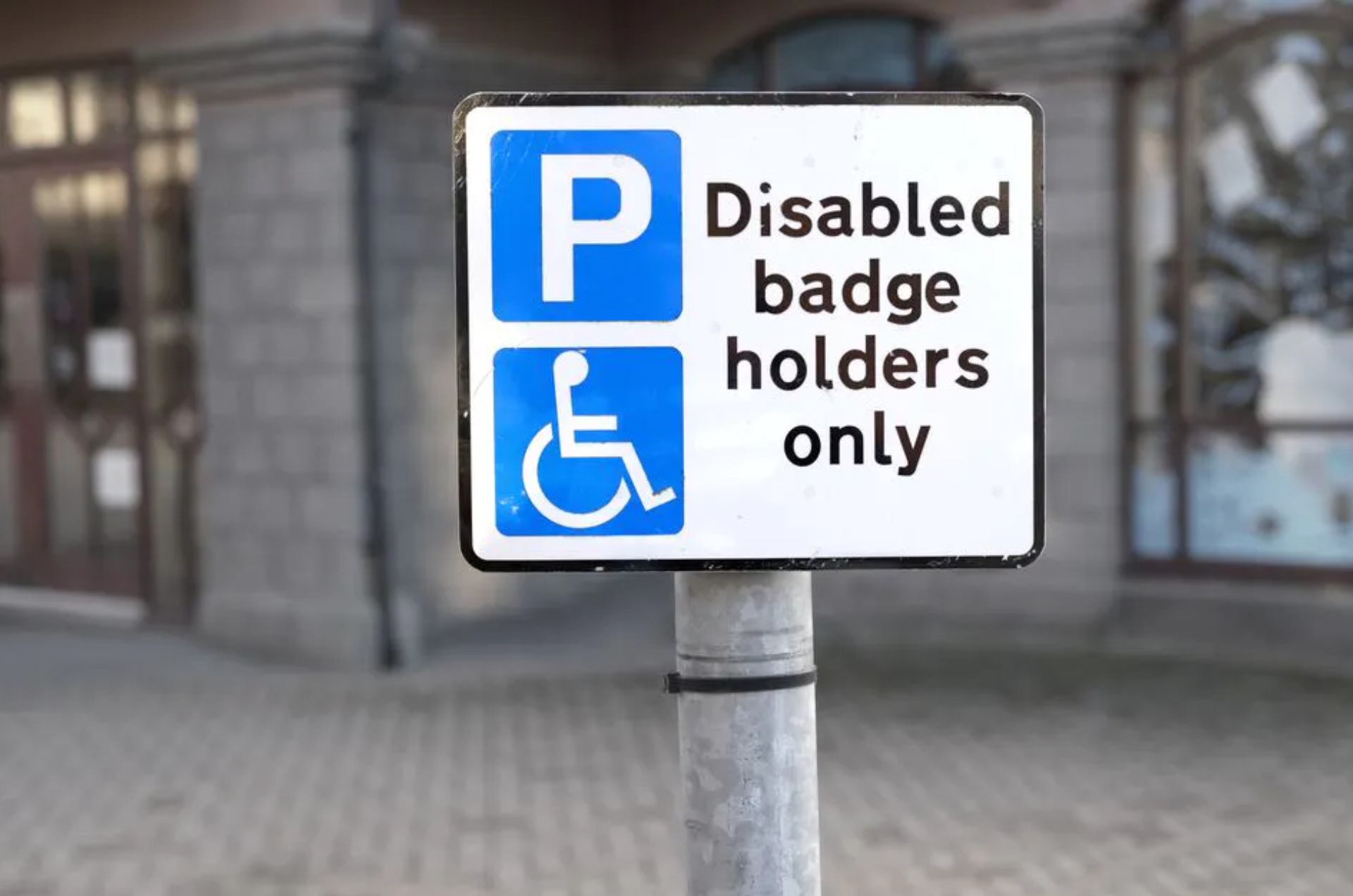

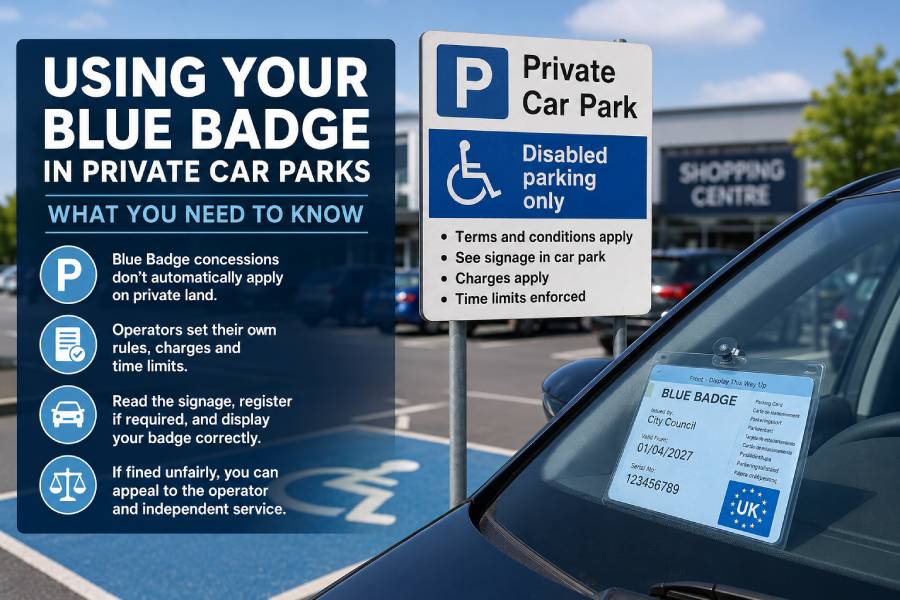
Your Blue Badge does not automatically give you free parking, unlimited parking or the usual on-street concessions when you use a private car park.
Supermarkets, retail parks, shopping centres and other privately managed parking facilities can set their own terms, so you may need to pay, register your vehicle, use a designated bay or comply with a maximum stay even when displaying a valid Blue Badge.
However, that does not mean private car park operators can simply ignore the needs of disabled motorists. In Great Britain, service providers have duties under the Equality Act 2010, including a duty to make reasonable adjustments for disabled people where required. Northern Ireland has separate disability discrimination legislation imposing accessibility obligations on service providers.
The practical rule is simple: never assume your Blue Badge gives you the same concessions you receive on the public highway. Read the signs, check whether payment or registration is required and ask about a reasonable adjustment if a parking rule puts you at a substantial disadvantage because of your disability.
Does the Blue Badge scheme apply in private car parks?
Not in the same way as it applies on public roads.
The Blue Badge scheme is primarily an on-street parking scheme.
For example, in England the national scheme provides concessions such as:
- free parking at ordinary on-street parking meters and pay-and-display machines;
- use of on-street disabled bays;
- and parking on single or double yellow lines for up to three hours where the concession applies and there is no loading restriction.
Those concessions do not automatically transfer into an off-street private car park.
Official GOV.UK guidance specifically says that off-street car parks such as those provided by shopping centres, hospitals and supermarkets are covered by separate rules.
For the wider on-street rules, see where you can park with a Blue Badge.
Public road vs private car park: what changes?
| Issue | On-street Blue Badge parking | Private/off-street car park |
|---|---|---|
| Free parking | National concessions may apply | Not automatic |
| Maximum stay | Determined by national/local Blue Badge rules | Operator sets the terms |
| Disabled bay | Blue Badge rules apply | Check the site’s conditions |
| Parking clock | Required in certain circumstances | Only if the operator’s rules require it |
| ANPR registration | Usually not relevant to the national concession | Often required at modern private car parks |
| Enforcement notice | Usually a Penalty Charge Notice issued under public parking enforcement | Usually a Parking Charge issued under private parking arrangements |
Do Blue Badge holders park free in private car parks?
Not automatically.
A private car park owner can decide whether Blue Badge holders receive:
- free parking;
- discounted parking;
- additional parking time;
- designated accessible spaces;
- or no separate tariff concession at all.
Official Blue Badge guidance in England specifically warns badge holders:
do not assume you can always park for free in off-street car parks.
A valid Blue Badge may allow you to use an accessible parking bay while the operator still requires you to pay the normal parking tariff.
For the broader charging rules, see do you get free parking with a Blue Badge?
Does a disabled parking bay mean free parking?
No.
These are two separate issues:
- who may use the bay; and
- whether a parking charge must be paid.
A private operator may provide a marked accessible bay for disabled customers but still require those customers to:
- pay the normal tariff;
- enter their registration number;
- validate their parking;
- display a Blue Badge;
- or comply with a maximum stay.
POPLA has published a case example confirming this distinction: a motorist with a valid Blue Badge was still required to pay because the signs clearly stated that no free disabled parking concession applied at that private site.
Do private car parks have to recognise a Blue Badge?
The Blue Badge itself does not automatically impose the national on-street concessions on a private operator.
However, operators and the businesses using the car park still need to consider disability discrimination law.
What does the Equality Act mean for private parking?
In England, Scotland and Wales, service providers are subject to the Equality Act 2010.
The Equality and Human Rights Commission’s current statutory guidance explains that service providers have an anticipatory duty to take reasonable steps to prevent disabled people being placed at a substantial disadvantage.
Reasonable adjustments can involve:
- changing a policy or practice;
- changing or avoiding a physical barrier;
- providing additional assistance;
- or adapting the way a service is provided.
The EHRC specifically identifies parking areas as physical features that can fall within the reasonable-adjustment duty.
Does the Equality Act mean Blue Badge holders must park free?
No.
This distinction is very important.
The Equality Act does not simply say:
“Blue Badge holder = free private parking.”
Instead, the question is whether a disabled person is being placed at a substantial disadvantage and whether there is a reasonable adjustment that the service provider should make.
Depending on the circumstances, an adjustment might involve:
- additional time;
- a different way to pay;
- accessible parking close to the entrance;
- help using a payment system;
- or another practical modification.
Whether a particular adjustment is reasonable depends on the circumstances.
Does every Blue Badge holder automatically qualify under the Equality Act?
You should not treat the two systems as interchangeable.
The Blue Badge scheme has its own eligibility rules.
The Equality Act 2010 has its own legal definition of disability.
Under the Equality Act, a person is generally disabled if they have a physical or mental impairment that has a substantial and long-term adverse effect on their ability to carry out normal day-to-day activities, subject to additional provisions and exceptions.
Likewise, a disabled person protected by equality law does not necessarily need to possess a Blue Badge before a service provider’s reasonable-adjustment duties can apply.
What about disabled motorists in Northern Ireland?
Northern Ireland does not use the Equality Act 2010 in the same way as Great Britain.
Instead, disability discrimination protections for access to goods, facilities and services operate under Northern Ireland’s own disability discrimination legislation.
Service providers can still have duties to make reasonable adjustments for disabled people.
So the practical principle is similar: a private parking operator may set its parking terms, but disability-access obligations still need to be considered.
Can disabled customers be given extra parking time?
Potentially.
A fixed time limit can place some disabled customers at a disadvantage because they may:
- take longer to enter or leave a vehicle;
- need more time to use mobility equipment;
- walk more slowly;
- need additional rest breaks;
- take longer to reach payment equipment;
- or need assistance accessing the premises.
Depending on the circumstances, additional time may be a reasonable adjustment.
However, you should not simply assume that displaying your Blue Badge automatically extends a private car park’s maximum stay.
If you know you will need additional time, check the parking terms and ask the business or operator how disabled visitors can request an adjustment.
What should you check before parking?
Before leaving your vehicle in a private car park, check all of the following:
- Do Blue Badge holders have to pay?
- Do you need to park in a specific accessible bay?
- Is there a maximum stay?
- Do you need to display your Blue Badge?
- Do you need to enter your number plate into a machine?
- Do you need to register or validate your vehicle inside the premises?
- Is the car park monitored by ANPR?
- What happens if you need additional time because of your disability?
What is ANPR and why does it matter?
Automatic Number Plate Recognition (ANPR) cameras record vehicle registration numbers as cars enter and leave a car park.
This is particularly important for Blue Badge holders because an ANPR camera normally cannot determine simply from the number plate that a vehicle is carrying a Blue Badge holder.
You may therefore need to:
- enter your registration into a terminal;
- register at a customer service desk;
- validate parking at reception;
- use a payment machine;
- or register online.
Displaying the physical Blue Badge in the windscreen does not necessarily register your vehicle with an ANPR parking system.
What about supermarket car parks?
Supermarkets commonly operate private car parks themselves or appoint a private parking company.
Possible rules include:
- free parking for all customers for a set period;
- extra time for registered Blue Badge holders;
- designated disabled bays but no additional time;
- minimum-spend requirements;
- vehicle registration inside the shop;
- or payment followed by validation or refund.
Do not assume one supermarket branch uses the same rules as another.
What about shopping centres and retail parks?
The same principle applies.
A retail park may have:
- ANPR cameras;
- a two- or three-hour maximum stay;
- different restrictions for different parts of the site;
- customer-only parking;
- designated Blue Badge bays;
- or a process for requesting additional time.
Read the entrance and parking signs carefully.
If your disability means the ordinary time limit is not sufficient, ask whether a reasonable adjustment is available rather than simply overstaying without contacting anyone.
What about railway station and airport car parks?
Be particularly careful at:
- railway stations;
- airports;
- ports;
- and other transport facilities.
Some of these sites have special rules, byelaws or separate drop-off and no-stopping restrictions.
A Blue Badge does not automatically override:
- airport drop-off charges;
- no-stopping roads;
- railway parking conditions;
- barrier-controlled tariffs;
- or other site-specific restrictions.
Check the transport operator’s accessibility and parking information before travelling.
What about hospital car parks?
Hospital parking deserves separate treatment because the rules differ substantially across the UK.
England NHS hospitals
At NHS trusts and NHS foundation trusts in England, national NHS parking guidance provides a specific mandatory concession.
Valid Blue Badge holders attending hospital as patients or visitors receive free parking for the duration of their attendance or visit.
This remains the case where an NHS organisation contracts a private company to operate the car park on its behalf: NHS organisations remain responsible for the actions of their parking contractors.
You may still need to:
- register the vehicle;
- validate the Blue Badge;
- enter your registration at reception;
- or follow an ANPR process.
See is hospital parking free for Blue Badge holders?
Do private car parks use the Blue Badge parking clock?
Not automatically.
The blue parking clock is part of the national Blue Badge rules for particular on-street concessions.
A private car park can instead use:
- ANPR;
- a ticket;
- a digital registration system;
- a permit;
- or its own method of recording parking time.
If the private operator specifically tells Blue Badge holders to display the clock, follow that instruction.
Otherwise, do not assume that setting your Blue Badge clock overrides the site’s maximum stay.
Should I still display my Blue Badge in a private disabled bay?
Yes if the signs require it.
Many operators make display of a valid Blue Badge a condition for using an accessible parking bay.
Make sure:
- the badge is valid;
- it is clearly visible;
- you follow any instructions on the sign;
- and you separately comply with payment, registration and time-limit requirements.
See how to display your Blue Badge correctly.
What is a private Parking Charge Notice?
A parking charge issued on private land is normally called a Parking Charge Notice.
It should not be confused with a council Penalty Charge Notice.
Private parking is largely managed through the terms and conditions applying to the site. When a driver parks, the operator may argue that the driver accepted those terms.
If the operator believes the terms were breached, it may issue a parking charge.
Common reasons include:
- not paying the tariff;
- overstaying;
- not registering the vehicle;
- entering the wrong registration number;
- using a disabled bay without complying with its conditions;
- parking outside a marked bay;
- or parking where the site prohibits it.
Is a private parking charge the same as a fine?
No.
A private Parking Charge Notice is not the same type of penalty as a council-issued parking fine.
Government guidance describes private parking charges as charges arising from alleged breaches of the parking terms and conditions or related private parking obligations.
That does not mean you should ignore the notice. An unpaid charge may ultimately be pursued through civil proceedings where the legal requirements are met.
What private parking rules apply in 2026?
The regulatory position is worth understanding because it has been changing.
The UK Government published a statutory Private Parking Code of Practice in 2022 for England, Scotland and Wales, but that version was subsequently withdrawn following legal challenges.
In 2025, the Government consulted on a replacement statutory code and compliance framework.
As of 2026, the Government’s latest published material still describes the replacement statutory code as being developed rather than already in force.
Meanwhile, the two main accredited parking trade associations — the British Parking Association (BPA) and International Parking Community (IPC) — operate a common industry Single Code of Practice for their private parking operators.
This distinction matters because you may still find websites incorrectly referring to the withdrawn 2022 Government Code as though it were currently in force.
Can you appeal a private parking charge?
Yes.
If you believe the charge was issued incorrectly or that important circumstances were not considered, use the appeals process shown on the notice.
Possible evidence includes:
- photographs of the signs;
- photographs of the vehicle and bay;
- proof of payment;
- proof that the vehicle was registered or validated;
- a copy or photograph of your Blue Badge where relevant;
- evidence of a machine or app failure;
- receipts showing you were a customer;
- and evidence supporting a request for a disability-related reasonable adjustment.
How to appeal a private Parking Charge Notice
- Read the notice carefully. Check the alleged breach, date, times, vehicle registration and appeal deadline.
- Do not pay first if you intend to appeal. Paying a private parking charge can end your right to use the normal appeals process.
- Photograph the signs and site. Record anything unclear, obscured, contradictory or inaccessible.
- Gather evidence. Include payment records, receipts, registration confirmations and disability-related evidence that is genuinely relevant.
- Appeal to the parking operator first. Explain clearly why you believe the charge should be cancelled.
- Explain any reasonable-adjustment issue. If your disability caused or contributed to the alleged breach, explain the substantial disadvantage and the adjustment you believe should have been made.
- Escalate if the operator rejects the appeal. The correct independent appeals service depends on which accredited trade association the operator belongs to.
POPLA or IAS: which appeal service should you use?
| Parking operator membership | Independent appeal service |
|---|---|
| British Parking Association (BPA) | POPLA |
| International Parking Community (IPC) | Independent Appeals Service (IAS) |
POPLA
POPLA considers appeals against private parking operators that belong to the BPA Approved Operator Scheme.
You normally need to:
- appeal to the operator first;
- receive a rejection;
- obtain the POPLA verification code;
- and submit the POPLA appeal within the specified deadline.
POPLA currently states that it must normally receive the independent appeal within 28 days of the operator’s rejection.
IAS
The Independent Appeals Service deals with charges issued by operators belonging to the IPC.
Again, you normally appeal to the parking operator first.
If that appeal is rejected, an eligible standard appeal can then be taken to the IAS.
Does having a Blue Badge guarantee that an appeal will succeed?
No.
This is another common misconception.
If the sign clearly required Blue Badge holders to:
- pay a tariff;
- register the vehicle;
- stay within a time limit;
- or comply with another condition,
simply showing that you possessed a valid Blue Badge may not invalidate the charge.
The stronger question is whether:
- the parking terms were clear;
- you complied with them;
- the operator followed the applicable parking code and legal requirements;
- and, where disability caused a substantial disadvantage, appropriate reasonable adjustments were considered.
Should I contact the supermarket or landowner too?
It can be worth doing so.
If the parking company manages the site for a:
- supermarket;
- shopping centre;
- hotel;
- restaurant;
- medical facility;
- or other business,
you can contact that business or landowner as well as following the formal parking appeal.
Explain:
- that you were a genuine customer or visitor;
- what happened;
- why the charge appears unfair;
- and any disability-related adjustment that was needed.
Do not miss the formal parking appeal deadline while waiting for the landowner to respond.
What should I do if my disability caused the overstay?
If a disability caused you to take longer than the ordinary parking period, explain that clearly in your appeal or reasonable-adjustment request.
For example, relevant circumstances might include needing substantially longer to:
- enter or leave the vehicle;
- walk to and from the premises;
- use mobility equipment;
- access a payment machine;
- or otherwise use the service.
Do not simply write:
“I have a Blue Badge, so cancel the ticket.”
Instead, explain what disability-related disadvantage occurred and what adjustment was reasonably needed.
How to avoid a private parking charge
- Read the entrance sign and the signs beside the bay.
- Never assume Blue Badge parking is free.
- Check the maximum stay.
- Check whether the vehicle must be registered.
- Check whether ANPR is in use.
- Display the badge where required.
- Keep your parking ticket or payment confirmation.
- Take a photograph if the signs are unclear or a machine is broken.
- Ask about a reasonable adjustment if your disability makes the normal parking terms difficult to comply with.
- Do not assume the rules at one branch apply at another.
Private parking vs other Blue Badge parking
Your Blue Badge has much clearer statutory concessions when you use qualifying on-street parking.
You may want to compare private parking with:
- on-street pay-and-display parking;
- residents’ parking bays;
- loading bays;
- and the complete Blue Badge parking rules.
Official information about Blue Badges and private parking
For further information, use the current official and independent guidance:
- GOV.UK — Blue Badge rights and responsibilities in England
- GOV.UK — Private Parking Code of Practice consultation and current government position
- Equality and Human Rights Commission — Reasonable adjustments for disabled people
- nidirect — Disability access and reasonable adjustments in Northern Ireland
- POPLA — Independent private parking appeals for BPA operators
- IAS — Independent appeals for IPC parking operators
- GOV.UK — NHS car parking guidance for England
The bottom line
Your Blue Badge does not automatically give you free or unlimited parking in a private car park.
The operator may require you to:
- pay;
- register your number plate;
- use a specific accessible bay;
- display your badge;
- validate your parking;
- or leave within a stated time.
But private parking rules do not exist in isolation from disability law. In Great Britain, service providers have duties under the Equality Act 2010 to make reasonable adjustments where required, while Northern Ireland has its own disability discrimination protections.
So the safest approach is: read the signs, follow the site’s registration process and request a reasonable adjustment when your disability creates a genuine disadvantage.
If you receive a Parking Charge Notice, do not assume that the Blue Badge alone will cancel it — but equally, do not assume the charge must be correct. Check the terms, collect evidence and use the appropriate operator, POPLA or IAS appeal process.
Frequently asked questions
Does my Blue Badge give free parking in private car parks?
No, not automatically. Private and off-street car park owners can set their own parking tariffs and conditions. Some provide free Blue Badge parking, while others require payment, registration or compliance with a maximum stay.
Can a private car park charge Blue Badge holders?
Yes. A Blue Badge does not itself create a general right to free private parking. However, businesses and service providers must still comply with applicable disability discrimination and reasonable-adjustment duties.
Does parking in a disabled bay mean I do not have to pay?
No. A private operator can reserve a bay for Blue Badge holders while still requiring those motorists to pay the normal tariff. Always check the signs.
Do I need to display my Blue Badge in a private car park?
If the car park’s terms require a Blue Badge to be displayed when using an accessible bay, yes. You may also need to pay, register your number plate or complete another validation process.
Does the Equality Act give Blue Badge holders free parking?
No. The Equality Act 2010 does not provide a general rule giving Blue Badge holders free private parking. It requires service providers in Great Britain to make reasonable adjustments for disabled people where the legal duty applies.
Can a disabled person ask for extra time in a private car park?
Potentially, yes. If a standard time limit places a disabled person at a substantial disadvantage, additional time may be a reasonable adjustment depending on the circumstances. It is best to contact the business or operator rather than assuming extra time applies automatically.
Do I have to register my vehicle if the car park uses ANPR?
If the signs or operator’s process require registration, yes. Displaying a physical Blue Badge does not necessarily tell an ANPR system that you qualify for a parking concession.
Is hospital parking different from other private car parks?
Yes. In England, valid Blue Badge holders attending NHS hospitals as patients or visitors receive free parking for the duration of their attendance or visit under mandatory NHS parking guidance. Local registration or validation procedures can still apply.
Can I appeal a private Parking Charge Notice?
Yes. Appeal to the parking operator first. If a BPA operator rejects the appeal, you can normally take an eligible case to POPLA. If the operator belongs to the IPC, the independent appeal route is the IAS.
Does having a Blue Badge guarantee my private parking appeal will succeed?
No. The Blue Badge alone does not override private parking terms. Your appeal should address why the charge is incorrect, whether the signs or procedures were adequate and any relevant disability-related reasonable adjustment.
Should I pay a private parking charge before appealing?
If you intend to appeal, check the notice and appeal rules before paying. Paying the charge can end your ability to use the normal appeal process.
Is a private Parking Charge Notice the same as a council fine?
No. A private Parking Charge Notice arises from private parking terms and is different from a Penalty Charge Notice issued by a council or other public enforcement authority.
[…] Private car parks — supermarkets, retail parks and many hospital car parks are run by private operators who set their own rules and may still charge. See using your Blue Badge in private car parks. […]
[…] Private pay-and-display car parks (supermarkets, retail parks, station and hospital car parks) set their own rules and frequently charge, even in disabled bays. See using your Blue Badge in private car parks. […]